What the French New Right Accomplished, Part II
Michael Walker, American Renaissance, November 6, 2026
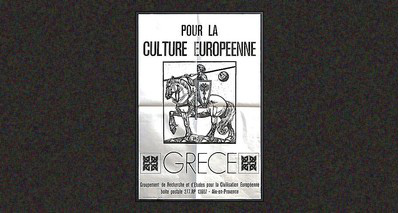
Continued from Part I.
Mr. Dambelin describes how GRECE in the 1970s engaged in what today would be called “networking” with influential people, developing from what he cryptically calls a phase of “discretion, if not confidentiality” (p.146). GRECE set out a number of doctrinal points, and Mr. Dambelin highlights three of them: ethno-pluralism (which Mr. de Benoist calls “non-ideological anti-racism”) instead of doctrinal biological racialism; anti-Americanism; and paganism. (p. 153) By 1977, GRECE had established 12 position statements, six positive and six negative, which gave structure to its orientation. Mr. Dambelin writes, “Equipped with a vision of the world that was at once coherent, original and radical, at the same time being clear of extremist distractions, GRECE cadres were ready for the next step: leaving the intellectual world to enter the public stage, where they would seek to seduce and convince.” (p. 158)
Mr. Dambelin covers just such seduction and the ensuing media “counter attack.” A key figure bridging GRECE and popular media and political figures was Louis Pauwels, the bestselling co-author of Le Matin des Magiciens, published in the USA in 1967 as The Morning of the Magicians. Ironically, Pauwels owed his fame to that book, whose subject matter, esoteric history, is the one right-wing trope noticeably absent from all GRECE published articles and statements. However, Mr. Dambelin states that Alain de Benoist was “an avid reader” of Pauwels’s esoteric journal, Planète, which continued until 1972. (p. 158)
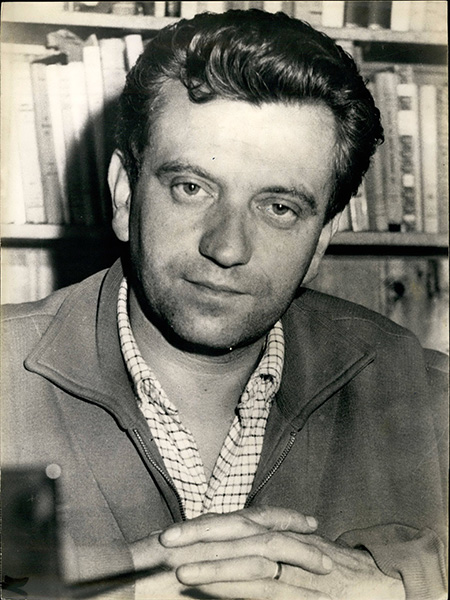
Louis Pauwels (1961) (Credit Image: © Keystone Press Agency/ZUMA Press Wire)
Mr. Dambelin describes Pauwels’ first meeting with Mr. de Benoist and writes about his “growing enthusiasm” for GRECE. He dedicated his film President Faust to two prominent GRECE co-founders: Mr. de Benoist and Jean-Claude Valla. Pauwels spoke with de Benoist and Valla of a project he had, to create a weekly review with a wide readership that would embrace GRECE ideas and make them known to the general public. According to Valla, Pauwels was relying on the endorsement and support of none other than the French President, Georges Pompidou. Valla recalls, “He had succeeded, thanks to who knows what intermediaries, in convincing the President of the need for such a weekly, but in 1974 the President died and Pauwels’ project fell through.” (p. 161)
The adroit and hard-working Pauwels did not let Pompidou’s death deter him. In 1977, he was appointed “director of cultural services” at a leading French daily newspaper, Le Figaro. He persuaded press magnate Robert Hersant, who owned the paper, to start a weekly supplement to the paper called Le Figaro Dimanche — The Sunday Figaro. It proved popular, and Pauwels ensured that GRECE members contributed to it. The supplement was such a success that it was upgraded to a separate publication called Le Figaro Magazine. Alain de Benoist recalls that Pauwels told members of GRECE that Le Figaro Magazine would become “a New Right organ.”
The first issue appeared in 1978 with the face of the new French president Giscard d’Estaing on the cover. There were two long exclusive interviews, one with French Prime Minister Raymond Barre and one with American ex-President Richard Nixon. With disarming understatement, Mr. Dambelin calls this “a good start.” (p. 164)
The New Right was now in the public eye, but Mr. Dambelin suggests, probably rightly, that success had been too rapid. In a chapter titled “The System fights back!” he relates the unedifying story of an orchestrated, multi-faceted and ultimately successful counterattack. Initial media commentary on Le Figaro Magazine was broadly favorable, but the mood soon soured. Christian groups as well as royalists, according to Mr. Dambelin, assailed the New Right and Le Figaro Magazine, not least by supplying the press with “information unsupported by evidence,” often related to alleged Nazi links, reports which served as information for the subsequent major anti-GRECE campaign that was launched in the summer of 1979 in the press and on the air.
What will strike the reader is how seriously opponents of the New Right regarded GRECE’s success in reaching large sections of the public and how well orchestrated and coordinated they were in ending that. In acting as they did, they tacitly acknowledged that Gramsci was right about the importance of cultural hegemony. Support expressed for GRECE by extremists, notably Pascal Gauchon’s PFN (Parti des Forces Nouvelles, which was a breakaway from Jean-Marie Le Pen’s National Front), and “shock” revelations from the pasts of a number of New Right figures, were ruthlessly exploited to warn that neo-Nazis and racists were threatening the post-war consensus of egalitarianism, humanism, democracy, and decency, using mainstream conservatives as “useful idiots.” With the exception of Le Figaro Magazine itself, the reaction of Hersant-owned publications ranged from neutral at best to very hostile.
Worse was to come. In 1979, at the 12th national assembly of GRECE, a hitherto totally unknown “Organization of Jewish Defense,” (not the French branch of the Jewish Defense League) stormed the conference to cries of “Israel will conquer!” and “Israel will live!” Chairs and poles were hurled at security staff and conference participants. The theme of the conference was “Against all totalitarianisms,” an irony not lost on GRECE when it held a press conference later. Robert Steuckers, who was attending his first GRECE event, recalls:
Grégory Pons carried on smiling sardonically although he was “covered in blood from head to foot” while “Alain de Benoist, menthol cigarette hanging from his lips, was muttering, ‘mad quite mad’, oblivious to the projectiles flying in all directions around him.” (p.188)
The attack was brief but very violent. Several people were injured and one man was blinded permanently in one eye.
The attackers had not left the premises before calls had been made to media reporting violence committed by GRECE against a Jewish defense organization. The daily newspaper France-Soir carried the headline, “Brawl erupts to cries of Death to the Jews!” Louis Pauwels began to get cold feet. He dismissed Grégory Pons, one of the official Figaro Magazine writers and GRECE member. Non-GRECE members who worked for Figaro Magazine began to disassociate themselves from GRECE colleagues. The dismissal of Pons did not appease critics, and according to Mr. Dambelin, “certain personalities,” banks, PR agents, and “especially the publicity lobby” successfully pressured the Hersant group to end its relationship with the New Right.
At the time happened, there were a number of terrorist attacks on anti-racist centers and Jews. Responsibility was claimed by callers to the press purporting to come from a group called FANE, which Mr. Dambelin calls “a tiny caricature Nazi group with fewer than five hundred members.” FANE denied committing the offenses but stated unhelpfully that it felt close to the ideas of Alain de Benoist and Louis Pauwels. A bomb exploded outside a synagogue in Paris, killing four people. Pauwels fired Jean-Claude Valla, the leading GRECE member employed by Le Figaro Magazine, signaling the end of the GRECE-Figaro relationship. Pauwels expressed deep regret, claiming that Mr. Hersant himself had forced his hand. As Alain de Benoist noted, “Louis Pauwels did not have a martyr’s soul.”

Jean-Claude Valla
Mr. Dambelin takes the view that in the years following the disappointment with Le Figaro Magazine, GRECE positions hardened and became, he writes, “much more hazardous.” It was predictable that leading figures in GRECE took a somewhat more radical position on certain issues in the 1980s than in the 1970s, now that there was no strong connection to an establishment paper to encourage restraint. Mr. Dambelin writes that the radicalization was especially notable with respect to Christianity and hostility towards the West in general and especially towards the United States. Mr. De Benoist’s book Comment peut-on être paien? — What does being Pagan mean? and Guillaume Faye’s Le Système à tuer les peuples — The System for killing peoples were both published in 1981. Mr. Dambelin calls the latter “a frontal assault on Western civilization, a civilization viewed as a techno-economic system that behind a mask of humanitarian and hedonistic values destroys peoples.” He cites Faye directly: the system destroys peoples by “gnawing at their joy in life from within, uprooting them from the organic earth of their living traditions and deterring them from seeking a future.” (p. 211)
However, it is very debatable whether an abrupt radicalization had taken place in the way Mr. Dambelin claims. The well-known and influential (some would say notorious) double issue of Nouvelle École, L’Amérique, with its merciless critique of the United States by Giorgio Locchi, had appeared in 1975, well before the media assault on GRECE; and paganism and hostility towards Christianity had characterized GRECE from its earliest days.
What did change in the 1980s was GRECE’s position on ecology and a sharpening in tone with regard to capitalism, especially by Mr. de Benoist, accompanied by favorable references to such traditional bugbears of the Right as Marx and Rousseau. Articles appeared in Éléments condemning the waste, exploitation, and global egalitarianism of consumer society and the destruction of identities by global capitalism. Mr. de Benoist began to write enthusiastically about Jean-Claude Michéa (who calls himself an “anarchist Tory” or conservative socialist) and other thinkers on the Left, while Guillaume Faye in Éléments lauded Christopher Lasch’s The Culture of Narcissism, a work extremely critical of American free-market individualism and the decline in social standards and responsibility that Lasch believed came with the cult of individualism.
Mr. Dambelin accurately adumbrates the dilemma New Right authors faced regarding ecology, environmentalism, and the doctrine of growth. For years, much of the Right had dismissed ecology as a left-wing fad — a pretext for finding fault with capitalism, a creed of the work-shy, a negative reaction to the entrepreneurial spirit — a view famously championed by Ayn Rand.
The New Right had always taken a more subtle approach. It made a distinction between ecology and what it dubbed “ecologism.” By ecologism, it meant the idealization of nature, a Christian-inspired longing for a prelapsarian state where the lion lies down with the lamb, a place where time stands still and nothing needs to change. It was judged as a secular form of Christian millennialism. At the same time, New Right thinkers were aware of the destruction of diversity caused by unlimited economic growth, and during the 1980s, they became increasingly critical of the belief in growth as the social and economic panacea that our rulers claim it to be. Mr. Dambelin quotes Mr. de Benoist already writing in Issue 9 of Nouvelle École in 1969 about problems that he believed were coming to the fore, including what is for the New Right a rare acknowledgment, the challenge of population growth: “the demographic surge first of all, with all that that entails, water and air pollution, the destruction of natural ways of life, the rupture of the meticulously acquired relationship of the species and its habitat.” (p. 299)
There was an issue of Éléments in 1977 on ecology called Les Équivoques de l’écologie — The ambiguities of ecology. Writing as Robert de Herte, Alain de Benoist seemed to favor a robust attitude towards the exploitation and development of the natural environment. He praised nuclear power and together with Christian Lahall, a leading advocate of social Darwinism, in what Mr. Dambelin calls a “very Promethean tone” “denounced the flaws of ecologism (a cult of catastrophe, pacifism, naturalism, Malthusianism).” Mr. de Benoist wrote:
The challenge facing us is not to find ways of conserving an ancient nature but to institute a new culture . . . . The “naturalist” illusion consists in believing that Man should cease transforming the world. The “superhuman” response consists in maintaining that man should transform himself to regain possession of the world that he has transformed.
By the 1990s, GRECE had taken a position that was arguably “pro-green.” Mr. Dambelin writes:
[Alain de Benoist] recognized and approved of the fact that the Greens aligned themselves neither on the left nor on the right, and welcomed their willingness to surpass both liberalism and socialism and the fact that they were raising doubts about the supremacy of consumerism. Philosophically, he defended an organic approach (to ecological issues) in which man and the world exist interdependently . . . and his denunciation of “a society without aim or meaning, which is rushing into the future pretending that it can correct technology with more technology, correct progress with more progress” was irrevocable. (pp 300-302)
Mr. Dambelin writes of the varied reactions of what he calls GRECE “dissidents” to this change. Robert Steuckers was skeptical, while Pierre Vial and his identitarian movement Terre et Peuple — Land and People was already committed to protecting the environment. Guillaume Faye, seeking to accommodate environmentalism without discarding a bold approach to progress, published a widely read science fiction book in 1998 called L’Archeofuturisme, which portrayed a world on a double track of technology and a return to ancient values. It is worth noting that in his later years, Faye stressed impending catastrophe, paradoxically the very kind of apocalyptic vision which in the 1970s GRECE had depicted as a view of the future symptomatic of Judeo-Christian fatalism, not least with regard to environmental challenges.
It is striking that while Éléments significantly changed the tenor of its writing on ecology between the 1970s and 1990s, moving from an implicit acceptance of the belief in growth and the mastery of nature to an explicit denunciation of them, it has never to my knowledge examined Malthusianism, or the challenge of population growth as such, nor does it seem to consider population growth to be a significant political or economic factor. Mr. Dambelin also seems unconcerned with demographics, but does at least note that in relation to race and religion, it became a major part of Faye’s projection of catastrophe after Faye had become an outspoken foe of Islam, depicting Islamic immigration into Europe as part of a war on the West. Increasingly frustrated with what he saw as de Benoist’s failure to acknowledge the demographic challenge of Islam with its explicit boasts that it would outbreed the West, Faye took the line that as nature abhors a vacuum, so the low European birthrate invited occupation of spaces where Europeans had not been born by non-Europeans who had.
Mr. Dambelin calls the 1980s a high-water mark (“particularly rich at the metapolitical level”) for GRECE. He also writes about the misfortunes of the monthly publication Le Choc du mois — The Monthly Shock, for which a number of New Right journalists were writing, including notably Jean-Claude Valla, the man whom Louis Pauwels had hired for Le Figaro Magazine and who had been an editor of Éléments. The Monthly Shock was driven into bankruptcy by a swinging fine imposed for having published an interview with Robert Faurisson, who, as Mr. Dambelin coyly puts it, “expressed his [Holocaust] revisionist theories.” (p. 294)
A new publishing venture called Labyrinthe published a monograph by Guillaume Faye in 1983, Contre l’économisme-Principes d’économie politique — Against economism-Principles of political economy, in which Faye argued in favor of an economy under the direction of a state which was neither interventionist nor economically liberal. (p. 226) Mr. Dambelin rightly stresses that it was rare for GRECE to publish anything concrete on economic issues, a deficiency only finally rectified, writes Mr. Dambelin, when Guillaume Travers, a professor of economics, began to write regularly for Éléments in the 2020s. Both Robert Steuckers and Guillaume Faye came to regard the lack of concern for economic questions as a fundamental weakness of GRECE and that was at least one of their reasons for breaking with the organization.
GRECE ran into serious financial difficulties and clashes over money in the 1980s, and Mr. Dambelin writes that Mr. de Benoist “withdrew from GRECE” to focus on Nouvelle École and on Krisis, which he started in 1988. Mr. Dambelin’s choice of words (“withdrew”) leaves it unclear whether Mr. de Benoist formally resigned from GRECE or simply became less active.
Krisis is a very demanding publication, without the handsome presentation of Nouvelle École and Éléments. Mr. Dambelin notes that it attracted contributors who would not have been willing to write for any other GRECE publication, noting: “The objective of the editor of Krisis was no longer to reach cultural hegemony by all-out ideological warfare but to keep ideas alive in the intellectual arena and if possible to make them successful through debate.” (p. 260)
This is a polite way of saying that Mr. de Benoist had retreated from outright political confrontation, a move which has earned him the scorn of those who believe in confrontation. It was in clear opposition to Faye, who was calling for commitment to a cause that sounded like the cause of the very “West” he had once denounced, in an End-of-the-World scenario reminiscent of Huntington’s Clash of Civilizations.
In 1996, GRECE held its 30th conference, drawing more than 1,000 people; the theme was The Great Anxieties of the Year 2000. Mr. Dambelin notes that “not for the first time, GRECE proved itself to be prescient,” and he quotes from the text of the invitation:
Popular revolts against a globalization that nobody wants, social crises in the face of permanent mass unemployment, emergence of a new virus and the disturbing aggravation of the risks of epidemics, uncontrolled urbanization at a global level, destruction of the environments familiar to us, loss of a sense of the West and a multifarious renewal of Islam. The end of the century is heavy with menace and anger. In face of this situation the new ruling class, political, intellectual and in the media, chooses to ignore or minimize the dangers and continues down the road of its one and only orthodoxy. (p. 309).
In the last 100 pages of The New Right, covering the years since 2011, Mr. Dambelin has more to say about the reaction of GRECE figures to public events and less to say about metapolitics. This is partly because leading voices on the New Right were more embroiled in public events than in previous years, and were taking public policy stances on current issues, despite the original undertaking to avoid intervening in current affairs.
GRECE proved to be prescient again with its choice of theme for its 32nd conference, War Tomorrow? which took place in November 1998, only months before NATO’s attack on Serbia. After the attack, Charles Champetier, the editor of Éléments, and Laurent Ozon, the ecologist and former editor of Recours aux Forêts — Back to the Forests, worded a petition protesting NATO’s action, a petition that Mr. Dambelin says garnered 90,000 signatures, including those of the author and member of the French Academy Michel Déon, Alexander Solzhenitsyn, and the playwrights Harold Pinter and Peter Handke. The petition was denounced in the legacy media as a trap by the New Right that “fooled” naive pacifists.
The success of the petition rekindled globalist fears of a “red-brown axis.” The pro-EU media and all those in sympathy with the traditional NATO and EU alliances are swift to condemn anyone and anything showing the least sympathy towards anything like a European-Russian Federation. Fears of the “axis” had been fueled when Éléments published a photograph taken during a trip that Mr. Steuckers and Mr. de Benoist made to Russia in 1992. It showed Alexander Dugin and Alain de Benoist standing together in Red Square in front of the Kremlin. Mr. Dugin had been the Russian correspondent for Éléments since 1989, and he was a speaker at the 24th annual GRECE conference in 1991. The ensuing denunciations recalled those of 1979. Le Monde wrote that GRECE was “immersing its faithful followers in the symbolic universe of Pagan Nazism.” (p. 280)
In this context, Mr. Dambelin mentions the influence on some New Right thinkers, especially Belgian political theorist Jean Thiriart. Mr. Dugin frequently promoted Thiriart’s vision of a Eurasian bloc “from Lisbon to Vladivostok.”
Mr. Dambelin relates a major dispute that undoubtedly did GRECE great harm.
In 2000, Guillaume Faye published Colonization of Europe, marking his increasing and increasingly polemical distancing from what he saw as self-destructive cultural relativism with regard to Islam. This led to a “pamphlet war.” Mr. de Benoist, once the admirer of Ernst Jünger (Issue 48 of Nouvelle École is devoted to Jünger) and someone who stressed European roots and the importance of ancestry, now reproached Faye for “strongly racist positions.” (p. 323)
After leaving GRECE, Faye was welcomed by Pierre Vial and his organization Terre et Peuple, but Mr. Dambelin writes that Mr. Vial soon became exasperated by Faye’s polemical tone and sympathy with Israel, Terre et Peuple taking the line that the Israeli-Arab conflict was a dispute that Europeans should stay out of. Mr. Dambelin quotes the Vial view: “Real Europeans should not get involved with that fratricidal conflict between the sons of Abraham, which is what the Israeli-Muslim standoff really is.” (p. 358) The final breach with Faye came with the publication in 2007 of Faye’s pro-Israel essay bearing the mischievous title, La Nouvelle Question Juive — The New Jewish Question.
Mr. Dambelin opines further that while Faye continued to play the loose cannon, writing pamphlets and sometimes speaking in public, he had failed to grasp the growing importance of the internet. He contrasts Faye’s polemical papers with the energy that Jean-Yves Le Gallou (just one year older than Faye and co-founder of the currently very active Institut Iliade) invested in metapolitical influence on the internet. Mr. Le Gallou was a former associate of GRECE, and served in the European Parliament from 1994 to 1999 as a member of Jean-Marie Le Pen’s National Front (now Marine Le Pen’s National Rally). He left the National Front to join the MNR, a breakaway movement of the Front National, but later returned to metapolitics after the MNR failed to make headway against the much larger National Front. He founded the internet site polemia.com, and in 2007 he began to work for the New Right radio station, Radio Courtoisie. He has also given interviews on YouTube to Frontières, an online media group clearly influenced by New Right ideas as well as to Jared Taylor of American Renaissance.

Jean-Yves Le Gallou (Credit Image: Renaud Camus / Wikimedia)
Although he criticizes Faye for underestimating the importance of the internet, Mr. Dambelin himself has little to say about the New Right online. Jean-Yves Le Gallou was co-founder of the successful “webtelevision” TV Libertés. Mr. Dambelin’s lack of attention to the internet could be because GRECE never achieved a strong presence there, and it is with GRECE that La Nouvelle Droite is mainly concerned.
A note of sadness creeps into Mr. Dambelin’s account in the penultimate chapter, called Sacrifice and Renewal, covering the years 2011–2022. Throughout The New Right he has told the story of GRECE rather in the style of a biography, from birth to dotage. Mr. Dambelin notes that GRECE has been in decline for years and today (2026) little more remains of it than the magazine Éléments, which continues to thrive:
GRECE in the course of those years continued to shrink, until it boasted only a token residual and solely Parisian activity. With neither a figurehead nor cadres, attempts to revive the group came to nothing. GRECE organized a summer university in 2001 and a European gathering in 2001 before throwing in the towel. As for the international conferences, there was a name change in 2002 [to “Meetings of rebel thought”] when the conference was sponsored by Éléments and GRECE began to fade . . . . The meeting in 2005 What Religion for the Twenty-first century? attracted fewer than 500 people. Those were the last GRECE events. An attempt to put a foot in the door on the internet failed as well. A GRECE website begun in 2002, despite a relatively successful discussion forum at the beginning, petered out after a few years. . . . GRECE, the standard bearer of legend (sometimes dark), vanished as an active and militant organization. Those who met up in 2008 for the 40th anniversary of its foundation were friends and veterans rather than members of a living community of reflection and struggle.” (pp 343–345)
Mr. Dambelin writes nevertheless that the decline and probably imminent demise of GRECE is a sad but natural event, as natural as a cycle of nature, for he sees that GRECE is already being replaced. The New Right begins and ends, perhaps intentionally symbolically, with the same figure, Dominique Venner, who shot himself before the altar of Notre Dame in a gesture he intended to symbolize defiance, departure, and renewal. GRECE writers had frequently written with admiration of writers who had chosen to take their own lives rather than live abjectly, dishonorably, or in humiliation. Drieu La Rochelle in 1945, and Henry de Montherlant in 1972 come to mind. Mr. Dambelin quotes Venner from one of his last pieces written for his own Nouvelle Revue d’Histoire — New History Review: “Existence is commitment and devotion, yet dying can be another kind of existing, existing in the face of destiny.” (p. 386)
Shortly before his death, Venner asked four friends (one of them Jean-Yves Le Gallou) to start a new organization to replace GRECE. The four were as good as their word and in the days that followed, they had a name, l’Institut Iliade, a name chosen in honor of Venner’s great love of Homer. A small group traveled to Mount Olympus during the summer solstice officially to found the institute. Mr. Dambelin writes that Institut Iliade “can be considered a nephew of GRECE, a nephew that learned from its uncle, from his successes and his errors.” (p. 393) Like GRECE before it, the institute also holds annual conferences, invites speakers and groups to debate, and mixes instruction with entertainment.
Éléments has also enjoyed an upsurge in readership, at a time when publications political or not were everywhere stagnating or declining. In 2019, François Bousquet, author of Anti-White Racism: The Forbidden Investigation and reviewed on this site, launched a new publishing house called La Nouvelle Librairie. It has taken the place of the former GRECE publishing houses of Copernic and Labyrinthe, and is publisher of The New Right. It evidently works in close collaboration with the Institut Iliade, for the name Iliade, along with the group’s iconic owl motif, decorates the book’s front cover. The publishers have done a good job technically and artistically: the book is robust, easy to read, has an attractive appearance, and a practical compact size, unlike many French books of philosophy, which tend to be unwieldy and fragile.
Mr. Dambelin reminds the reader of a new development threatening whoever wants books or magazines to be read or wants to make a commercial venture of selling them:
In all milieus, the young and not so young read less; their amount of brain at their disposal is mobbed by an imposing clamorous mass of media or networks of reinformation, dozens of video interviews with representatives from the movement or from elsewhere, sometimes as long as two hours, shorts, stories, punchlines, posts, threads, clashes, shitstorms, and the like. Of course, that leaves less time for people to read books published by the Nouvelle Librairie. (p. 420)
Constant media bombardment leaves people with less time to read books of any kind. Some who used to read intelligently no longer do so; they listen to podcasts and watch videos instead. GRECE’s decline may not be unrelated to a decline in reading, especially non-fiction reading. The crowning achievement of GRECE was, after all, to offer a huge quantity of intelligent reading material, tens of thousands of articles, thousands of books, countless reviews. Its material is always intellectually demanding and time-consuming. How many people will take the time to read Mr. Dambelin’s own 500-page book?
The last and shortest chapter of La Nouvelle Droite is simply called “Conclusion,” but it is not so much a conclusion as a reiteration of points already covered, and a tribute to the Institut Iliade, which Mr. Dambelin expects to “carry the flame.” He writes that the Nouvelle Librairie has made great efforts to translate works by “identitarian essayists,” but mentions translations from only German, Italian and Hungarian. In the last pages of Nouvelle Droite, Mr. Dambelin addresses a question many readers will probably have been asking from the start: Is there a coherent New Right world view that has never changed? Is there a common denominator that can be used to determine what is New Right and what is not? Mr. Dambelin answers indirectly. He reflects on the fact that up until the beginning of this century, the editorial team of Éléments consisted “mostly or mainly of members or former members of GRECE, many had been involved in the same combat and they shared very much the same ideological vision of the world. . . . Today the team is much more disparate.” (p. 456) He then describes the team:
If one wants to find the widest ideological common denominator in the editorial board today, it is not so much to be found in a common vision of the world as in a definition of the main enemy, one close to the definition given by Alain de Benoist: “The main enemy for me more than ever is universalism at the philosophical level, liberalism at the political level, capitalism at the economic level, and the Anglo-Saxon world at the geopolitical level.” (pp 456–457)
This is a very good statement by one individual, but it is the view of Alain de Benoist. That does not mean it can serve as a defining criterion for the New Right. Guillaume Faye is generally regarded as “New Right,” but his principal enemy in the later years of his life, at least, was not the “Anglo-Saxon world at the geopolitical level.” He spoke at two American Renaissance conferences, in 2006 and 2012, and his later speech was called “America and Europe: Brothers in Arms.” It is likewise questionable, to say the least, whether Jean-Yves Le Gallou, surely also of the New Right, would say that capitalism was the “main enemy” at the economic level.
Mr. Dambelin then goes on to cite a long list of ideological identities that an editor of Éléments might claim as his or her own, including ecologist, conservative, agnostic, identitarian, “Pagan-Christian” and many more. He also cites many names of thinkers that an Éléments editor might refer to, including Pareto, Venner, Gehlen, Tolkien and Ivan Illich. The inclusion of Illich’s name should raise eyebrows, for the name appears in Mr. Dambelin’s book once before, between “intellectual terrorism” and “egalitarianism” on a list Mr. Dambelin calls Alain de Benoist’s “adverse ideologies and their figureheads,” which Mr. de Benoist presented as such in Le Figaro Magazine. What Mr. Dambelin is really writing about here is the current ideological position of Mr. de Benoist himself, yet Mr. de Benoist’s main enemies seem to have changed over the years. He is far more radically “anti-capitalist” than he was in the 1970s; Ivan Illich is now regarded with benevolence instead of hostility, which is consistent with his changed worldview.
How successful has the “Gramsciism of the Right” been? Opinions will vary greatly, but the fact is that today right-wing media, or whatever word one may prefer to use — identitarian, non-globalist, conservative — are thriving. The Lislameft no longer holds the intellectual high ground in serious debate. In news publications, works on literature, the arts, sciences, biology, and in private conversation, it is those who can be loosely called conservative or to the right who argue cogently and reasonably, while left and left-liberal speakers seem to be in retreat, falling back on sentiment and old slogans rather than rising to meet an intellectual challenge from opponents. If that is true, it seems reasonable, in view of the considerable work and energy of the New Right to bring about such a state of affairs, to conclude that it has indeed played a large part in creating such a “vibe shift.” The New Right uses the weapons of the mind, and to achieve anything, it is necessary to fight with a weapon, be it of body or mind:
“A weapon is more than a weapon, it challenges despair, it is an appeal to courage, a rupture with fate.” (Dominique Venner: Carnets Rebelles –Notebooks of a Rebel Nouvelle Librairie 2022)
The sincerity, sacrifice, and energy of those who created and contributed to GRECE shine through in The New Right. Such qualities invite emulation from all who cherish what Maurice Rollet liked to call “the longest memories.” The common denominator I find in the ideas of GRECE and the New Right is a joy in difference, and opposition to everyone and everything that seeks to eliminate difference and create sameness. The New Right throws a spotlight on an organization which gave shape and direction to that faith.