Hating Whitey in France
F. Roger Devlin, American Renaissance, October 9, 2026
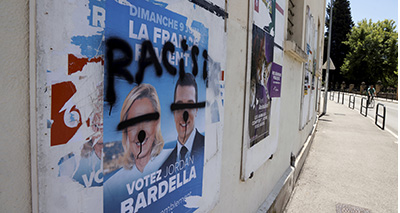
Credit Image: © Stephane Duclet/PhotoPQR/Maxppp via ZUMA Press
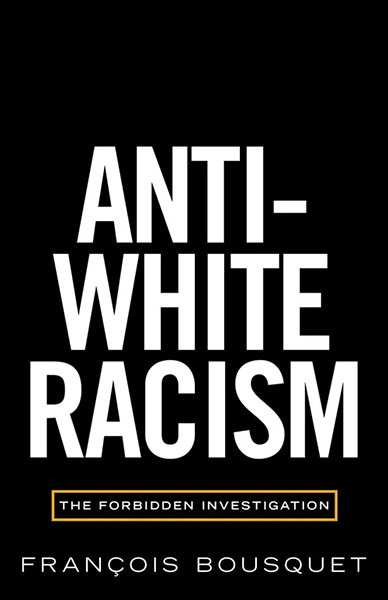
François Bousquet, Anti-White Racism: The Forbidden Investigation, Arktos Media Ltd., 2026, $25.00 softcover, $2.99 ebook
“Antiracism” is mostly the same throughout the West: the same utopian fantasy of equality and harmony, and the same blame placed exclusively on whites when those fantasies fail to materialize. But regional and national variations exist.
For example, while American antiracism began by stressing the denial of differences and advocating total integration, this gradually gave way to the affirmation of “cultural” group differences along with partial non-white separatism in order to protect them — the multicultural idea. This shift never really took place in France, where the social reality of racially distinct “communities” is treated as scandalous.
This is one reason we can be grateful to Arktos Media for bringing out an English translation of François Bousquet’s valuable and informative polemic. Of course, the reader will also see that France’s struggle has much in common with what is happening in the Anglosphere.
Mr. Bousquet is editor-in-chief of the magazine Éléments and the founder of the publishing imprint Éditions de la nouvelle librairie, which brought out the French original of Anti-White Racism. The book is divided into two parts: first, a brief analysis of the ideological fraud of “systemic racism” that legitimizes anti-white hostility and violence, then a report from the front lines on the daily struggles faced especially by younger and poorer Frenchmen. The author mostly lets them speak for themselves.
The doublethink of structural racism
According to official French thinking about “racism,” there are two kinds, but one of them does not exist. The bad kind oppresses the entire planet except for white people, who use it to maintain their unearned position of power over the rest of the world. Then there is good racism, which is a response to bad white racism, and directed with righteous indignation back at whites themselves. Although it would be fully justified, such good racism does not exist. It is a “far-right conspiracy theory,” or (to cite a more recently popular French term) a “moral panic” orchestrated by hysterics and failures.
According to polling, 80 percent of Frenchmen are now concerned about this non-existent anti-white racism. That is a great many far-right hysterics and failures.
Despite a law forbidding the government from collecting racial data, France’s official demographic agency did report in 2009 that 17 percent of the “majority population” (whites) say they have been “targeted by racist insults, remarks, or behavior.”
Without so much as cracking a smile, the study’s authors then produced a miracle explanation, delivered with the gravity of a coroner touching up a corpse: “The situations of discrimination or racism perceived by a portion of the majority population could be explained by the presence, within that population, of individuals of older migratory origins.”
In other words, the 17 percent must consist of French citizens of Italian or Polish background experiencing residual prejudice from the original French stock. Whom do these authors think they are fooling? In any case, Mr. Bousquet reports, “the question was removed from subsequent surveys: no more question, no more problem.”
All whites are said to be practicing racism without knowing it or even wanting to: The entire society is structured by this elusive yet omnipresent racism emanating from whites. Such a doctrine is an example of what French-Jewish historian Léon Poliakov has called “diabolical causality” — the primitive notion that some occult, malevolent force must always be identified to explain history’s misfortunes. In formulating the concept, Mr. Poliakov drew on a reflection of Albert Einstein: “In all probability, belief in the action of demons is, in general terms, at the root of our concept of causality.”
According to the doctrine of structural racism, there can be no anti-white racism in a society where whites constitute the majority group, because majority status implies power and dominance. The truth is the reverse: societies are everywhere dominated by minorities, although not usually by racial minorities. But the theoretical pretense that the white majority has power over others is necessary to justify disadvantaging and dispossessing them. In an increasing number of places in contemporary France — in the streets, the schoolyards, on athletic fields — whites are dominated both numerically and socially by non-whites.
The author compares the story of extra-European immigration to France to Jean Renoir’s comic film Boudu Saved from Drowning (1932), in which a decent bourgeois pulls the tramp Boudu from the Seine. Being a man of progressive views, he takes the tramp under his own roof. But Boudu, far from showing gratitude, proceeds to run the household, throw it into confusion, press his attentions on the maid — and eventually raise his sights to the lady of the house.
As the author explains, today’s Boudu has a name like Slimane or Mwamba, and is pulled from the Mediterranean rather than the Seine. Little by little, he makes himself at home. One day, he unrolls his prayer mat in the middle of the living room. The next, he brings over his wife and children, who settle in as though they owned the place. The eldest son spray-paints “F— France!” on the gate and blasts rap music all day long. The daughter refuses to shake the host’s hand and takes over the kitchen. Before long, they bring in all their friends who start calling the host family “dirty white bastards.” And according to official French anti-racism, all this is entirely the fault of the host family.
In one respect, however, the analogy with that old Renoir movie breaks down: in today’s France, the people enduring the tramp’s ingratitude are not the same ones who pulled him from the Seine. The author illustrates the class dimension of French anti-racism, by using the term petit Blanc, or “little white,” which originated in the days of French colonialism. The petit Blanc was
born in the colonies, at the bottom of the ladder of power, wedged between the natives he supervised and the colonial elites who looked down on him. He was a foreman without prestige, a subordinate whose social distance from the colonized was narrower than his distance from the true masters of the game.
In contemporary France, it is the petit Blanc who pays the price for the generous impulses of the bourgeois who offers the tramp a new home. The heir to Renoir’s overindulgent bourgeois, meanwhile, is the “big white” or grand Blanc, convinced that he belongs to the vanguard of a more advanced humanity liberated from all identity. Anti-racism expresses and justifies his conviction. The grand Blanc views the continuing national identity and allegiance of ordinary Frenchmen “with the haughtiness of a colonial ethnologist confronting a backward tribe.” The television shows and movies produced by the French elite are filled with hostile caricatures of the narrow-minded bumpkins they despise.
The elite anti-racist assumes an attitude toward the real or alleged historic sins of the white race which has been described as “narcissistic guilt.” He drapes himself in an ethics of solicitude, assuming a collective guilt, the better to be personally exonerated from it. Narcissistic guilt allows the grand Blanc to achieve his own salvation by means of a villain: the petit Blanc. He has a far more positive view of migrants, in large part because the only ones he sees are those pressed into his service:
Fatoumata the nanny, Kader the Uber driver, Mamadou the delivery rider. For the grand Blanc lives in a vast “safe space,” a protected enclosure where he keeps the petits Blancs and the immigrants at arm’s length. He dreams of a world without borders — from inside an inviolable fortress.
The pricey neighborhoods in which such elite whites live are “a stage set in which one pretends to believe that migrants crossing our borders step out of an organic market fragrant with Oriental spices.” The universalism of the grand Blanc,
so quick to dissolve his own people, bows respectfully before the tribalism of the migrant. Why this paradoxical hyper-tolerance? It is because the migrant is not merely an agent of identity erosion, like a sandstorm come to erase the traces of the past. He is also — and above all — a child. A child, but an unhappy child. The grand Blanc cannot help but regard him with a saccharine condescension and a paternalism as infantilizing as it is irresponsible. He forgives him everything, almost against his will.
The author reports one curious exception to such forgiveness: every three or four years, Parisian administrators are seized by a bout of ideological fervor and redraw the school zoning map to increase “integration.” Elite parents reliably throw a fit.
They very nearly brandish the guillotine outside the education offices. You do not shell out €10,000 per square meter to set up at the foot of [fashionable] Montmartre only to see your kids dispatched to primary school with the future purse snatchers of Goutte-d’Or.
This last-named district is, according to Google, a “vibrant multicultural community” — in other words, what our President would call a “shithole.” Agnès van Zanten, a leading French sociologist of education, has confirmed that those who circumvent the school zoning system are, for the most part, left-wing. The grands Blancs are not quite as out of touch with racial realities as they want everyone to think.
The front lines of the Great Replacement
During the 30 or so years of prosperity that followed World War II, the French government established inexpensive public housing in many suburban areas. Their original inhabitants were white Frenchmen from farms and rural villages moving to urban areas, often taking modest civil-service jobs. Those who succeeded moved on to better, unsubsidized housing. By the 1980s, such upwardly mobile Frenchmen were increasingly being replaced in public housing by newcomers from North or sub-Saharan Africa who settled there permanently, transforming the surrounding neighborhoods into centers of drug-dealing and crime. The remaining whites are increasingly the target of racial hostility and violence. These whites make up a large share of the author’s interviewees. They are the ones on the front lines of the Great Replacement — the ones paying the price for the sanctimonious anti-racism of France’s elites.
Like all Frenchmen, they are taught from earliest childhood the official doctrine that non-whites are victims. This leaves them defenseless when they first encounter the reality of racial aggression from the migrants:
Most of the witnesses I met had never questioned their identity before being confronted with anti-White racism. How many have confided to me the stupefaction that seized them when, for the first time, they were confronted with the logic of discrimination they never could have imagined? From their earliest age, they were taught that racism could only run in one direction. So, when they themselves became its targets . . . there is a kind of conceptual void, [and] no one to turn to.
Identity is no theoretical matter to such young whites; it is forced on them by the need to survive in a hostile environment:
Those of us over the age of fifty do not grasp the intensity of the identity question among the young. In fairness to ourselves . . . immigration was something we encountered sporadically — on the metro, on television. It was not a mass phenomenon. The youth today have . . . experienced it in the flesh from the school playground onward, in the street, on the football field, everywhere. Immigration is no longer an intellectual debate, but a raw fact of their existence.
The watershed came in 1976 with the enactment of the family reunification law — “one of the most consequential decisions ever made by a government” — allowing legal immigrants to bring their immediate families to settle in France. Its effects took a generation to materialize.
In the post-family-reunification world, everyone — and the young generations first of all — knows by instinct who is dominant and who is dominated; everyone has internalized the symbolic hierarchies; everyone knows where the conquerors are, and the conquered.
Mr. Bousquet reports that he was inspired to write Anti-White Racism by a young colleague’s explanation of the ethno-sexual hierarchy prevailing in French schools where whites have been reduced to a minority:
The ‘thugs’ exert a fascination. More ‘stylish,’ they sit at the top of the ladder; at the very bottom are the whites who stick together and refuse to play the game of reverse assimilation. In the middle are the Africans who have adopted French cultural codes and French students who have adopted Arab-African cultural codes. It’s separation rather than conflict. Except for the pretty white girls, who hung around with the delinquent group.
As one teacher put it:
It’s the white girl — because she crystallizes fantasies, because she dresses more lightly — who inflames desire, but also, simultaneously, hatred. Dating the alpha male of the courtyard protects her and confers prestige. But it’s very fragile. It’s mafioso. When you protect, you subjugate.
“When you live in that environment of extreme minority,” explains one white woman, “you quickly understand that strength and standing your ground are not options. Only submission saves you. Keep your head down.” Politeness can be counterproductive, being perceived as a sign of weakness. Some whites actually sport the emblems of lefty “anti-racist” organizations as a display of submission. Others go further and develop a kind of Stockholm syndrome, internalizing the views of their tormentors. Many become defenders of Islam. As one teacher explains: “Islam does not need to be a majority in order to impose its law . . . . It needs only to dominate. Once that dominance is established, even non-Muslim students rally to it — often with bewildering eagerness.” Some French pupils, not even converts, now refuse to eat pork.
Clémence works with juvenile delinquents aged 13 to 18. One day, she asked them how they chose their robbery victims: “Their answer was blunt: ‘The French, because they’re easy targets who don’t fight back.’” Frenchmen are not cowards, but most have never lived in an environment where protecting themselves physically was an everyday concern. For those on the front lines, the Great Replacement is like a return to the jungle. In the schools, French children know that if they retaliate against a non-white, five or six more will pile on, and no white will come to their aid.
Nicolas transferred to an 80-percent North African school when he began eighth grade.
I was white and a reasonably good student — the surest way to make yourself conspicuous. Even more than that: I was a child, and I was landing in a class where there were no children left. It was a competition to see who could be the most aggressive — up to and including slapping a teacher. The Arabs, in the majority, on one side; the blacks on the other. The groups self-segregated. The class quickly turned against me. Insults, constant blows, slaps from the front, from behind. All year long. It was pure hatred. A hatred of France — held by people who almost certainly had French nationality. I was the embodiment of that France they despised . . . .
Around the age of 16, I began identifying with immigrants, listening to rap, dressing like a delinquent, smoking weed, adopting Arab-African cultural codes, despising everything France represented. I wanted my tormentors to ‘like’ me.
It took Nicolas 20 years to recover.
After years of insults, thefts, extortion and beatings, Paul took advantage of his naturally dark complexion to become “Ibrahim.”
I went from prey to predator. Until then, I’d been taking the beatings. Now it was others’ turn. What I had suffered, I would inflict on others. I’m not proud of it, but I remember calling French people gouérons [an insult for whites that comes from the Turkish gavur, meaning ‘heathen’ or ‘unbeliever.’] I could say to my Arab mates: ‘Hey, check out the gouéron, he’s got a gold chain!’ One of us would trip him up, the other would snatch his chain. Other times we’d throw a punch for no reason other than that the guy was white.
By eighth grade, Paul had almost entirely stopped going to classes. He smoked marijuana and made money by panhandling or petty theft. After being shunted from school to school for several years, he enlisted in the French Army, which finally set him straight. He stopped calling himself “Ibrahim,” and today supports his family as a metalworker. He is affiliated with the identitarian group Lyon Populaire. When he hears anti-French remarks, he no longer lets it slide:
The other day at work, I heard a colleague — a Lebanese man of Armenian background — casually recounting how some black or Arab guy was causing trouble downstairs from his place. He’d gone to see him and said: ‘I’m not French, so stop bothering me!’ I told him that not only was what he was saying racist, but that there were still Frenchmen ready to break him in two if he wanted to test it.
Other interviewees, taught by the streets, have taken up combat sports and step in when they see native French being harassed. Such efforts are not necessarily met with gratitude, reports one such man: “Oddly enough, it is often white women who get indignant: ‘Why are you talking to him like that? He didn’t do anything!’ I don’t spare them a few well-aimed insults.” Mr. Bousquet confirms from his own experience that white French women are the most reliable enforcers of official anti-racism.
The irony of this has often been noted. Migrants are massively overrepresented in sexual violence against French women. But the women are not allowed to say so:
Laura knows something of this. Attacked by a North African man on the RER [Paris commuter railroad] in August 2023 (“I’m going to f*** you, you dirty white b*tch”), she [testifies] that she was not permitted to describe her attacker: “When I tried to describe my attacker’s appearance, I was told I had no right to say that, that he was just a man like any other.”
Feminists are especially zealous about enforcing such anti-racist taboos.
Born in 1983, Richard began having troubles in seventh grade. At his school “there was already a heavy Afro-North-African population. In a class of around thirty pupils, there must have been 12 or 13 Afro-North-Africans and 17 or 18 Whites.” At first, it was just a matter of anti-white epithets, of which there are now many. Some refer to fair skin: “chalk face”, “cheese face.” Others are Muslim terms for unbeliever or infidel: gaouri (from Arabic), gwer (from Turkish). Still others are distorted forms of the word français: céfranc, Francaoui.
Then came extortion: “What little I had on me was taken — my pocket money, just a few francs that were supposed to go toward buying sodas.” Richard’s tormentors even forced him to sit in the back of the class.
The physical violence started in eighth grade. I was slapped, humiliated. The thugs even forced me to undress in the yard, leaving me in my underpants to ridicule me in front of everyone. It eventually became unbearable, to the point where I started skipping classes. I didn’t tell my parents straight away, out of shame. My father eventually noticed I wasn’t going to school anymore. One day, he followed me and discovered the violence we were suffering. He confronted the thugs, lectured them. But it was no use: the very next day, they laid into me even harder.
Soccer looms large in the lives of French adolescents, and a turning point in Richard’s life came when his uncle began taking him to matches where the fans were largely white:
This world immediately seduced me. There, we were finally among our own. I was already a Paris Saint-Germain supporter, but in the stands, between 1998 and 2011, I became a hooligan. It was the opposite of the schoolyard: a White solidarity that warmed our hearts. That is where I discovered politics, seeing people capable of defending themselves against the thugs. I decided to do the same.
Richard joined identitarian groups: “It was the political world that saved me,” he recalls with gratitude. He eventually became a member of the National Front’s security service, for which he received a certificate of appreciation from Jean-Marie Le Pen in person. He still works in security. “I won’t claim to be an angel,” he admits. “I have done prison time. My wife nearly got raped by an Afro-North-African. I beat him severely, which earned me nine months in prison, six of them without parole.” The Algerian thugs who bullied him as a child only toughened him.
Richard is one of several of the author’s interviewees who stressed the fecklessness of teachers. “The teachers were the last to defend us,” he recalls; “out of cowardice, opportunism, or ideology, they systematically took the side of the thugs against us.” Another former pupil recalls repeatedly coming home with bruises and torn clothing; when his mother made an appointment with the headmaster to complain, the man “declared that we were responsible for the violence we were suffering, on the grounds that we had the audacity to wear T-shirts bearing the logos of metal bands” (a white cultural marker; the foreigners listen to rap).
However contemptible their failure to protect French children, teachers suffer problems of their own:
10.1% of preschool and elementary school teachers faced threats in 2021–2022, amounting to 37,700 teachers, of whom 11,200 suffered physical assaults. In secondary education (middle schools and high schools), nearly 12% of teachers were threatened in 2018–2019.
Many teachers would not talk to Mr. Bousquet. Many do not stay in the profession long. Some responsibility lies with teachers’ unions, wedded to an archaic left-wing myth of resistance to the “bosses,” as if school administrators were greedy capitalists: “These unions conceive of their relationship with management only through the prism of permanent conflict” and are unable to see supposedly oppressed non-white students as a threat to anyone, regardless of how they behave.
Teaching migrants can be challenging. Young Muslims may simply refuse to believe that, for example, Charles Martel stopped the Arabs at the Battle of Poitiers in 732 AD: “In their logic, Muslims could not be defeated; France must have invented the story.” Black students have difficulty accepting that slavery was common in European antiquity without its victims being black.
The author’s informants agree that whites suffer greater racial hostility than other groups. One says:
Whites suffer a far more pernicious racism, because it reaches the level of violence. When a Black or an Arab is turned away from somewhere, they are turned away. That’s not the kind of experience that traumatizes you for life. When a White gets their face smashed in, it traumatizes. When several people wipe their soles on you while calling you a ‘dirty White,’ it marks you, it wakes you up at night, it changes your behavior. I have met many people traumatized by an assault — more or less violent — who end up seeing therapists, sometimes developing agoraphobia. Blacks and Arabs don’t suffer that, because nobody hits them — it’s extremely rare. I have never met a Black or an Arab who told me they had their face bashed in by a group of Whites and were called a ‘dirty Arab’ or a ‘dirty Black.’ There is not a single place in France where a Black or an Arab cannot go, whereas the neighborhoods where a White had better not set foot are beyond counting.
The situation will not improve. Left-wing sociologists noted a “radicalization of attitudes” among the children of immigrants as far back as 2003. Yet this has inspired no reconsideration on the part of the French elite. What is finally changing is that ordinary Frenchmen no longer accept aggression from hostile and ungrateful foreigners. Mr. Bousquet concludes:
Those whom I have encountered have refused to let themselves be carried along by the current. They have seized the helm and pushed back the grim horizon that has been assigned to them. They are the true heroes of this book.