The War of All Against All
Kevin DeAnna, American Renaissance, August 18, 2026
Subscribe to future audio versions of AmRen articles here.
One of the great questions of international relations is how ethnic conflicts, civil wars, and separatist movements begin. In the former Yugoslavia, in the Middle East, Rwanda, and elsewhere, ethnic groups coexisted for many years before conflict broke out. “Coexistence” may not mean much; living side-by-side without killing each other is hardly an expression of community, and diversity seems to decrease social trust both within and between groups.
However, over time, there will be friendships, partnerships, and romantic relationships across ethnic lines. This would suggest that multiracialism and multiculturalism can work, perhaps even without assimilation. Scholars disagree about why such societies collapse, but most in the mainstream argue that it is not inevitable; demagogic leaders, perverse policy incentives, and irrational political systems sabotage diversity from within. There is nothing inherent that leads to conflict; it is simply a lack of skillful management.
Many race realists and certainly most white advocates would disagree. We believe race is not socially constructed, but a biological reality. It has physical and social consequences. Different races do not just perform at different levels; they perceive the world differently, and cultures are deeply rooted in a people’s genetic makeup. Homogenous nations work better. Diversity is unnatural. When left to their own devices, people generally want to be among their own.
But do people act as we predict? The United States of America has many problems, but it has not collapsed. Younger people are often pessimistic about the future of the country, but they say they are more comfortable with racial diversity.
The more diversity people are exposed to, the more they seem to favor it, at least on a mass scale and publicly.
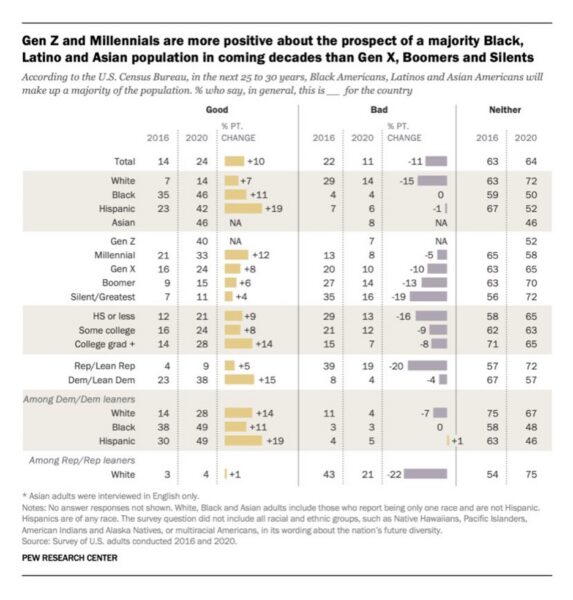
Of course, each generation is less white than the one before, and it would have been interesting to see answers by race and cohort. Are young whites more likely than older whites to think becoming a minority will be a good thing? Also, can 75 percent of white Republicans really think that whites becoming a minority will be neither good nor bad?
Some of these answers may reflect only how hard it is for people to imagine a real change of direction. There is much ruin in a nation, and people can get used to anything. Even today in South Africa, most whites believe inequality will be reduced by “education” and “more jobs,” with whites expressing more optimism than any other group. But what is the alternative? If this isn’t true, hard decisions must be made, and many people prefer to muddle along than be forced to do something drastic. Besides, in diverse societies, people form various relationships across ethnic lines and this tends to undermine the ideal of homogeneity.
Yet such relationships do not prove anything. Indeed, they may reinforce the fragility of the situation. To take the most extreme examples. Products of mixed marriages or families, such as Colin Kaepernick, Jesse Williams, or even Barack Obama express racial resentments and pick sides. From Jeremiah Wright to Malcolm X, lighter-skinned blacks are overrepresented among anti-white organizers. O. J. Simpson was not seen as a “black” celebrity for much of his career because he was married to a white woman and had a family-friendly, noncombative image. However, after he was accused of murdering his ex-wife, he became a hero to blacks, who rallied to his defense and celebrated his acquittal.
Perhaps the best way to explain sudden social conflict emerging in diverse societies or in private relationships is that people fall back on primordial identities in moments of crisis or conflict. Cross-racial friendships, relationships, and even families may not survive. If anything, race becomes something else to fight over. In societies with a dominant host population, this may happen less often because a small minority group is often not a major political threat. A conflict is “just personal,” so to speak. However, in a multiracial, multicultural society with no dominant group, political power is often dependent on group cohesion, and even a relatively small personal conflict can spark a major conflict.
Consider the case of Nolan Wells. The black teenager went out with a group of white friends in Mississippi on July 4 for a boat ride to Horn Island, 10 miles off the coast. The group had gone there before. This time, he never returned, and his body was found two days later. On the surface, this appears to be an unfortunate accident. A young black man drowns, and his friends and family are sad.
However, incredibly, this has now become a major political issue. The NAACP has accused Mississippi of not doing enough to investigate the death. Ben Crump, perhaps the leading racial ambulance-chaser in a country with no lack of them, has been tapped by Nolan Wells’s family to call for an independent investigation.
Just last week, Mr. Crump, Rev. Al Sharpton and (black) Rep. Lucy McBath of Georgia held a press conference calling for a federal investigation of Wells’s death. Mr. Crump has suggested that because of Mississippi’s history of racial violence, the state cannot be trusted. “The family has some concerns about the state of Mississippi doing an investigation of the death of a young black man, where a young white student may be looked at as having some culpability,” he said. Of course, though autopsy results are pending, there is thus far no evidence of foul play, let alone that the boy’s white friends murdered him. It is also unclear why the likes of Mr. Crump or Rev. Sharpton would accept the word of the Trump Administration’s Department of Justice if they don’t trust Mississippi.
Nolan Wells’s white friends are now reportedly getting death threats and accusations of murder. Some of the families have retained well-known defamation lawyer Edward Paltzik, who has represented President Donald Trump. We thus have a conflict along both racial and political lines, with lawyers associated with the Left and Right lining up on the black and white sides. We even have dueling fundraisers, the way racial conflicts are now fought out in America.
The accusations against the white friends may be the most remarkable aspect of the case. There is no more evidence that they are “racist” than that they are murderers. It would be strange indeed for racists to spend July Fourth hanging out with a young black man. Assuming their friendship was sincere and not an elaborate conspiracy by white teenagers to commit murder, this is a nightmare for them. Not only is their friend dead, but much of the country thinks they killed him. Nolan Wells’s family members, whom they probably know, have turned to several of the country’s most inflammatory racial arsonists to draw more attention to the death. Several uninvolved parties have already been arrested for allegedly issuing threats to parties in the case.
Even celebrities are involved, with the white, relentlessly leftist children’s entertainer “Ms. Rachel” calling for “justice.” She claimed that if Mr. Wells were white, things would have been different. She’s right. No one with any power or influence would care about his death, nor would it even make the news. “National Conservative” points out that CNN has run more than 20 stories about Nolan Wells’s death so far, though there’s yet no evidence there was a murder at all. At the same time, it ignores many proven, lurid black-on-white murders.
The mainstream media is not helping, hinting darkly that Nolan Wells’s death could be part of a larger trend. One popular link is between the death of Nolan Wells and that of Tasia Fortune, a young black woman found hanged in Mississippi. Thus far, her death has not been ruled a murder. However, a “person of interest” has been identified in her death, an older black man who may have fathered her child. This significant racial detail is often neglected by mainstream news sources such as CNN, eager to invoke memories of “Mississippi Burning.”
We thus face an entirely invented racial hysteria centered in Mississippi. Even if Tasia Fortune was murdered, the person of interest is a black man. In the Nolan Wells case, it seems even less likely there was foul play. The white boys’ friendship with Nolan has not protected them from vicious accusations. It’s why they are caught in this disaster to begin with.
The sad spectacle should be instructive for white people. Racial tensions and conflicts are bigger than any personal relationship. When tragedy strikes, the incentives of media, politics, and power do not bring racial groups together. Those with power magnify racial tensions or even invent a racial conflict when nothing happened. If that becomes common, cross-racial friendships and relationships become impossible.
The America our rulers have forcibly diversified is now in a permanent state of simmering tension. Any incident, or even a media storm over something that didn’t happen, can become a divisive national issue. Those who believe increased diversity will eventually make Americans look past race should be cautious. With increased contact comes increased chances for conflict, especially when those in the media and politics are so quick to take sides.