Breaking News: ‘Huckleberry Finn’ is Racist!
Jared Taylor, American Renaissance, August 27, 2026
Subscribe to future audio versions of AmRen articles here.
Last Sunday’s New York Times Magazine has a long article on how — or even whether — Mark Twain’s The Adventures of Huckleberry Finn should be taught to American students. Reportedly, in 1989, it was the third most common novel students were assigned to read in high school. There is no comparable ranking today, but a recent study found that only 77 of 4,000 high school teachers used the book often.
The author of the article, Ruth Franklin, is a journalism professor and literary critic, who has written three books: one about Holocaust fiction, a biography of white novelist Shirley Jackson, and a book about Anne Frank. You can guess the main objection she and others have against Huckleberry Finn: “the racist slur known euphemistically as the N-word appears more than 200 times.” Some teachers think the word “endangers Black students.” (Miss Franklin gives blacks, but not whites, reverential upper-case treatment.) She also reports that many teachers have dropped the book because they don’t have “the intellectual energy to handle a text widely seen as radioactive — and . . . fear that a misstep could cost them their jobs.”
Fetishizing this two-syllable word is one of the supreme acts of white sycophancy, especially since blacks use it freely. The word “endangers black students” when whites use it, but is neutral, even friendly, when blacks use it. Whites don’t get a pass if they say “nigga” rather than “nigger.” If there are other examples in history of a word commonly used by one race in a society but its use is a punishable offense in another race, I can’t think of one. Blacks, and no one else, have the doubtful honor of a slur that is considered 10 times more terrible than the grossest obscenity or profanity. No doubt, liberals and blacks would tell you that this is because blacks have been uniquely stigmatized and exploited.
It is absurd that the reputation of a great American novel has become hostage to white toadying of a kind Twain could never have imagined. It is even more absurd that teachers — and only white teachers, I imagine — can lose their jobs because of a “misstep” because of this terrifying word. This says a great deal about the whipped state of mind of whites and nothing about the novel.
The word “nigger” evolved from Spanish and Portuguese negro and French nègre, which entered English in the 16th century as “neger” or “niger.” These words meant a dark-skinned person, and “niger” survived into the 1800s. The double-G spelling, “nigger” was first recorded in 1608. None of these words was pejorative, and in the South, “nigger” also became a neutral term for “slave.” Jefferson referred to his “niggers” in this sense in Notes on the State of Virginia (1785), but by the late 19th century, and certainly by the mid-20th century, “nigger” was considered a slur.
The first time its use was treated as a fireable offense was apparently in 1989, when a white factory worker said of a co-worker, “I am not afraid of no black-ass nigger.” Just one year later, a college teacher was fired for pronouncing the word in a class on taboo words. Ever since, it seems, no white person may say the word under any circumstances, not even when reading aloud from Mark Twain. Miss Franklin reports that without exception, the teachers she could find who still read aloud from “Huck Finn” say “N-word” or just “mm.” “N-word” is universally accepted as referring to “nigger,” but for some reason has no totemic power.
Twain’s novel was written in 1884, and is set in the slavery-era South of the 1840s. Its characters often refer to blacks as “niggers.” Whether the word was contemptuous or descriptive, it was surely accurate for Twain to include it in dialogue, especially since so many of his white characters are degenerates, bums, and drifters. One of the reasons we read literature is to inhabit worlds that are gone. To read Tolstoy or Trollope — or Sophocles — is to live vividly and convincingly in eras and societies that are forever closed to us. Accurate language is part of this.
Furthermore, these days we are supposed to meditate constantly on all the bad things whites have ever done, especially slavery. You can’t visit Monticello or Montpelier without being reminded by every interpretive panel of “enslaved people,” whom you are to think were just as important as Jefferson and Madison. Shouldn’t we be wallowing — glorying — in the edifying “racism” of “Huck Finn”? Shouldn’t all high-schoolers therefore be made to read it?
In fact, despite 200 appearances of the dreaded word, there’s virtually no cruelty or mistreatment of blacks in the story. There is nothing like the grisly scenes common in novels by blacks like Toni Morrison or Richard Wright or Ralph Ellison — which also put the totemic word in the mouths of vicious whites, but somehow without “endangering Black students.” Why aren’t they endangered? And if Twain’s book is “racist,” why isn’t Invisible Man or Beloved? Because it’s like using the N-word; blacks may do things whites mayn’t.
No matter how anyone talks in “Huck Finn,” Huck and the runaway slave Jim are the only winsome characters. Tom Sawyer appears at the end, but he makes an ass of himself, and the story would be better without him. As for triumphs over “racism,” a reader couldn’t ask for better than Huck’s decision to go against what he believes is his Christian duty, and help a slave escape rather than turn him in. He had written a letter to Jim’s owners telling them where to find and reclaim him, but then thinks of all the kindness Jim has shown him:
I took it [the letter] up, and held it in my hand. I was a-trembling, because I’d got to decide, forever, betwixt two things, and I knowed it. I studied a minute, sort of holding my breath, and then says to myself: “All right, then, I’ll go to hell” — and tore it up.
Huck risks damnation rather than betray a black man!
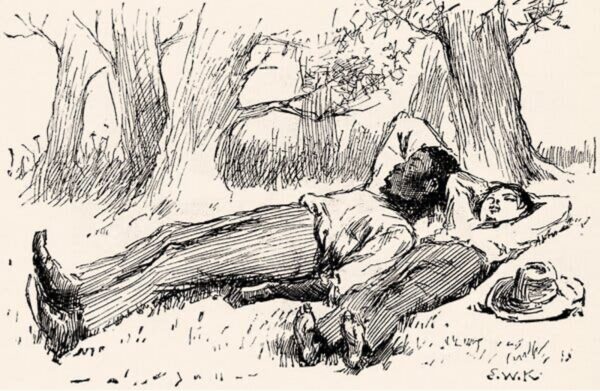
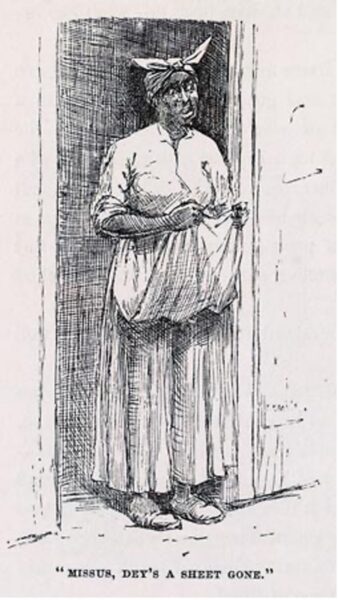
This is an illustration from the first edition of the book. Does this look like contemptuous treatment of a despised race?
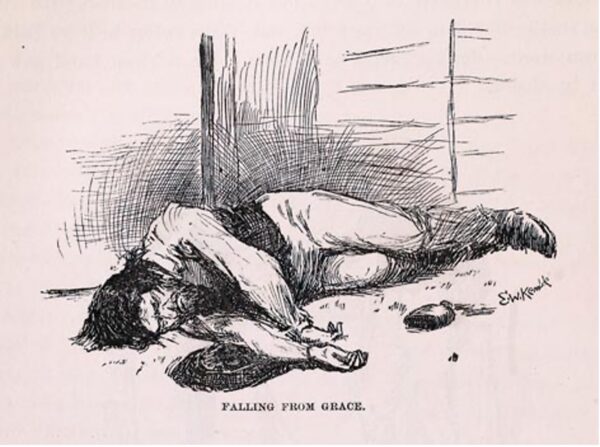
Here’s Huck’s passed-out-drunk father. Who’s the loser in the story?
Here are two white con men.
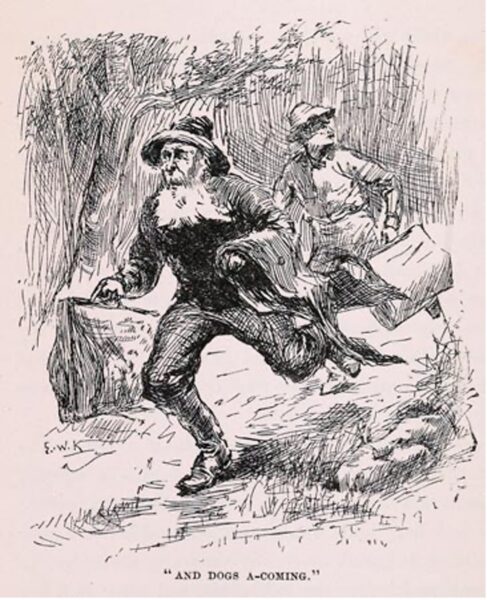
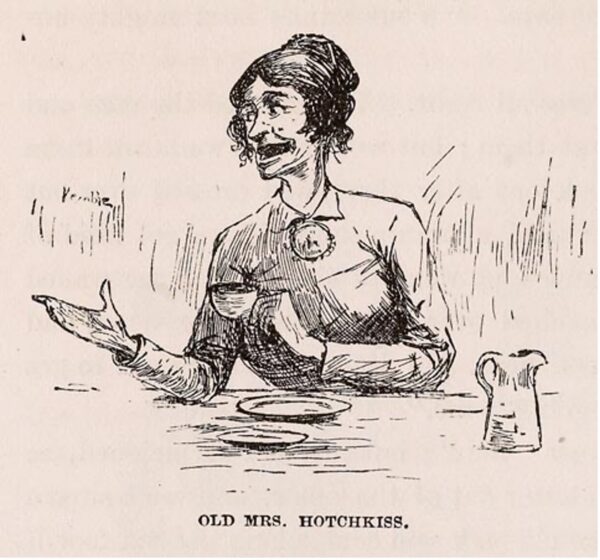
Black characters are certainly no more ridiculous than white characters.
Lickspittle whites have been moaning about the book’s “racism” since at least 1957. Seventy years later, The Adventures of Huckleberry Finn is still living up to its name. Miss Franklin, the author of this long reflection on white people, makes a mighty effort at the end and decides that the book is worth reading so students can learn “to value the skills of literary interpretation and critical thinking.” But teaching it is too tricky, too dangerous. She suspects this great classic of Americana may finally be about to drop out of sight.