The True Story of Dracula
Luther Claymore Pretorius, American Renaissance, October 31, 2026
In the 15th century, Wallachia was a vassal state of the Ottoman Empire. It had a population of well under one million and, for generations, was an unstable land of quarrelsome Europeans. Relations with the Ottoman Muslims vacillated between good and bad, depending on how much the Europeans were willing to compromise their sovereignty for peace, or ally with Muslims against a rival European power. Politics in the region were complicated and confusing. Today, the area is part of southern Romania, and the legend of Dracula began there with a real person.
In 1456, Prince Vlad Dracula III established himself as its ruler, but resisted Wallachia’s role as a vassal state of Sultan Mehmed II, who had conquered Constantinople in 1453. Vlad waited for three years before appearing before the Sultan in Constantinople to pay tribute, and he refused to send Christian boys to be made into Muslim Janissaries. When Turkish recruiters went into Wallachia to kidnap children, he had the Turks caught and executed. In 1460, the Sultan sent emissaries to Dracula’s court. They refused to remove their turbans as a gesture of respect to Vlad’s authority, claiming it was against their religion. Vlad declared he would “strengthen their custom,” and had spikes driven through their heads to pin their turbans in place permanently. He then sent their bodies back to the Sultan.
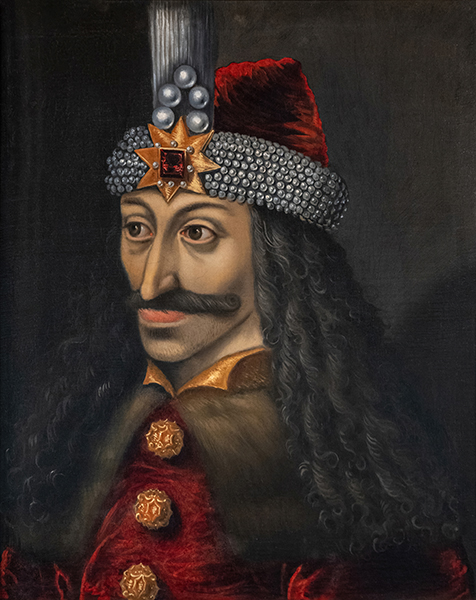
Ambras Castle portrait of Vlad III (c. 1560), reputedly a copy of an original made during his lifetime.
In response, the Conqueror of Constantinople himself led an invasion on May 17, 1462, to re-establish domination. His army may have been more than 100,000 men. Against them, Vlad could muster only about 25,000, but he waged effective guerrilla war. In his famous Night Attack of June 17–18, 1462, Vlad led a surprise cavalry raid on the enemy camp in the hope of killing Mehmed II. This led to chaos and fear in the camp, but Vlad failed to find the sultan, and the Wallachians withdrew when the Janissaries rallied.
The sultan’s army advanced steadily toward the capital of Targoviste, but was stunned to find a “forest” of impaled corpses, hanging from long, vertical wooden poles. These were enemies — some said as many as 20,000, though modern historians suspect about 1,700 — whom Vlad had brought back from raids into Ottoman-controlled Bulgaria. The “forest” was said to be in the form of a crescent a half mile wide and two miles long (some sources said five miles long). Because of this discovery and in response to military setbacks and logistics problems, the conquering sultan turned back.
This was hailed as a great victory for Dracula, but the sultan left behind Vlad’s brother Radu the Handsome, in charge of a small Turkish force. Radu also attracted Wallachian nobles who chafed under Vlad’s harsh rule, and to whom he promised privileges and milder rule. Faced with an insurrection and defections from his own army, Vlad fled to Transylvania, where he got no support.
For the next 14 years, Dracula was in exile, but invaded Wallachia and regained the throne in 1476. Only two months later, he died fighting Ottoman forces who supported another Wallachian pretender, Basarab Laiotă, who took his place. The Ottomans cut off Vlad’s head and sent it as a trophy to Constantinople.
Vlad Dracula III became infamous as “Vlad the Impaler.” He was brutal but typical of rulers in that brutal era. He had a strong sense of fair and impartial — and harsh — administration of justice, especially of thieves. He had a unique practice of imposing the punishment used in the jurisdiction from which the offender came. He was said to be scrupulously fair, ensuring that the accused was in fact proven guilty.
Vlad Dracula III was one of Christianity’s greatest warriors against Muslim subjugation and is credited with establishing some 50 churches and monasteries in Moldavia and Wallachia. In Romania, he is a national hero because of his battles against the Muslims and their collaborators. I think throughout the West he should be honored as a champion and hero of white, Christian civilization.
Dracula III is long gone, but his legend lives on. Starting in 1897 with the publication of Bram Stoker’s horror novel, his name has become universally known and associated with the evil, blood-drinking “undead.” Perhaps he is, himself, “undead.” In 1933, archaeologists excavated what was said to be Dracula’s grave at the Snagov Monastery, on an island near Bucharest. It was empty.