Helen Andrews: Brilliant Diagnosis but Wrong Course of Treatment
Jared Taylor, American Renaissance, August 6, 2026
Subscribe to future audio versions of AmRen articles here.
Conservative journalist and author Helen Andrews has written a marvelous essay on the terrible racial wreck the United States has become. Called “The Racial Crossroads,” it brilliantly summarizes the racial absurdities and double standards the United States now takes for granted. Mrs. Andrews has done such a masterful job that I hesitate to criticize, but I believe both her analysis of how we got here and what we should do next are off target.
“The Racial Crossroads” has many facets and subtleties, and my summary of its main arguments only skims the surface. Mrs. Andrews writes that during the “civil rights” era, when the United States was a biracial, black-and-white country that was almost 90 percent white, we decided it was fair to give blacks the leg up that came to be known as affirmative action. Since the gain for a small minority was at the expense of a large majority, and since the advantages were to be temporary, Americans generally accepted this retreat from color-blindness.
Now, however, the number and kind of people who get a leg up has vastly increased. The benefits were originally supposed to compensate only the descendants of slaves; now they go to all non-whites, women, sexual minorities, and in some cases, people with handicaps, and the “neurodivergent” — all seen as victims of “straight white males.” Perhaps the most obviously undeserving beneficiaries are immigrants, who qualify for priority treatment on arrival if they are non-white, as most are.
Furthermore, the decline in the white (male) population means that instead of the cost of the benefits for 10 percent being borne by 90 percent, the ratio has shifted perilously. The white male percentage of the US population under 30 is about 26 percent; everyone else comes first. Mrs. Andrews notes that this means “white men in particular are effectively shut out of many prestigious fields and institutions, especially in the lower rungs.”
Mrs. Andrews makes a striking comparison between America’s obsession for racial balancing and the principles of Communism that were forced into every area of Soviet life. She does not mention this, but the culmination of this obsession was two Joe Biden Executive Orders — 13985 and 14035 in 2021 — that required every federal agency to file a detailed study with the Office of Management and Budget explaining how it would ensure that every aspect of its work would heretofore promote “equity” for all groups “systematically denied a full opportunity to participate in aspects of economic, social, and civic life.” Rather than list those groups, it’s easier to define the only people who hadn’t been “systematically denied:” heterosexual, able-bodied, native-born, English-speaking white men who have never gone to prison. They keep everyone else down, and every agency was to keep careful count of how many it was shouldering aside.
There would be stringent “accountability,” with “new reporting requirements,” “definitions of success,” “evidence-based and data-driven measurement of improvement,” “increased transparency,” “analysis of effectiveness,” and reports on “lessons learned.” All government contractors had to follow the same rules, and agencies were ordered to browbeat the private sector to adopt similar measures — and much of it did. And everyone — idiotically — had to claim this was “consistent and systematic treatment of all individuals in a fair, just, and impartial manner.”
The Equity Action Plans every agency filed make astonishing reading. Substitute “Marxist-Leninist Thought” for “equity” and you have Stalinism. The reports used to be available here, but no longer. [They can now be found here.] If the Trump administration scrubbed them, that was a mistake. They are impassioned, detailed, government-mandated expressions of the exact mentality Mrs. Andrews describes, and some day, they will have a place in the National Museum of Racial Insanity.
These EOs were only the most exquisitely cynical expressions of a well established mentality, and this broad campaign of what amounted to anti-straight-white-male discrimination had already given rise to casual contempt for whites. Mrs. Andrews cites New York Times’ darling Sarah Jeong’s famous comment that whites were “only fit to live underground like groveling goblins,” and mentions a book on concerns about euthanasia that argues, in effect that “since over 90 percent of people who seek assisted dying are white, we shouldn’t worry about it.” A black clerk for the St. Paul, Minnesota, school board argued that “white, Christian cemeteries” would make ideal dog parks, because animals could “piss on white corpses.” It is astonishing that whites, while still a national majority, require no consequences for this kind of talk, but punish each other for far milder comments about non-whites.
Before going into Mrs. Andrews’ solutions to the problem, here are some observations about her argument so far. First, Americans did not accept race preferences. They were sneaked in under names such as “affirmative action,” a term first used in a John Kennedy executive order that required employers to take “affirmative action” to ensure they did not discriminate.
As Mrs. Andrews explains, the theory was that there were high barriers preventing qualified blacks from getting what they deserved. By removing barriers and broadening searches, employers would find many fine blacks without lowering standards. This was nonsense because there were few qualified blacks and everyone wanted them.
The resulting favoritism was called “equal employment opportunity,” which meant unequal, preferential opportunity for non-whites. Weaselly language was necessary, because in the 1960s and early 1970s, it would have been hard to make Americans accept explicit lower standards and racial preferences. At most, they might have agreed that if there were perfectly matched blacks and whites, it might be OK to hire the black.
The courts had a hand in the subterfuge. In 1971, just seven years after the Civil Rights Act of 1964 banned segregation and discrimination, the US Supreme Court ruled in Griggs v. Duke Power that any employment standard that had a “disparate impact” on minorities — it weeded out more non-whites than whites — was discriminatory unless proven otherwise. The Court assumed that if whites were setting high standards, it wasn’t because they wanted to hire the best; it was a trick to keep out blacks.
In 1978, with the Bakke decision, the court muddied the waters further by ruling that race preferences were permissible, no longer as compensation for past injustice, but to increase diversity. There was no justification for this in anti-discrimination law, but “diversity” was the legal foundation for anti-white, anti-male discrimination for the next 45 years, until the court finally did away with most of it in 2023 with Students for Fair Admissions v. Harvard.
There has never been a time when a majority of whites supported racial preferences for non-whites. I’ve always been struck by the small minorities of blacks who supported preferences for their own race: 27 percent in this 1977 poll, and similar figures right through the 1980s. Preferences were always an elite project, tirelessly promoted by liberals who didn’t suffer its consequences, and practiced by virtually all institutions. As Mrs. Andrews points out, when blatant double standards were revealed and could not be denied, some proponents argued that they were temporary and would disappear when blacks reached parity — though parity never comes.
But more crucially, Mrs. Andrews misses the key reason why preferences will not die — and why it is so common to hold white men in contempt. It is because of the rigid taboo on pointing out race differences in IQ and other traits. It is not pleasant to dwell on the one-standard-deviation gap between black and white average IQs (and the smaller white-Hispanic and white-Amerindian gaps). It is not pleasant to conclude that the evidence is overwhelming that genes contribute substantially to these gaps. However, in a multiracial society in which every difference in outcome goes under the microscope and is trumpeted as proof of white racism, whites should have publicized the race/IQ data out of pure self-defense. They haven’t. Just try it and you’ll see why.
Since it was forbidden to talk about the real reason blacks and Hispanics did poorly, the country had to invent new mysterious and malignant forms of “racism.” It used to be that racism was deliberate acts by bad people. Since only racism could be causing huge black/white disparities in crime rates, poverty, and incarceration, there had to be an awful lot of white racists. But who are those people? Where are they? What are they actually doing to grind down black people?
The number of whites who could plausibly be described as consciously oppressing blacks soon became vanishingly small. For decades, the favorite villains were the police, but serious criminology and now body cameras have mostly deflated those charges. David Duke might therefore be a certified “racist,” but how was he, personally, keeping black people poor and in jail, especially when he was hated and denounced by almost everyone?
The only answer could be that racism was not just deliberate acts by bad people, but was “institutional,” “systemic,” and “unconscious.” And there had to be an awful lot of that, too. Because every dollar difference in the median household net worths of blacks and whites ($45,000 v. $285,000) is a precise measure of white racism, past and present, whites are clearly a powerful force for evil.
Every disparity is proof, and if whites claim innocence or goodwill, it means only that they are “fragile” and “in denial.” From there, it’s a small step to assume that whites are inherent oppressors. It’s their nature to treat non-whites like animals, loot the Third World, and at the same time sincerely believe they are good, virtuous people. They cannot be salvaged, and they deserve every insult. It would be a public good to “abolish the white race,” as Noel Ignatiev of Harvard proposed, and non-whites should assume they are unsalvageable. As Chanequa Walker-Barnes wrote in a prayer published in 2021:
Dear God, Please help me to hate White people. Or at least to want to hate them. At least, I want to stop caring about them, individually and collectively. I want to stop caring about their misguided, racist souls, to stop believing that they can be better, that they can stop being racist.
Chanequa Walker-Barnes is professor of practical theology and pastoral counseling at Columbia Theological Seminary.
Ta-Nehisi Coates was showered with literary honors for a book, Between the World and Me, that contains this passage:
I would like to tell you that such a day approaches when the people who believe themselves to be white renounce this demon religion and begin to think of themselves as human. But I can see no real promise of such a day.
Professor Brittney Cooper of the Africana Studies Department of Rutgers said of whites as a group, “We got to take these motherfuckers out. But like, we can’t say that, right?” Wrong. She said it without consequences.
Black hatred for whites is inevitable. How could they not hate us if we are the source of everything that has ever gone wrong for them anywhere, anytime? When will whites ever explain that it is race differences, not white wickedness, that explain racial disparities? Many whites think blacks would riot and society would collapse if race differences were widely discussed. They are wrong, as I explain here.
At the same time, liberal whites take virtuous and vicious pleasure in denouncing fellow whites as bigots — Southerners, gun owners, Trump-voters, blue-collar workers — fancying that liberals will be exempted from the anti-white animus they are stirring up. When blacks and other non-whites attack us, they make no distinction between “racists” and “white allies.” If anything, they may be more contemptuous of self-professed “allies” whom they dismiss as self-deluded phonies.
So, where does this leave us? Mrs. Andrews says we are at a crossroads. If nothing changes, two things could happen. First, non-whites will become the voting, legislative, and judicial majorities, and entrench non-white privilege. As I wrote in 1996, it is not outlandish to imagine supplemental taxes on whites to strip them of undeserved wealth, exclusion from certain professions, laws to require non-white majorities on every corporate and non-profit board. Second, Mrs. Andrews writes that unbridled DEI could promote so many incompetents that society collapses. As I asked in 1994, “What will be the first American city where it’s unsafe to drink the water?” (The answer, as it turned out, was 57-percent-black Flint, Michigan, in 2014.)
Yes, you can call this a crossroads, but there have been countless crossroads, and we almost always took a wrong turn: bringing blacks to the colonies in 1619, giving up on remigration of blacks in the 19th century, destroying states’ rights, outlawing racial discrimination, opening up immigration to the whole world, the BLM madness of 2020, the Biden executive orders I mentioned earlier.
One of the few times we got it right was in 1790, when the first United States Congress restricted naturalization to “free white persons . . . of good character.” Electing Donald Trump was a step in the right direction, but every one of his accomplishments on race or immigration has been by executive order and the next Democratic president will undo them all, probably on day one. Moreover, all the good he has done will be associated with his, shall we say, unconventional behavior.
So, which way do we turn now? Mrs. Andrews says we must remove “every reference to race in our laws and regulations, apart from a bare-bones version of the 1964 law banning segregation.” This would mean repealing all “civil rights” laws to make racial (and presumably every other kind of) discrimination legal again. (I don’t know what Mrs. Andrews means by “segregation” or why it should remain banned, and she does not elaborate.) Her proposal would mean DEI was entirely optional and — most important — no one of any race could bring a discrimination suit, whatever the racial mix.
If that happened today, it would be harsh medicine. At least at first, virtually every university and large company would run amok with DEI. Mrs. Andrews recognizes this, but she predicts that sensible people would eventually start schools and businesses that pulled ahead quickly by bringing back merit. Maybe even an airline or car company would do that. If — and this is an enormous if — freedom to discriminate were combined with a public information campaign about race differences, we might eventually end up with something like meritocracy. We might get better immigrants: no more Africans or Hispanics; only whites and East Asians.
What we would not get is the America that only goofy white people pretend to believe in, in which citizens of every race and religion shed their particularist identities and link arms as Americans. Non-white solidarity is too strong, too powerful a battering ram against whites for them to give it up. Blacks and Hispanics would grow only more bitter — their racial identities sharper — if they had to compete on an equal footing with whites and Asians. Race would still be the most painful and persistent national fault line.
Mrs. Andrews may be proposing the impossible anyway. It is true that Trump-appointed Supreme Court justices banned most forms of racial preferences and his DOJ is trying to eliminate disparate impact. In both of his terms, however, Donald Trump could have asked Congresses with Republican majorities in both houses to repeal “civil rights” laws. Since he didn’t, who will? And if he had tried, what would have happened? Nothing. As I have noted elsewhere, in 2026, “the President, Vice President, and his cabinet are Republicans. So are 53 senators, 218 congressmen, 26 governors, and 4,070 state legislators. . . . Does even one call for the Civil Rights Act of 1964 to be repealed or pronounce the words ‘freedom of association’?”
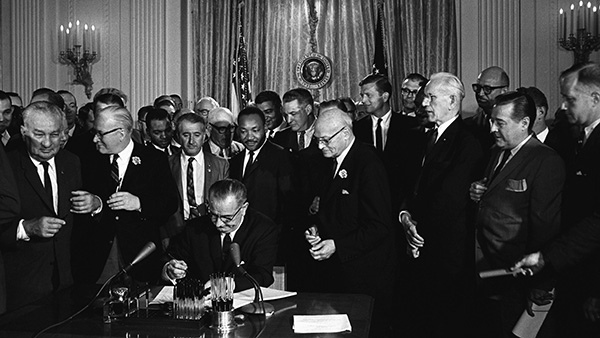
President Lyndon Johnson signing the Civil Rights Act. (Credit Image: © PHOTO12 via ZUMA Press)
It may be too late for racial sanity at the federal level. Despite his claims of a “landslide” victory, Mr. Trump got only 49.8 percent of the vote. During his four years in office, the white share of the vote will have declined, tilting the balance against Republicans. A Democrat president and all the vengeful horrors that entails are far more likely than Mrs. Andrews’ dream of a meritocratic America.
But I could be wrong about change at the national level; it’s impossible to predict what even just a few years could bring. If Elon Musk, trillionaire, decided to spend a few billion on white advocacy — which is making remarkable gains even without serious financial backing — it is possible to imagine Republican administrations that openly promote a return to a permanent white majority. They might not merely deport illegal aliens; they could offer incentives to non-whites to renounce citizenship and return to their racial homelands. A properly constituted Supreme Court could hold anti-discrimination laws unconstitutional and spare Congress the effort.
What if robots really do replace virtually all blue-collar work, as some now predict? Without the lure of cheap immigrant labor, would the US Chamber of Commerce really want large populations of Mexicans and Haitians just for the joy of diversity? There is no telling how great leaps in AI could change how Americans think about the economy and demography of their country. No matter what happens, whites who care about demographic security must never give up on politics. They should make every effort to turn the Republican Party at every level into one that protects their interests.
For now, though, I’ll stick with the country as it is. I wish Mrs. Andrews had further developed this key observation: “[D]emocracies that are polarized around race are fundamentally unstable. They don’t debate issues, they count heads, and they often degenerate into violence.” She could have substituted virtually any collective for “democracies:” nations, communities, institutions, groups, neighborhoods.
America’s fundamental problem has been the same from the start: multiracialism. The most salient racial divide has traditionally been black/white, and we stumbled from one clumsy, unjust arrangement to another trying to solve a problem that cannot be solved: slavery, emancipation, segregation, Jim Crow, integration, race preferences, DEI, and now a spasm of anti-anti-white reaction. And not content with one colossal race problem (two, if you include American Indians), we have imported countless more racial, religious, and ethnic problems from all around the world.
No matter what happens, no one will be happy in the seething broth of hostility we are brewing for the future, but whites will suffer most. We are the undisputed villains of the drama, and will remain so even after we are pushed aside. More than 30 years into black rule in South Africa, it’s still the “legacy of apartheid” that explains the ruin of what was once a successful country.
And so, I now propose what is perhaps my own pipe dream: disengagement. It may be difficult to achieve, but separation is the only future for whites that does not lead through dwindling numbers, persecution, and contempt to oblivion. Local ingatherings of racially conscious whites could eventually lead to local autonomy and perhaps even sovereignty.
I believe the United States as a whole will probably never again be the undisputed, permanent home for white people, where their children can grow up without being taught that they are dirt. That will be reserved, first, for racially conscious communities, then counties, perhaps whole states. Yes, the question of secession was answered in the 1860s, but only by violence, not by moral argument.
This will begin as a hard-fought struggle at the local level, and will require defiance of the central government. Curiously, the non-whites who profess to hate us and who should be delighted to see us go our own way will suddenly find reasons to want to keep us close.
The United States is not the only country where racial replacement means oblivion for the former majority. Every major European country has a vigorous youth movement dedicated to remigration, or returning non-whites to their home countries so Europe remains European. The dynamics of dispossession are everywhere the same. I believe that for historical and even moral reasons, American whites may be unable to reclaim their entire country, and will have to settle for balkanization, but whites and their civilization need lands of their own, where they are free to forge their own destiny, and free from the unwanted embrace of people who often hate them.
So, yes, we are at a crossroads. Mrs. Andrews reminds us of the last one in 2020 — the George-Floyd “racial reckoning” — during which, as mobs rioted month after month and it took curfews to calm 300 cities, America’s 50 biggest companies pledged $50 billion to racial “equity.” I consider 2020 the year the white man hit bottom. He has staggered back from the worst outright self-loathing, but is far from good health.
Mrs. Andrews is right to sound the alarm. Her reasons are carefully considered, and I cannot praise her highly enough. But the racial reckoning of 2026 must give up on the multiracial failure the United States has become and work towards disengagement. This will be our only salvation.