What the French New Right Accomplished, Part I
Michael Walker, American Renaissance, October 30, 2026

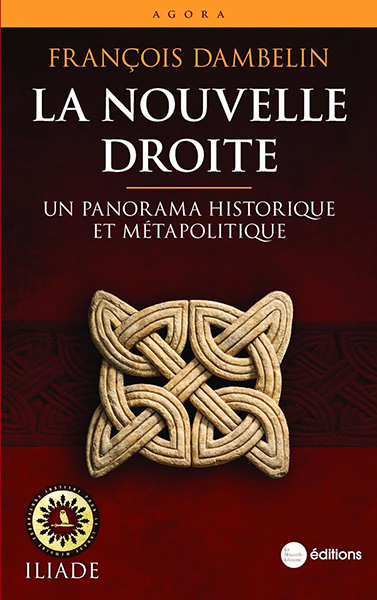
François Dambelin: La Nouvelle Droite: Un Panorama Historique et Metapolitique (The New Right: A Historical and Metapolitical Panorama), La Nouvelle Librairie, 2026, 504 pp., €24.90 (soft cover)
To my knowledge, François Dambelin’s The New Right is the first book to offer a complete history of the French New Right, let alone a “historical and metapolitical panorama” of it. The blurb on the back states that over many years, its adversaries have depicted it in terms of “slogans and caricatures” and that until now no objective and comprehensive published overview has been available. This book purports to fill the gap.
The New Right is a current of thought, often labeled the French New Right, that emerged out of a radical change of attitude on the part of French nationalists in the 1960s, one subsequently embodied in an organization called GRECE, founded in 1968. In the eyes of many hostile observers, then and now, the French New Right is just an old wine in a new bottle — a very old political worldview sporting a new label. The French New Right does indeed have personal and ideological roots in the French nationalist right of the postwar decades. Nevertheless, it is wrong to characterize it solely as the polite face of a historical far right. The transformation from militancy to think-tank which marked its beginnings was a radical, genuine, and far-reaching change, not only in terms of tactics but also in terms of ideas, as Mr. Dambelin’s study shows.
The term “New Right” is open to interpretation, even when it means only “French New Right,” as is generally the case in this book. What is politically on the Right can and does represent different things. It may indicate support of a free-market economy and a desire to reduce the remit of the state, a view which does not characterize the French New Right at all. As for the word “new,” should a movement still be called new when it is over half a century old? Many people who are associated with the French New Right dislike the name and try to avoid using it; others reject it entirely. Nobody is sure who first coined it. The term “New Right” sounds as though it is another example of a French tendency to add the word “new” to all kinds of recreated ideas and trends: Since the war, there have been nouvelle cuisine, nouvelle culture, nouveau roman, and nouvelle vague. Mr. Dambelin states in his “preamble” that when he talks about the “New Right”:
The purpose of this work is to present a historical panorama to its reader of the politico-cultural movement which developed around the Groupement de recherches et d’études pour la civilisation européenne -GRECE (Research and study Group for European Civilization) and the groups which it inspired or influenced. (p. 9) [All translations by the author, unless otherwise noted.]
Despite Mr. Dambelin’s promise to present groups that “developed around” GRECE and that were “inspired or influenced” by it, he actually says very little about such groups.
The French New Right (henceforth, simply New Right) has always sought to put clear blue water between itself and both a libertarian, free market Right, and a nationalist or revanchist Right. In the last century, the New Right seemed to be more comfortable calling itself Right than it does in 2026. Mr. Dambelin cites Alain de Benoist, probably the best known representative of the New Right. One of Mr. de Benoist’s many books, published in 1977, is called Vu de droite (Seen from the Right). In recent years, however, he has reiterated that he does not consider that he belongs to a political Right and that he does not care for the term New Right. In his book (reviewed in American Renaissance) titled The Populist Movement: The End of Right vs. Left, first published in French in 2017, he argues that the rise of populism heralds the end of the classic Right-Left political divide, which will soon become obsolete. Nonetheless, Mr. Dambelin’s choice of The New Right as the title of his book points to the resilience of the term. It persists faute de mieux; no one has coined a widely accepted alternative.

Alain de Benoist at a conference organized by L’Institut Iliade (Iliad Institute), April 2022. (Credit Image: © Vincent Isore/IP3 via ZUMA Press)
That Mr. Dambelin is principally concerned not with the New Right in general but with GRECE, is underlined by the use of GRECE’s icon, the Breton Cross, (an ancient motif, writes Mr. Dambelin, “found in engravings, jewels, monuments and tablets in many European countries” [p.57]) on the front cover of his book. Mr. Dambelin affords little space to New Right groups other than GRECE, so it is fair to call the title of his book a misnomer, and his focus on GRECE has a major disadvantage. By paying scant heed to the many people, publications, and groups influenced by GRECE but not closely or directly associated with it, Mr. Dambelin both exaggerates and diminishes GRECE’s importance. He exaggerates the importance of GRECE by focusing on it at the expense of other groups, but also downplays the huge impact that GRECE has had around the world.
Mr. Dambelin realizes that the term “Right” “creates difficulties,” and he quotes the then secretary general of GRECE, Jean-Claude Valla, who pointed out in 1977 that the term “New Right” is altogether misleading, because the word “Right” to describe GRECE suggests that it is political, whereas GRECE operates not in a political arena, but in a cultural and metapolitical one. (p.10) There is no New Right charter or statement, let alone membership. By contrast, GRECE is an organization which does (or did) have a charter and is a definable group with a select membership.
Mr. Dambelin’s account of the origins of GRECE reminds us that the early founders had stepped away from active politics and activism because they had become frustrated that every act of party-political engagement and activism failed to win support among the general population. The first chapter of The New Right is called “The Birth of GRECE” and in it Mr. Dambelin describes how a small group of French nationalists abandoned activist politics, adopting instead something they called a metapolitical perspective. Mr. Dambelin himself does not explain what metapolitics is, but he has collected some definitions offered by leading members of GRECE:
“I would summarize it like this: it is another way of doing politics, when you go upstream and downstream of the political arena stricto sensu, so as to include the entirety of life in society.” (Pierre Vial, in Une terre, une peuple — One land one people, p. 52)
“We call metapolitics the area of values which are not encompassed by politics in the traditional sense of the term, but which have a direct effect on the consistency or absence of the social consensus which politics depends on.” (Jean-Claude Valla, from Entretien avec Jean-Claude Valla in Dix ans de combat, pour une renaissance-Interview with Jean-Claude Valla in Ten years of struggle for a renaissance, 1977.)
Dissemination of values and ideas (or “ideologemes”) in civil society, in the collective mindset; metapolitics ignores the stratagems and ambitions of career politicians as well as all political labels, pursuing instead the politics of greatness, that is to say it seeks to make political impact. It is beyond and above the politics of career politicians. Their performance has become theatrical and their stage is no longer where politics plays out.” (Guillaume Faye, in Petit lexique du partisan européen- Small lexicon of the European partisan pub. 1985, p. 45)
Probably the person who did the most to redirect a disillusioned Right from party politics towards metapolitics was Dominique Venner, one of the founders of GRECE. A volunteer in the Algerian war, Venner had been a member of the proscribed OAS, the counter insurgency organization that opposed Algerian independence, and he was jailed twice for political reasons. Abel Mestre, who wrote Venner’s obituary in Le Monde after Venner’s suicide in 2013, called him “the father of the French extreme right.” He can more plausibly be called the father of the French New Right. It was Venner whose career took him from agitation to thought, from party campaigning to cultural vision, and, to use the term dear to GRECE, from politics to metapolitics.

Dominique Venner
French and British nationalists (or if one will, the French and the British “far right”) were faced in 1945 with a similar demotivating pattern of insurrection and surrender in the colonies, or, as it was called by those who favored it, decolonization and demands for independence. Postwar socialist politicians granted independence to former colonies as quickly as they could (Britain’s Labor government granted independence to India just two years after the Second World War), while conservative politicians, despite some bluster, made no attempt to reverse the trend. Every postwar government in Britain and France from the 1950s through to the 1970s acted as though decolonization was probably desirable and in any case unstoppable. When addressing the South African Parliament in 1960, British Prime Minister Harold Macmillan famously stated, “The wind of change is blowing through this continent. Whether we like it or not, this growth of national consciousness is a political fact and our national policies must take account of it.”
However, many European nationalists believed that the loss of the colonies was not “inevitable” (British nationalist A. K. Chesterton famously stated in his work New Unhappy Lords that “inevitable” was the word he most hated in the English language) and that military defeat in colonial wars was brought about by betrayal at home. The French army surrendered to the communist Viet Minh in 1954 and de Gaulle surrendered Algeria to the FLN in 1962. Many French nationalists were convinced that in both cases, the army had been “stabbed in the back.” De Gaulle reneged on his undertaking to protect European settlers in North Africa, as laid down in the Évian accords. Over a million European settlers were forced to flee their homes, and the French government stood by and did nothing. French settlers saw their options as la valise ou le cercueil (the suitcase or the coffin). For Venner, it was an ignominious betrayal.
Venner soon came to believe that seeking immediate redress in an electoral surge of support for a lost empire was doomed to disappointment. He turned his back on a romantic quest to restore colonization, which in any case he increasingly associated with Jacobinism and the French Revolution. He looked forward instead to the emergence of a European bloc, one independent of West and East, aspiring to neither a capitalist nor communist panacea. For a time, Venner believed that electioneering could win over the general public to such a pan-nationalist European vision, but his optimism was short-lived. It ended with the 1965 French presidential election, when the conservative lawyer Jean-Louis Tixier-Vignancour, the candidate backed by Venner and with Jean-Marie Le Pen as campaign director, came in a poor fourth out of six candidates, with only 5.2 percent of the vote. Mr. Dambelin writes that in 1967, Venner “threw in the towel” of activist nationalism, realizing that the world had changed. Mr. Dambelin quotes from Venner’s autobiographical Le Coeur rebelle (Rebel Heart): “We were entering a different world. The Algerian war had ended with another defeat for my country, and I felt it as a European defeat.” (p. 28)
Venner’s remark that he felt the loss of Algeria as a European defeat indicates the direction he was to take and those whom he drew to his cause. He took over the Federation of Nationalist Students (FEN), “mobilizing it around his project, creating a movement based on a review which was to become its ideological dynamo.” (p. 29) The FEN had been publishing the review in question, Europe-Action, since 1963. Many future members of GRECE were already writing for it, including Alain de Benoist, under the pen name Fabrice Laroche. With Venner as director, Europe-Action aimed at breaking free of traditional French nationalism in favor of a neo-nationalistic, pan-European identity — even a European empire. Mr. Dambelin writes that Venner was impressed by Mr. de Benoist’s “culture, intellectual agility and editorial abilities” (p. 40) and he decided to appoint him as editor. Venner was not the only one impressed by Mr. de Benoist. Mr. Dambelin also quotes the former Trotskyite, Roland Gaucher, who had joined Marcel Déat’s Vichy-collaborationist RNP (National Popular Rally) during the war, writing about Mr. de Benoist:
I was at once struck by the extensive knowledge he had accumulated, despite his youth, and by the meticulous and passionate way he pursued his aims. He had corresponded with personalities from the global scientific community, notably in the United States and in Germany, and had made notes about them all. He may be intending to become leader of a school of thought. He is calm, balanced, precise. He is not loud. (p. 40)
Mr. Dambelin also quotes Gaucher on Venner’s new kind of nationalism:
This neo-nationalism broke with the Jacobinism of the Nation State, opening out towards a Europe seen as a community of peoples. It sought to root itself in the various countries of what [Breton nationalist] Yann Fouéré called “the Europe of a Hundred Flags.” . . . We conceived a Europe structured like the Carolingian Empire, a spiritual, political and economic space sufficient in itself, so as not to fear the world beyond its borders.” (pp 30–31)
Such ideas would characterize the New Right. They included an acceptance of the loss of the colonies, a rejection of nationalism of the kind embodied by the French Revolution and manifested by the tricolor flag, the French national anthem, and Bastille Day. Venner and his comrades sought inspiration and identity, not in republican nationalist France, but in the post-Roman Frankish empire and the Pagan legacy of Ancient Greece. The identity they claimed was European before it was French. Venner proposed to proceed in a novel way, not by appealing to the greatest possible number, not by political action, not by campaigning as a party, but by working indirectly through discussion and argument to influence those who were themselves in positions of influence or who might be influential in the future. Mr. de Benoist was thinking along the same lines. Mr. Dambelin quotes Maurice Rollet, the ebullient former pro-French-Algeria militant, who recalled that Alain de Benoist had convinced a small number of people, most of them linked to FEN, to create a “metapolitical” initiative, not seeking short-term gains, but “in it for the long haul.” Rollet called Mr. de Benoist’s initiative “a Gramsciism of the right”.
“Gramsciism” is named after the Italian thinker and communist activist, Antonio Gramsci. It refers to a long-term strategy of infiltrating and influencing institutions in advance of any open initiative to achieve political power — a strategy to change a social consensus in advance of political agitation or campaigning. While imprisoned by the Fascist government in 1926, Gramsci wrote Prison Notebooks, in which he argued that a movement had to achieve what he called “cultural hegemony” before it could expect to gain the mass support necessary to raise it to political power. Gramsci’s essential argument was that widespread political support is not the beginning but the result of political progress. Today, the historian Niall Ferguson writes in the same way and calls the change in consensus preceding political change a “vibe shift.” The thought processes of people, their education, upbringing, cultural milieu, literature, mores, influences of many kinds — influences that need not be obviously political — predetermine later outcomes in political life. In the face of military defeat and electoral humiliation, Venner led French nationalists and militants down such a “Gramscian” path. Doing so required engaging in a battle of ideas and taking a step back from the politics of elections, political parties, and current affairs.
Mr. Dambelin relates how Mr. de Benoist, in his capacity as editorial secretary, spearheaded a metapolitical initiative in the pages of Cahiers Universitaires, which was the official publication of the federation of nationalist students (FEN). It started publishing theoretical articles on a wide variety of subjects — war, science, snobbery, fantasy writing, cartoon strips — and it also interviewed personalities not necessarily linked to right-wing politics. This approach, practically unique in post-war France, was a pilot run for GRECE’s future metapolitical initiative. In 1967, Alain de Benoist announced his plan to start an entirely new kind of magazine, Nouvelle École — New School. This would serve as the launch pad for a new school of thought, one concerned with politics, but only indirectly, for it would be detached from day-to-day partisan engagement. It would instead examine a wide range of themes and ideas in depth. It would be ideologically and financially independent. (The sudden collapse of The European Conservative in 2026, a paper that had depended on the largesse of the Hungarian government, shows how wise Mr. de Benoist was to stress that point.) Nouvelle École would be deeply rooted in an awareness of European culture, and it would strongly identify with that culture. It would be supported by a new organization with a “metapolitical vocation” (p. 45).
A novel feature of the review’s format and something that was to become a hallmark of many New Right publications was that each issue would have a special theme, focusing on a single subject or person. Early issues of Nouvelle École included The Middle Ages, Demographics, Eugenics, Positivism, The Indo-Europeans, America; the names of people who have been the theme of individual issues include Bertrand Russell, Ernst Jünger, Thomas Mann, Oswald Spengler, Friedrich Nietzsche, and Georges Sorel. Each of the early issues up to Issue 33 was introduced by an anonymous essay called Itinerary. Mr. Dambelin draws his readers’ attention to the Itinerary of Issue 9, published in 1969, which he quotes at length, including these lines, which must have seemed highly unusual to readers at the time:
Our points of reference, the frontiers of our world are not at all those which preoccupy so many of our contemporaries. Those ephemeral struggles which exhaust so many good people are the result of confused priorities. . . . Real politics is biopolitics. What matters above all is the preservation of life. The rest, the economy, social matters, are important but secondary considerations. . . . Progress disorients, because people do not truly progress when not remaining what they are: creative growth has its roots in an ancient collective subconscious, a mental structure created in the course of millennia, created through century upon century of selection.” (pp 50–51)
Wikipedia gives credit to Michel Foucault for coining the term biopolitics in 1974. It does not mention Nouvelle École or the New Right. AI states that the term is “famously associated” with Foucault, and this attribution can be seen as an example of the way Gramsci’s “cultural hegemony” works, in this case against the New Right.
Nouvelle École was entirely new. When I read it for the first time, I could not think of any publication that it resembled. It had intellectual depth, immense energy, extensive research, a combative spirit, a highly attractive format, restless intellectual curiosity, unpredictability, a willingness to study the genealogy of moral precepts (to borrow an expression from Nietzsche), familiarity with and serious consideration of the intellectual constructs and paradigms of different thinkers, not limited to one worldview, and a general passion for ideas, biology, science, history and debate. All this and more was a welcome change to the usually predictable judgments and opinions of the political Right. It put an end to the trope of the floundering, well-meaning but intellectually outgunned conservative confronting an aggressive, confident left-winger — a situation which Mr. de Benoist himself memorably depicted in his work Vu de Droite (Seen from the Right). It put an end to the notion that if someone was deeply familiar with political philosophy, social anthropology or sociology, that person would inevitably be left-wing — that the expression “left-wing” and “intellectual” were always linked. It put an end to the notion that appreciation of the arts, openness to new ideas, readiness to discuss political or sociological issues in depth, must be a monopoly of the Left.
Mr. Dambelin’s “panorama” includes few personal anecdotes and will disappoint any reader hoping this book offers a “behind the scenes” view of GRECE. Mr. Dambelin was born in 1967 and is too young to have witnessed the genesis of GRECE or even its early years. He writes that he regrets not having met the charismatic Guillaume Faye, who died in 2019, and it is unclear from reading this book how many prominent members of GRECE he has actually met, because he writes personal recollections of only two, Michel Marmin and Maurice Rollet.

Guillaume Faye
Mr. Dambelin takes due note of the very wide range of issues debated within GRECE and its other publications, such as Éléments and Krisis and other New Right publications. He offers a well-researched and detailed history of GRECE and the huge cast of players involved in the GRECE project and its many issues, but he does not analyze them, nor does he seem aware of their wider import. He writes like a conscientious and sympathetic journalist who is too concerned with relating events accurately to find the time to explain them, still less to appraise them. In fact, Mr. Dambelin hardly offers any appraisal or critique at all. His book is not that ambitious. It offers a “historical panorama,” as he puts it.
The first edition of Nouvelle École appeared in March of 1968, and GRECE was founded soon after that. Some 40 people met in Lyon in May 1968 for the first formal meeting of what became GRECE, the Articles of Association of which were registered in January 1969. It is still possible to talk about GRECE in the present tense, but as Mr. Dambelin himself writes, the organization in 2026 has become a shadow of its former self.
Allowing for the many policy revisions, disagreements and changes in approach to many subjects taken by GRECE over the years, is it still possible to provide a broad outline of its worldview. It is a Pagan one, drawing on inspiration from Greek and Nordic divinities and the mythology of European ancestors. Christianity is seen as foreign to the European spirit. It is elitist, believing that people should be aware of their role in society and should not be entitled or authorized to assume responsibilities beyond their capacities. It is skeptical of nationalism and jingoism and central government in general, which it frequently terms “Jacobinism.” It is anti-utilitarian and thus anti-American, insofar as it regards the United States as the center of consumerism and the standard bearer (like communism but more subtly and effectively) of the anti-elitist, utilitarian maxim that the aim of politics should be the greatest happiness for the greatest number. It believes that economics should serve politics and not vice versa. It tends towards cultural relativism, meaning that it does not stress, still less does it argue for, universal timeless values or belief systems to be imposed on others (an obvious reason for its hostility towards Christianity). As part of its metapolitical mission, it holds party politics in low esteem, concentrating instead on the ideas and passions that make the rise and fall of political movements and ideologies possible. It is committed to the free exchange of ideas and is open to any intellectual challenge to its own views. It believes in understanding the history of ideas and “knowing the enemy,” meaning that the rejection or acceptance of ideas and initiatives should be based on knowledge, reason, and an understanding of the worldview of opponents.
Pursuing a metapolitical course means that values and policies should be explained and explored, not grasped or rejected for short-term political, still less economic, advantage. Identity is a key word in the GRECE lexicon: universal values attenuate and ultimately destroy differences, and ethnic and cultural differences are essential to mankind’s heritage, to human identity. The vision of universal equality destroys the variety and inspiration of human culture and reduces human beings to identikit consumers. An influential book by Guillaume Faye, a then leading figure in GRECE, published in 1981, is Le Système à tuer les peoples — The System for killing peoples.
The above is a crude outline of some of the tenets of an organization that was constantly changing perspective and revising itself. Former members and associates who may still be called New Right, may have moved away from GRECE out of disagreement with some of those views. Pierre Vial left GRECE in the direction of an identitarian and a more obviously political and nativist orientation. The organization Institut Iliade does not share GRECE’s outright hostility towards Christianity. Jean-Yves Le Gallou, who later co-founded the institute, left GRECE to set up a think tank (Le Club de l’ Horloge — The Clock Club) that argued for economic liberalism and the benefits of capitalism. Robert Steuckers and Guillaume Faye left GRECE for what they saw as the too theoretical and professorial approach of GRECE’s metapolitics and a growing discomfort with what they believed was GRECE’s too moderate approach to immigration.
Although Mr. Dambelin covers only lightly the New Right outside of France, he does note that Alain de Benoist had speaking engagements in other countries, and in a sub-chapter titled Alain de Benoist: A European Intellectual! he writes:
Despite being ostracized in France, with few exceptions, by the entire Parisian media and the intelligentsia, Alain de Benoist has been an intellectual figure in Europe since the middle of the 1990s, most notably in Italy. A list of conferences and meetings in which he has taken part over the years 2000 and 2001 alone will serve to make that clear. (p. 335)
He then lists 13 events, but the list remains just a list: event, venue, and some of the speakers, without comment. The last event on the list was a conference held in Rome in November 2001 on Carl Schmitt, and Mr. Dambelin mentions a speaker, Paul Piccone from New York. This is the only time he names Piccone, and he does not explain who he was. Until his death in 2014, Piccone edited an American publication called Telos. Although he regarded himself as left-wing, he enjoyed a good relationship with Mr. de Benoist, who wrote regularly for Telos. It is not clear whether Mr. Dambelin is unaware of this or considers it too trivial to mention. He is mysteriously silent about the English-speaking world. He gives the impression that he has read only New Right publications in French. That would help explain his minimal coverage of the New Right in other countries.
When Mr. Dambelin does allude to publications not in French and people who are not French, he has little to say. His short account of the thriving Italian Nuova destra (New Right) is taken, as he notes, only from articles translated into French. His description of the Italian New Right is extremely brief, appearing in a sub-chapter in the same very small type he uses for footnotes.
On page 345, there is a sub-chapter — again in very small print — three pages long, in which Mr. Dambelin covers some of the New Right initiatives outside France. For Germany, he names a minuscule group run by the French-German Professor Pierre Krebs, called the Thule Seminar, while entirely ignoring Dieter Stein’s very well established and very well known weekly newspaper, Junge Freiheit — Young Freedom), a publication for which Alain de Benoist has written many times. Mr. Dambelin passes over in complete silence all publications and groups in all of Latin America which were ever influenced by or collaborated with the French New Right, for example La Hostera Volante in Argentina and Metapolítica in Mexico.
Mr. Dambelin has nothing to say about the New Right in English-speaking countries. My own publication, The Scorpion, which existed from 1981 to 2004, was strongly influenced by the New Right and translated articles by Alain de Benoist, Guillaume Faye and Robert Steuckers, is not mentioned. The New Right does not inform the reader that Alain de Benoist and Robert Steuckers both spoke in England more than once at the invitation of The Scorpion and that Guillaume Faye twice spoke at conferences in the United States at the invitation of American Renaissance. Mr. Dambelin does not tell us that translations of New Right authors such as Mr. de Benoist and Faye have been published in English, notably by Daniel Friberg’s Arktos Media. De Benoist’s Le Moment Populiste was recently translated by F. Roger Devlin and published in English by Middle Europe Books in 2024 as The Populist Moment.
Mr. Dambelin ignores many publications and groups obviously influenced by GRECE in France itself: There is not a word on Patrick Wagner’s excellent literary quarterly Livr’arbitres, a publication clearly influenced by the New Right. These and many other omissions leave a lacuna that greatly diminishes the value and interest of this book. In sum, The New Right offers no historical and metaphysical panorama of the New Right, just a careful, well documented but superficial panorama of GRECE.
The official public organ of GRECE, and the one part of GRECE that is thriving in 2026, is Éléments, a review that has been appearing since 1973 with varying degrees of regularity and under many different editors. Typically for the New Right, each issue is devoted to a special theme. Although less academic than Nouvelle École, it is by no means an intellectual lightweight. Over the years, it has accumulated an impressive list of contributors and covered a very wide range of subjects, paying special attention to the arts, but also providing space for articles and news on anthropology, genetics, sociology, and sociobiology. In an overview called Elements of Elements, Mr. Dambelin lists the publication’s changes of editor, logo ,and layout since the first issue in 1973. The rapid turnover of editors is somewhat comically reminiscent of the short pontificates of Medieval popes. This goes on for several pages, a strange priority in view of all that The New Right does not find space for.
Mr. Dambelin takes due note of some of the themes and arguments with which GRECE wrestles and some of the provocative statements made by GRECE members (such as Alain de Benoist’s mischievous claim that he would rather wear a Red Army helmet than eat a hamburger in Brooklyn) but it offers no in-depth appraisals. Mr. Dambelin admits he is not qualified to do so:
Being neither a historian, a political scientist, a journalist, still less a philosopher, I won’t pretend that I have written a “history” of the New Right. I have confined my aim to presenting a chronological panorama of the movement. (p 15)
When Mr. Dambelin criticizes groups or factions within GRECE or those who leave, he does so cautiously and sometimes cryptically. For example, he calls former GRECE member Robert Steuckers “the New Right Trotskyite,” like a devout Catholic describing Martin Luther: “One can only regret that his criticisms of the French New Right, some of them justified and relevant, were all too often drowned in a flood of ad hominem attacks that were at the very least offensive and were often unwarranted.” (p. 289) So what were Steuckers’ “justified and relevant” criticisms? Mr. Dambelin doesn’t say. He notes in a similarly murky fashion that there was dissatisfaction among some GRECE members in the face of Mr. de Benoist’s “sometimes provocative positions, which could disorient or destabilize, nuances taken to the point of paradox on sensitive subjects such as immigration, identity, the Third World or Islam.” (p. 284) One would like to know more about these positions and nuances.
Hostile critics of the New Right (and the great majority of critics are very hostile) belong with few exceptions to one of two groups. First, there are investigative and critical journalists, from left-liberal to antifa, who constantly seek to vilify GRECE and its allies by uncovering links with an older “extreme right,” and who argue that the New Right is a fascist wolf in the clothing of the intellectual sheep. Secondly, there are the apparently rigorous and rational “experts,” who seem to be the principal contributors to academic writing on the New Right available on the internet. They usually boast a professional title and claim to be an “authority.” Their studies invariably conclude that the New Right is amoral or anti-democratic and should therefore not be regarded as “legitimate.”
Mr. Dambelin’s panorama, by contrast, presents the views and statements of the New Right as the New Right itself does, not through the lens of hostile analysis. He leaves it to readers to make up their own minds about them, while being clear about his own sympathy for GRECE. Mr. Dambelin’s “metapolitical panorama” lacks analysis, but his fairness enabled him to write a dispassionate account, something the New Right’s detractors and supporters alike rarely do. This approach goes some way to compensating for his book’s omissions.
Mr. Dambelin has a long chapter titled Tout est métapolitique! — It’s all metapolitics! (1971-1978) on GRECE in the 1970s, as its vision fleshed out. He describes the establishment in 1973 of summer camps for the young, organized like the boy scouts, called Europe Jeunesse, which has a Spartan helmet logo and modeled on similar initiatives by FEN. Europe Jeunesse continues to this day. Mr. Dambelin also writes of GRECE’s “summer universities,” which convened annually in a house called La Domus, not far from Aix-en-Provence — with an uncharacteristically lyrical enthusiasm that arises from his experiences there:
Those summer universities provided an opportunity for the young (and not so young!) keen to get to know the New Right from the inside, to come and discover for themselves and to meet the cadres of GRECE and leading writers of Éléments. The Domus was as suitable a venue for serious studies as it was for getting to know others around a glass (and a plate!), it was the venue for memorable evening get-togethers, all within a congenial communal atmosphere where everyone was expected to lend a helping hand with daily chores. In the early 1990s when the writer of these lines, complete with rucksack, arrived for his first Summer University at the Domus, the first person he encountered there was none other than Michel Marmin [president of GRECE in 1991-1992] busy washing up in the vast kitchen of the old house! The ambiance was magical. The chancellor of GRECE, Maurice Rollet, having been picked as president of the Domus Association in 1989, fulfilled the role of master of ceremonies. A welcoming and yet truculent host, he supported the organizational team and animated the Domus in the best sense of the word with his poetry, his songs, and his dazzling energy. There were not many participants untouched by his flamboyant personality. As Alain de Benoist wrote of the Domus on the occasion of its 50th anniversary, Maurice Rollet was its omnipresent soul and inspired bard.” (pp 95–96)

Europe Jeunesse
Mr. Dambelin later writes of “diverging strategies” in GRECE between the intellectualism of Alain de Benoist and the communitarianism of Maurice Rollet, but the truth is that they were very different tendencies reflecting different ways of living that complemented each other while GRECE was growing, and only began to pull apart when GRECE weakened. The question was never in my mind whether Mr. Rollet or Mr. de Benoist or anyone else in GRECE were more or less right about communitarianism and intellectual debate. The difference of opinion so far as it existed was where to prioritize finite resources. Be that as it may, Mr. Dambelin sums up Mr. Rollet’s vision well: His never-flagging aim was “to forge the elite of a counter-society and to construct militant bases welded together by Pagan vitalist spirituality.” (p. 243)
Mr. Dambelin writes further of the Domus:
Although it no longer belongs to GRECE, the Domus is still a special place in the New Right and identitarian galaxy. Meetings and conferences are still held and the Iliad Institute has been organizing educational sessions there recently. It is still a venue for marrying, for grieving for the dead, a place where couples introduce their children to the community, a place for feasting around a roast, finding time for a book or a thesis to meditate in the company of the Lares [guardian deities] who dwell there and the great old ones who frequented it and animated it and who have passed on.” (p. 96)
I attended the GRECE summer university three times and share Mr. Dambelin’s enthusiasm. The extravagant, larger-than-life Maurice Rollet combined a love of the arts, especially poetry and music, fine food and wine and fair women, with a fanatical devotion to the cause of Europe; he displayed both sensitivity and gregariousness, a rare combination. The GRECE summer universities are a model for others to follow, offering as they did a felicitous combination of high quality educational instruction, animated debate, entertainment, outdoor activities, and above all, a spirit of genuine camaraderie.
Continued in Part II.