American Renaissance
Previous Story       Next Story       View Comments       Send This Page       Date Archives       Category Archives

Will Whites Ever Learn?

More news stories on Africa

Review by Jared Taylor, American Renaissance, February 2006

 
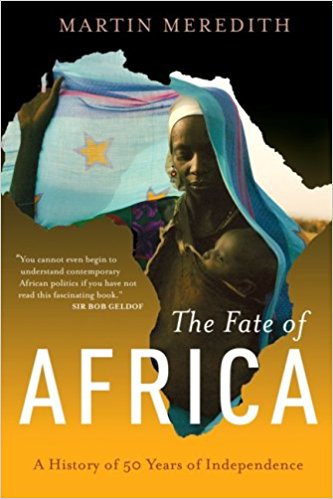
The Fate of Africa: From the Hopes of Freedom to the Heart of Despair
By Martin Meredith
Public Affairs Press, 2005
752 pp., $35.00

At close to 800 pages, The Fate of Africa is a huge book about a huge subject: the history of Africa since independence. Martin Meredith, who worked for years as a journalist on the continent and who has written eight other books about Africa, carries off this nearly impossible task with just the right combination of style and scholarship. At the same time, he sugarcoats nothing and spares no one. As any honest contemporary history of the continent must be, this is largely a story of greed, corruption, oppression and massacre. There may be no better and more up-to-date single-volume account. The Fate of Africa covers North Africa as well, but this review will concentrate on the continent south of the Sahara. Although Mr. Meredith draws few broad conclusions, he offers a wealth of evidence for anyone who wishes to.
Untouched by Europe

As Mr. Meredith explains, even though in some cases colonization had lasted 200 years, most blacks were essentially untouched by Europe. The French ran their West African empire with only 385 white administrators, and the British were famous for equally thin-stretched, indirect rule. At the end of the Second World War, only the British even thought in terms of eventual independence for these untutored lands, and did not foresee it until the end of the 20th century. It was pressure from the United States, post-war exhaustion, and militant independence movements that forced a pace no one anticipated in 1945.

Whatever the timetable, because it was West Africa that had been in closest contact with Europe, it was thought best prepared for self-government. By 1920, for example, the Gold Coast (future Ghana) had 60 practicing black lawyers, whereas Kenya did not get its first lawyer until 1956. The first black deputy to the French National Assembly came from Senegal in West Africa in 1914. Leopold Senghor, another deputy from Senegal, helped draft France’s Fourth Republic constitution in 1945. His French was so good he was in charge of policing the constitution’s grammar.

Independence consequently did come first in West Africa, with Kwame Nkrumah as leader of Ghana. Nkrumah’s career set so many patterns for the new Africa that it is worth following in some detail. What began with great promise ended in tears, in a cycle so often repeated that Mr. Meredith has adopted it as the subtitle of his book.

Nkrumah had one of the most sudden rises to power of any politician in history—from prisoner to prime minister in a single day. Held in a Gold Coast prison for stirring up anti-British riots, his party managed to win 34 of 38 contested seats in a 1951 election. The British governor, Charles Arden-Clark, stiffened his upper lip, summoned his prisoner, and asked him to form a government.

Ghana went on to six years of democratic self-government under the close supervision of Arden-Clark. It seemed to be perfect training for sovereignty for the perfect candidate for independence. Ghana had a sound educational and economic infrastructure built by the British, excellent natural resources, and healthy foreign currency reserves due to cocoa exports. The Cold War was raging, and both the United States and the Soviet Union were eager for new clients. Mr. Meredith writes that when independence came in 1957, there was world-wide hope and optimism on a scale now difficult to imagine. The six-day gala was a love-feast of goodwill and high expectations.

Once the British were gone, Nkrumah stamped out the opposition, built up a personality cult, squandered money on gold-plated projects, and ran the economy into the ground. He built the largest dry dock in Africa, which was almost never used. He set up a national airline and insisted it fly to politically fashionable places like Cairo and Moscow for which there was no commercial demand. He set up state-run corporations and state farms that only spread failure and corruption. He made it a crime for anyone to “show disrespect to the person and dignity of the Head of State.” Foreign businessmen learned that anyone with a glib tongue and a bright idea—the more grandiose the better—could get a fat government contract. The head of state himself signed deals.

Nkrumah had ambitions for the entire continent. In 1958 he hosted an All-African People’s Conference to promote anti-colonial agitation. Among his guests were many who later became heads of state: Julius Nyerere (Tanzania), Kenneth Kaunda (Zambia), Hastings Banda (Malawi), Patrice Lumumba (Congo), Amilcar Cabral (Guinea Bissau—assassinated shortly before independence), Holden Roberto (Angola), and Joshua Nkomo (never quite made it to the top in Zimbabwe). Nkrumah is still something of a saint for many Africans and American blacks because of his militant anti-imperialism. He dreamed of an Africa as mighty as the United States, and squandered millions on a huge complex of buildings he hoped would become the capital of a continent united under his leadership.

Nkrumah’s follies had predictable results. By 1965, just eight years after independence, what had been one of Africa’s most prosperous countries was bankrupt. Increasingly deluded and anti-white, Nkrumah blamed every failure on imperialists and neo-colonialists. He might have gone on wrecking Ghana had he not tried to clip the wings of the army. In 1966, while he was junketing in Peking, the generals took over and told him not to come home. School children who had been taught to chant “Nkrumah is our messiah,” now chanted “Nkrumah is not our messiah.”

The cashiered messiah found refuge in a clapped-out house in Guinea Conakry, where he received ever-dwindling bands of admirers, and spent his days drawing up impossible plans for Ghana. He was convinced that a popular movement would rise up to bring him back to power. By the time of his death in a Bucharest hospital in 1972, he was a pathetic figure.

In many respects, therefore, Nkrumah set the pattern for the continent: dictatorship, corruption, mismanagement, quirks bordering on madness, and involuntary departure from office. In particular, his example of one-man rule caught on almost everywhere. A few dictators explained that nation-building required unity of purpose, but most simply siezed power without explanation or apology. When someone once asked Habib Bourghiba of Tunisia what kind of political system his country had, he relied, “System? What system? I am the system.” Hastings Banda of Malawi once observed, “Everything is my business. Everything.” He also said, “Anything I say is law. Literally law.” In 1965 he went further: “If, to maintain the political stability and efficient administration, I have to detain ten thousand or one hundred thousand, I will do it.” Julius Nyerere of Tanzania, whose attempt at African socialism will be examined later, explained that political parties arose in the West because there were economic classes. In Africa, there were no classes, so only one party was necessary: his.

Nkrumah was also typical of a surprising number of independence rulers who had been jailed or banished by the white authorities before taking power: Kenneth Kaunda of Zambia, Jomo Kenyatta of Kenya, Robert Mugabe of Zimbabwe, Bourghiba of Tunisia, Banda of Malawi, Mohammed V of Morocco, and Patrice Lumumba of Congo (convicted of embezzlement, not independence activity).

Also, like virtually the entire first-generation of independence leaders, Nkrumah had lived and studied in Europe or the United States. Men who went abroad were undoubtedly a better sort to begin with, and some experience of the West probably tempered their excesses, at least at first. In the next generation, semi-savages like Idi Amin (Uganda), Samuel Doe (Liberia), and Jean-Bedel Bokassa (Central African Republic) would shoot their way into presidential palaces, and go on to ever-more gruesome antics.

Unlike most African rulers, however, Nkrumah did not surround himself with toadies and mistresses, and seems to have been lonely and isolated. He decided, apparently on a whim, to marry, and asked Gamel Nasser of Egypt to find him a wife. Nasser did: an Egyptian girl who spoke only Arabic and a bit of French; Nkrumah understood neither language. He married her the same day he met her, and she gave him three children but little companionship. The only real friend Nkrumah seems to have had in power was a British woman, Erica Powell, whom he met when she was Governor Arden-Clark’s private secretary. He hired her away, with the governor’s blessing, and always said she was the only person who gave him unbiased advice.

Nkrumah’s interest in a European woman did not lead to marriage, but for many rulers it did. Kenyatta, Bourghiba, and Banda had white wives, as did Leopold Senghor of Senegal and Seretse Khama of Botswana. Jean-Bedel Bokassa, who crowned himself “emperor,” had 17 wives, including a blonde Rumanian cabaret dancer, a German, and a Swede. (He kept wives in separate houses and left his office several times a day to call on them.)

Finally, Nkrumah differed from other African rulers in another important way: He does not appear to have looted the treasury. He enjoyed the privileges of office—his secretary Powell wrote that he was “a-gog with excitement” at the prospect of meeting the Queen of England—but his own greatness was to come not from bank accounts but from a spectacular new Ghana.

All things considered, by African standards, Ghana’s transition to independence was a great success. Elsewhere, there were failures, some so spectacular the West could not ignore the mess. Mr. Meredith’s account of the Congo’s almost immediate implosion is worth summarizing.

The Belgians have long been derided for failing to prepare the Congo for self-rule, and there is some truth to the accusation. In 1960, the country had only 30 university graduates and no black doctors, secondary school teachers, or army officers. However, the Belgians had built good basic infrastructure, and a broad base of elementary schools. They simply had not foreseen independence, but did not try to thwart it when times changed. After riots in 1959, they proposed a four-year transition to self-government. It was the Congolese who insisted on a quick handover.

Mr. Meredith points out that the independence ceremony of June 30, 1960 set the initial jarring note. King Baudouin of Belgium praised the early colonizing work of his great uncle, Leopold II—whose exactions were so ruthless that the Belgian government took over in 1908 what had been his private preserve—and talked down to the Congolese: “It is up to you now, gentlemen, to show that you are worthy of our confidence.” Patrice Lumumba, prime minister to be, replied with a rant against “exploitation,” “terrible suffering,” and “humiliating slavery that was imposed on us by force.” “We are no longer your monkeys,” he added.

Just a few days later, black soldiers revolted against their white officers, and went on a rampage, beating and raping whites, singling out priests and nuns for particular abuse. Thousands of whites fled the country—setting a model for what was to happen with dreary regularity elsewhere. The Belgians asked Lumumba for permission to use force to save whites. When Lumumba refused, Belgium acted unilaterally. The southwest province of Katanga seceded. The Congo was just two weeks old and already in chaos.

Lumumba called on the UN for help, which arrived in July, but what he most wanted UN soldiers to do was kick out the Belgians. He gave the UN two days; otherwise he would turn to the Soviets. Ralph Bunche, the black American head of the UN mission described Lumumba as “crazy” and acting “like a child.”

Later that month, Lumumba visited the United States. Under-Secretary of state Douglas Dillon thought him “an irrational, almost psychotic personality.” Lumumba telephoned the Congo desk at the State Department and asked for a blonde companion. The CIA found someone to send over, but the White House quashed the tryst.

Belgian troops eventually left the Congo after they had evacuated whites, but Lumumba then insisted that the UN put down the Katanga rebellion. When another province, South Kasai, went into revolt, Lumumba really did call in the Soviets, who sent technical assistance. His attempt to put down the Kasai rebellion resulted in massacre and produced 250,000 refugees. By now, both Belgium and the US were convinced Lumumba was a menace, and both governments wanted him assassinated.

President of the Congo, Joseph Kasa-Vubu, dismissed Lumumba, who in turn dismissed Kasa-Vubu. In September, Joseph Mobutu, chief of staff of the army, ousted all politicians in a military coup. Lumumba stayed on in the prime minister’s residence in Leopoldville, guarded by an inner ring of UN troops to keep Mobutu’s men from arresting him. An outer ring of Mobutu’s soldiers made sure he did not escape. In pouring rain on the night of Nov. 27, Lumumba slipped out and headed for Stanleyville, where he had support, expecting to form a rival government. He might have reached Stanleyville, except that he kept stopping to harangue villagers. Mobutu’s men caught him and brought him back to Leopoldville, and his supporters in Stanleyville set up a government without him. That made a total of four competing governments, along with Mobutu’s, and secessionist regimes in Katanga and South Kasai.

Mobutu had Lumumba hauled before him and spat in his face. With the approval of the Belgians, he flew him off to the leader of the Katanga revolt, Moise Tshombe, who was certain to kill him. Tshombe helped torture him for hours, returning home, according to his butler, “covered in blood.” The next day, Belgian officers commanded a firing squad that executed Lumumba. The Belgians began to worry about bad press, and concocted the story that Lumumba escaped from detention and was killed by “patriotic” villagers. To cover their tracks, they cut up Lumumba’s body and dissolved it in sulfuric acid. Still, word of his murder prompted anti-Belgian demonstrations all over the world. To this day, Lumumba is a hero to nutty leftists because he called in the Soviets, and to nutty blacks because he was rude to white people.

The UN eventually put down the Katanga rebellion in 1963, and by the time Joseph Mobutu consolidated power in 1965, he could almost be seen as the savior of his country.

Far less well known is the independence disaster of the tiny country of Equatorial Guinea, which was a Spanish colony until 1968. The Spanish had groomed Francisco Macias Nguema to be leader, but like so many whites, had no idea how much he hated them. One of his first acts was to stir up anti-white violence, and most of the country’s 7,000 Spaniards left their businesses and farms and were gone in the first six months.

Nguema was a real monster. When a director of statistics published figures that displeased him, Nguema had him cut into little pieces to “help him learn to count.” On at least two occasions, he ordered the killing of all known former lovers of a mistress. Whenever he wanted a new woman, he had her husband killed. Of his 12 original ministers, only two escaped murder.

Nguema ran out of money and started paying only soldiers and the police. Every other part of the government shut down. Nguema closed all libraries, newspapers, and printing presses, and in 1974 emptied the country’s last school. He outlawed Christianity and turned churches into warehouses. To raise money, he started holding foreigners for ransom: $57,600 for a German woman, $40,000 for a Spaniard, $6,000 for a dead Soviet. He held hostage the last Claretine missionary, age 85, until he got a ransom. Nguema carried on for 11 years until a nephew deposed him in a 1979 coup. When it came time to execute Nguema, blacks were so afraid of his rumored supernatural powers they refused to pull the trigger. Moroccan soldiers had to be found for the firing squad.

The new man, Teodoro Obiang, is still in power, and the country still has no newspapers. A recent statement from an aide hints at the flavor of his regime: “He can decide to kill without anyone calling him to account and without going to hell because it is God himself, with whom he is in permanent contact, who gives him this strength.”

A few African leaders have sincerely tried to help their people. A curious and genuinely tragic figure, Julius Nyerere of Tanzania stole nothing, fought corruption, and worked tirelessly. The trouble was, his schemes were all wrongheaded. With his “Arusha Declaration” of February 1967, he set out to nationalize everything in sight, even private houses that were rented out. He wanted the whole country run on the principle of ujamaa or “familyhood,” which was supposed to capture the ancient spirit of “African socialism.”

His state corporations posted huge losses, but his greatest folly were collective farms, or ujamaa villages. Joining up was supposed to be voluntary, but eventually 11 million people were herded onto collectives in the largest mass movement of people in African history. When farmers fled back to their old fields, government workers burned their houses. Nyerere tolerated no dissent from socialism, and under his rule Tanzania went from being the largest African exporter of food to the largest importer. Always the darling of Western leftists, he got enough foreign aid to keep the country from starving. In 1985, after 23 years of familyhood, he gave up and left office. With a frankness unusual in politicians anywhere, he announced, “I failed. Let’s admit it.”

Nelson Mandela is another exceptional figure. He, too, is among the tiny number who have not enriched themselves, who genuinely tried to better their people, and who sought true racial reconciliation. With his successor, Thabo Mbeki, South Africans are discovering what black rule is really like. Those who follow are likely to be worse.

The Facts As He Finds Them

Mr. Meredith records the facts as he finds them, and the result is largely a litany of horrors. He gives us full accounts of the complex and sordid events surrounding the Hutu/Tutsi genocide of Rwanda, the wars of extermination in Sudan, the chaos and barbarity of “liberation” in Angola and Mozambique, and the downfall of white regimes in Rhodesia and South Africa.

Still, a few of Mr. Meredith’s observations stand out: In Kenya, a popular saying is “Why hire a lawyer when you can buy a judge?” Omar Bongo of Gabon, who ran the country for 22 years and had a penchant for trying to seduce American Peace Corps volunteers, spent no less than $500 million on his presidential palace. Nigeria spent $8 billion on a steel industry that never produced steel. During the civil war in Chad in 1982, mobs sacked and burned both the national museum and the national archives. President Siaka Stevens of Sierra Leone once spent two thirds of the country’s annual budget to host a meeting of the OAU. When AIDS was discovered, Africans widely derided preventive measures as a racist plot to keep them from reproducing. In 1973, Juvenal Habyarimana of Rwanda forced everyone, even babies, to join his political party. And how is this, asks Mr. Meredith, for an absurdity: In the late 1980s, Cuban troops were protecting American-owned oil fields in Marxist Angola from attacks by US-supported guerillas.

Here are more vignettes from The Fate of Africa:

Abeid Karume became ruler of Zanzibar in 1964 before the merger with Tanganyika that produced Tanzania. One of his first acts was to supervise the slaughter and expulsion of Arabs and Asians. Somewhat more unusually, he stopped all anti-malaria measures, claiming Africans were “malaria-proof.” There was a huge upsurge in malaria. An army officer shot Karume to death in 1972, not for political reasons but over a personal grudge.

In 1984, Haile Mariam Mengistu of Ethiopia spent $150 million on the 10th anniversary of his Marxist-Leninist “revolution” rather than do anything about a terrible famine ravaging his country. As he explained to an aide, “There was famine in Ethiopia for years before we took power—it is the way nature kept the balance.”

Liberia has had a particularly colorful history, but a few episodes stand out. Thomas Quiwonkpa led a revolt against tyrant Samuel Doe in 1985. When Doe’s men caught and killed him they publicly castrated him, cut him in pieces and ate him. Five years later, it was Doe’s turn. Prince Johnson ate at least one of his ears while he was still alive. After suitably torturing him, Johnson’s men paraded Doe’s mutilated body through the streets of Monrovia in a wheelbarrow. Doe had been a guest of Ronald Reagan at the White House in 1982.

In 1996, one of the groups fighting in the streets of Monrovia earned the nickname the Butt Naked Brigade, from its belief that fighting naked gave protection from bullets. In 1997, when Liberia held elections of a sort, warlord Charles Taylor announced there would be killing if he lost. He campaigned on the slogan “He killed my ma, he killed my pa, but I will vote for him”—and won.

Nigeria, with its oil revenue, should be one of the richest countries on the continent, but hundreds of billions of dollars have disappeared. In 2000 and 2001 in the eastern part of the country, crime was so bad and the police so corrupt that vigilantes took charge. A group known as the Bakassi Boys liked to herd criminals into a public square, where huge crowds watched while they hacked away with blunt machetes. If some of the condemned men were still alive, writhing on the ground, the boys would finish them off by tossing gasoline-doused tires on them and setting them on fire. Street crime disappeared, and the Bakassi Boys were hugely popular.

Mr. Meredith tells us that even the fabled revolutionary Ernesto “Che” Guevara had an African mishap. In 1965, he went to north Katanga in the Congo to test his “detonator theory” that revolution could be kicked up with a little violence. It was a complete failure. He was supposed to be helping Laurent Kabila (who was still knocking about 30 years later and had a brief stint as Mobutu’s successor) but Guevara found him “addicted to drink and women.” “The basic feature of the People’s Liberation Army,” he wrote later, “was that it was a parasite army; it did not work, did not train, did not fight, and demanded provisions and labor from the population, sometimes with extreme harshness.” It was worthless as a fighting force: “Often it was the officers who took the lead in running away,” he wrote. Guevara gave up in disgust after seven months.

The French, who had been in Africa for a long time, seem to have understood that European forms of government are not natural to the continent. They kept bases and soldiers in Africa, and used them frequently to keep order. As one spokesman explained, it just wouldn’t do “for a few men carrying machine guns to be left free to seize a presidential palace at any time.”

Even with Europeans around to spoil the fun, African politics have been a gaudy business. By the end of the 1980s, of the 150 heads of state the continent had boasted, only six had left office voluntarily, three of these after more than 20 years in power. Not one had been voted out of office. That did not come until after the Cold War, when the US and the Soviets stopped propping up thugs for ideological reasons. Western donors began to pressure the Big Men to hold multi-party elections, and in 1991 Benin became the first country to see a ruler voted out. Democratic change hardly caught on. By 2000 only three others had been voted out.

When pressured to produce “democracy,” Africans showed considerable resourcefulness. In 1989, General Babangida of Nigeria set up two parties. His government wrote their constitutions, gave them their emblems, and most of their cash. One was to be, in the general’s words, “a little to the left” and the other was to be “a little to the right.” Three years later he got tired of them, and abolished both. Sani Abacha, also Nigerian, did even better. In the mid-1990s, under yet more pressure to democratize, he set up five political parties. Each duly chose him as its candidate for president.

The idea of elections makes no sense to the average African ruler. The whole purpose of government is to make him rich and powerful. An election, of all things, is the stupidest reason to step down. For the huge majority of Africans, political activity is therefore palace politics; the closer you are to the Big Man, the better your chances for patronage, kickbacks, payoffs, and outright theft. Mr. Meredith writes that almost without exception, government jobs mean legalized theft. Public service is an empty concept on a continent of what he calls “vampire governments,” where nepotism and corruption are as natural as breathing.

Like all experts on Africa, Mr. Meredith notes that Botswana is the great exception. Independent in 1966 under Seretse Khama, it has little corruption and regularly-contested elections. Diamonds supply half of all government income, but the Big Men have kept hands off. By the end of the 1980s, careful use of diamond income had given the country a per capita GDP that hardly sounds like black Africa: $1,700. Like other experts, Mr. Meredith ventures no explanation as to how Botswana does it.

Elsewhere, the picture is bleak. Since independence, the continent has swallowed more than $300 billion in Western aid with, as Mr. Meredith puts it, “little discernable result.” Corruption eats up an estimated one quarter of the continent’s gross domestic product. Although sub-Saharan Africa has ten percent of the world population, it has 70 percent of the AIDS cases, and accounts for only 1.3 percent of world GDP. By the end of the 1980s, per capita GDP was lower than in 1960, when many countries became independent.

Mr. Meredith generally refrains from drawing larger conclusions, but does note near the end of the book that “in reality, fifty years after the beginning of the independence era, Africa’s prospects are bleaker than ever before.” At the beginning he writes of “the extent to which African states have suffered so many of the same misfortunes.”

Why the mess? Mr. Meredith does not say. Perhaps the closest he comes is to note that tribalism has been a continuing curse. Ancient enemies sometimes buried the hatchet during the independence struggle but dug it up again once the common enemy was gone. The simplest conclusion is that Africans are simply not like Europeans and cannot build European-style societies.

Another conclusion Mr. Meredith could have drawn but did not is that white relations with post-independence Africa have been naïve and stupid. Interventions have been consistent failures. Whether it is Americans in Somalia or Liberia, the British in Sierra Leone, the French in Rwanda, the Soviets in Ethiopia or Somalia, no one gets what he expected. Even semi-Third-World people like the Cubans, North Koreans (in Zimbabwe) or Chinese (in Tanzania) got nothing for their efforts. When Europeans ruled Africans outright, without illusions that they were dealing with people like themselves, they had modest goals and achieved them. As soon as they started reading cultural anthropology, they lost their bearings.

Mr. Meredith writes that not until 1989 did the World Bank acknowledge that Africa’s problems were not all economic, that there were also leadership problems. Men from 100 years earlier like Lord Lugard or Sir Garnet Wolseley would have been amazed by such stupidity.

Another remarkable aspect of recent African history is how easily one thug after another duped the white man. Both the United States and the Soviet Union funneled enormous sums to people who claimed to be either capitalist or communist but were really just thieves. Samuel Doe was not the only White House or Kremlin guest to end up in a wheelbarrow.

Mengistu of Ethiopia, who let his people starve while he celebrated ten years of “revolution,” also played whites for fools. Once word got out about the famine, whites shipped in tons of food. Mengistu learned that it made no difference what he did with it—sell it on the black market, dole it out to friendly tribes, deny it to starving enemies—it kept coming. Gaafar Numeiri of the Sudan learned the same thing. The famine of 1984 did him a lot of good. White people showed up with boatloads of food he could use as a weapon. Whites fed his people while he bought guns and kept killing his enemies.

Perhaps saddest of all is that time and again—in Congo, Kenya, Zimbabwe, South Africa, the Guineas, Angola—whites who spent their lives in Africa and should have known better, underestimated the hatred of blacks. Whites everywhere think blacks will love them if they treat them kindly. They do not realize that kindness or fairness are not enough; many blacks hate whites because they cannot be like whites. No matter how they are treated, blacks will blame their failures on “racism.”

Some of the whites who fail to understand this end up in piles of bloody corpses. Others get out while they can. Two hundred thousand fled Mozambique, 300,000 left Angola, many thousands fled the Congo, Zimbabwe lost half its population immediately after black rule, and a steady flow of whites is now escaping South Africa. It was 40 years after independence, but thousands of French left the Ivory Coast when blacks started running through the streets shouting “Kill the whites.” There are pockets of friendliness and lulls in the process of dispossession, but once blacks take power, they do not like to live with a minority whose success highlights their own failure.

Despite the rotting bodies and mountains of evidence, despite the chronicle of barbarism Mr. Meredith tells so well, whites have an inexhaustible capacity to deceive themselves about the motives and behavior of Africans. Columnist Mary McGrory was fully exercising this capacity when she wrote in the Washington Post on May 12, 1994 about how wonderful black rule in South Africa was going to be: “[N]ewspaper readers will think they are reading scripture when they read dispatches from South Africa that cannot be read except through tears.” People wrote rubbish almost as bad about Kwame Nkrumah.

Whites will never understand Africa—or the blacks in their own countries—until they cease being capable of writing and publishing such nonsense. The Fate of Africa is an excellent corrective.

Buy this or any other book through this link and help AR.

Original article

(Posted on June 5, 2009)

     Previous story       Next Story       Post a Comment     Send This Page      Search

Comments

1 — Anonymous wrote at 7:19 PM on June 5:

Will Whites ever learn?

NO!

They are even worse now than ever before. At least many decades ago most Whites were against desegregation and miscegenation with blacks and assorted nonwhites. Now they are all for it.

2 — bill wrote at 7:46 PM on June 5:

These same cultural anthropological(Boas) doctrines, when believed, produced the consistently uniform disaster that is Africa, now are taught as truth in most universities. The total acceptance of these doctrines is required for a college degree leading to many jobs. Positions such as personnel, union leaders, teachers, and many Civil Servants must conform to the Boas fallacy. The same mind-set that brought us modern Africa, is now designing the future U.S.

3 — Anonymous wrote at 9:27 PM on June 5:


Yesterday, under the AR news item “Burn Armed Bandits, Says Guinea Crime Chief,” I wrote the following:


2 — Anonymous wrote at 11:15 PM on June 4:

A harsh as it is, this policy proposed by the military govt of Guinea is at least a more REALISTIC answer to a black crime epidemic than the catch-and-release/revolving-door paradigms currently in use by liberal criminal-justice systems here in the West. I’m certain the threat of state-sanctioned burnings by citizens would make the country’s armed-robbery rate drop dramatically.


Today, I read this wonderful reprint of a 2006 book review by Mr. Jared Taylor, and find the following:


“In 2000 and 2001 in the eastern part of [Nigeria], crime was so bad and the police so corrupt that vigilantes took charge. A group known as the Bakassi Boys liked to herd criminals into a public square, where huge crowds watched while they hacked away with blunt machetes. If some of the condemned men were still alive, writhing on the ground, the boys would finish them off by tossing gasoline-doused tires on them and setting them on fire. Street crime disappeared…”


So I was right!

4 — Anonymous wrote at 9:51 PM on June 5:

Look into The Urantia Book to understand why blacks cannot ever sustain a government completely on their own. Of all the races, they could not comprehend the art of governing and what a government means. This inability is genetic which explains the inability to ever change and improve. And their ever constant need to blame their shortcomings on others. The policies of white authorities at taxpayers’ expense do not help with the blacks having to face reality, (the demands of life based on their own wits like everyone else).


5 — Anonymous wrote at 3:47 AM on June 6:

“Whites everywhere think blacks will love them if they treat them kindly. They do not realize that kindness or fairness are not enough; many blacks hate whites because they cannot be like whites.”

“[O]nce blacks take power, they do not like to live with a minority whose success highlights their own failure.”

Must I be blunt? It is sometimes unkind to be blunt, but here goes. How would you feel if you were an unattractive dark woman with kinky, ugly hair and a deep voice and beside you sat a lovely, feminine green-eyed blonde with a sweet voice?

Many blacks are JEALOUS of races with qualities and achievements they wish they had for themselves. They know what beauty and intelligence are. They know they rarely invent anything. They know that when Algebra II is beyond their ability it isn’t because of “racism.”

To hide any shame they feel, they like to concentrate on how hateful white people are. This empowers them, and they like power. Blacks don’t want to accept that maybe black hair with black eyes with black skin is kind of boring looks-wise, or maybe they aren’t able to understand science or philosophy. That is too painful for their proud egos. No, they prefer the feeling of “righteous anger” towards white society. Now they can be a belligerent, permanently aggrieved people fighting a social war against the evil white man. Being “righteously” angry and demanding special consideration from whites is so much more fun than making it on one’s own talent!

Whites are so mean, yet blacks from Africa and Haiti flee their all-black countries to emigrate to majority-white countries. Whites are so evil, yet American blacks move to white neighborhoods because they are safer there than amongst their own people. Blacks are so beautiful, yet rich black athletes and media stars disproportionately date white women rather than their own beautiful “sisters.”

Let’s get real and deal with reality. Blacks are big and tough. They don’t need to babied as though they are delicate fawns. Blacks can create societies by and for blacks that best fulfill them. Whites are good at creating societies that best fulfill whites. Ditto Hispanics, ditto Muslims. People are unique and personality traits cluster among races. We are not all the same!

6 — John Liu wrote at 4:14 AM on June 6:

At least many decades ago most Whites were against desegregation and miscegenation with blacks and assorted nonwhites. Now they are all for it.

Not really. What about Pocahontas, Japanese war brides, and Madam Butterfly? Not to mention Sally Hemmings, and the youthful indiscretions of Strom Thurmond.

It seems whites are against miscegenation only when it suits them to be (at least suits white men to be).

7 — john wrote at 10:11 AM on June 6:

While this piece by Taylor is instructive, one hardly has to look to Africa for a mega-example of black failure, incapacity, and barbarism.

Any American city with a significant black population provides its own example of invariable black African destructiveness. The simple indisputable fact is that black Africans have no place in advanced Euro-Asian societies, or anyplace else where civilization has advanced beyond the hunter-gatherer level.

8 — Anonymous wrote at 10:37 AM on June 6:

John Liu

Not really? Oh, I beg to differ….where do you get your facts? Or do you believe in the fairy tales you have been indoctrinated with about the past?

The MAINSTREAM Whites did NOT want desegregation or miscegenation and you know it. Whites today are too afraid of being labeled “racists” that they have succumbed to the destruction of their own race. LOOK AROUND! I lived during the time BEFORE desegregation, so don’t try to tell us Whites always did this sort of thing or condoned it, because they did not.

9 — SKIP wrote at 11:02 AM on June 6:

Whites are so mean, yet blacks from Africa and Haiti flee their all-black countries to emigrate to majority-white countries.

They do this because we Whites are so gullible with our WELFARE systems. Blacks from those black countries KNOW that if they get to the U.S. they get FREE STUFF and no longer have to work, AND they get White women….with or WITHOUT permission they get White women.

10 — jewamongyou wrote at 11:22 AM on June 6:

Anonymous at 9:51 speaks of government as if it is supposed to be the embodiment of Human righteousness. As a matter of fact, government is ALWAYS in the business of stealing from some people in order to give to others. It is ALWAYS in the business of dictating to people how to live their lives. It is ALWAYS built on lies and corruption. The only differences, between one government and another, are in degree and pretenses. The government of the U.S. pretends to be “by the People, of the People and for the People” while, in reality, “the People” are slaves to the government - which milks them of whatever it can and micromanages almost every aspect of their lives. In Africa, they may be more blunt about than in America, but the end result is brutalization, impoverishment and slavery for the masses in either case.

11 — Anonymous wrote at 1:09 PM on June 6:

blacks are JEALOUS of races with qualities and achievements they wish they had … They know that when Algebra II is beyond their ability it isn’t because of “racism.”
~~~~~~~~~~~~~

Oh, no, no, no! Goodness gracious! Where did you get such silly ideas? What kind of racisss stuff have you been reading?

The only reason blacks have trouble with Algebra II is because the ghetto schools are so bad and they get the worst teachers, and the stingy white taxpayers refuse to spend more money to give them good books and better gyms and swimming pools and more midnite basketball. That’s the only reason. The whites hoard all the best for themselves. Whites don’t want blacks to learn, it’s that simple. Everybody knows that. If your kid is having trouble with Algebra, it the white man’s fault!

All those kids in the white schools seem to be doing OK. What’s the reason? Obviously there’s some sneaky discrimination going on, it’s built into the system. That’s the only possible answer. Making kids learn silly stuff like Latin and Algebra is one way they do it. The white man has the system rigged.

12 — Dave wrote at 2:26 PM on June 6:

“Like all experts on Africa, Mr. Meredith notes that Botswana is the great exception. … Like other experts, Mr. Meredith ventures no explanation as to how Botswana does it.”

It’s not really “the” great exception — next door Namibia also has a relatively high per capita GDP and has had peaceful transitions of power as well.

Both countries share an unbelievable stock of natural resources (diamonds and uranium!) spread among populations so tiny that there’s simply not the same pressure for land that has fueled tribal conflicts in other African countries. They both also have common histories as part of the South African sphere, and to that extent are linked into the wealth produced in SA just as Mexico has a higher GDP than some of its southern neighbors due to its proximity to the USA.

And racially speaking, Namibia and Botswana both have relatively high proportions of whites, while the black population is more heavily mixed with the pre-Bantu Khoisan peoples than anywhere else in Africa. There are a lot of Indians, too — the head of the Botswana stock exchange appears to be a man of Indian descent.

13 — Anonymous wrote at 2:59 PM on June 6:

“Not really. What about Pocahontas, Japanese war brides, and Madam Butterfly? Not to mention Sally Hemmings, and the youthful indiscretions of Strom Thurmond.”

Men have always been more sexually indiscreet than women. And women with low social status are often more than willing to throw themselves at conquering men. This doesn’t change the fact that white society as a whole looked down and disapproved of miscegenation.

14 — ghw wrote at 4:25 PM on June 6:

“What about Pocahontas, Japanese war brides, and Madam Butterfly? Not to mention Sally Hemmings, and the youthful indiscretions of Strom Thurmond?”
……………………………

Poor examples, John. All of those named above were not “black”. And Sally Hemmings was only something like 1/8 black, I believe (If indeed that rumored liason was true at all, for which there is absolutely no proof to this day).

For most Americans, the common conception of miscegenation automatically means black and white. In the early days of this country, there was a surprising amount of inter-mixing between the Europeans and the native Indians. Especially in the South, the most racially sensitive part of the country. When you read the literature of the time, Indians were not thought of as a distinct race. Blacks were. There was no one-drop rule that applied to Indians, and there were no laws against inter-marriage with them. Many prominent whites had some Indian blood. And many prominent Indians —such as Chief Joseph Brant (Mohawk) and Chief Red Eagle (Creek) — also had white blood. Red Eagle (William Weatherford) had only 1/8 Indian blood! http://en.wikipedia.org/wiki/William_Weatherford Quanah Parker, Comanche chief, who became North America’s richest Indian, had a white mother (Cynthia Ann Parker), captured as a child from her family. http://www.vision.net.au/~pwood/Volume1092.jpg One could go on with many such examples.

At the terrible Fort Mims massacre, in which about 550 people were slaughtered, both sides of the battle were led by mixed bloods. Many of the people in the fort seeking refuge from the Indians were half-bloods; and the second in command, Capt. Dixon Bailey, was himself a half-blood Creek who had been educated in Philadelphia. http://en.wikipedia.org/wiki/Fort_Mims_Massacre His mortal enemies, leading the Creek Indians, were Peter McQueen and William Weatherford, both of them mostly white! What impresses one, reading the details of this history, was that there were no sharp “racial” distinctions between white and Indian. However, blacks were very distinct. Both whites and Indians had black slaves. There was no confusion about who was black. http://www.historycentral.com/1812/FTMIMS.html

As for Strom Thurmond’s youthful indiscretions, I don’t know how dark or African-featured his paramour was, but I think you’ve already given the answer. The word “youthful” would explain it. Many of us have done foolish things in our impetuous youth that we would not consider when we became older and wiser. Just because something happened does not mean it was socially approved.
…………………………….

The first recorded interracial marriage in North American history took place between John Rolfe and Pocahontas in 1614. By the time of the Revolution, somewhere between 60,000 and 120,000 people of “mixed” heritage resided in the colonies. During his presidency, Thomas Jefferson begged Americans to consider “let[ting] our settlements and [Indians’] meet and blend together, to intermix, and become one people”. American patriot Patrick Henry even proposed that intermarriage between whites and Indians be encouraged through the use of tax incentives and cash stipends. ….

[As for blacks,]To be sure, even most abolitionist reformers were opposed to interracial mixing. Abhorring both slavery and African-Americans, many wanted freed slaves removed to Canada, to a separate territory in the vast West, or, ideally, to Africa.

For white Protestants, who dominated politics, business, and cultural affairs in the mid-nineteenth century, America was a redeemer nation chosen by God to reform the entire world. This sense of mission was as old as the first Puritan settlers….. In this godly mission, there was no room for cultural or racial mixing with lesser stocks. Sanctioned by science and medicine, endorsed by powerful politicians, and fortified by popular culture, the hostility to racial intermingling had eclipsed the ideal of a mestizo America as the United States began to unravel over the issue of slavery.
http://thestudyofracialism.org/about4694.html

The One-Drop Rule: This notion of invisible/intangible membership in a racial group has seldom been applied to people of Native American ancestry. The concept has been chiefly applied to those of black African ancestry. …The “Pocahontas exception” existed because many influential Virginia families claimed descent from the American Indian Pocahontas of the colonial era. To avoid classifying such people as non-white, the Virginia General Assembly declared that a person could be considered white so long as he or she had no more than one-sixteenth Indian “blood”. http://en.wikipedia.org/wiki/One-drop_rule

15 — Alexandra wrote at 7:05 PM on June 6:

@ghw

Interestingly enough, some states had laws against mixing white and black, but not white and Native. Other states had laws against both, from what I understand.

The one-drop rule would make me Native if it applied to Natives, even though it’s been several generations for me. I’m maybe 1/32 Native if that.

16 — SKIP wrote at 7:17 PM on June 6:

The MAINSTREAM Whites did NOT want desegregation or miscegenation and you know it. Whites today are too afraid of being labeled “racists”

This last is especially true of Teachers, Law enforcement types, WHITE public/civil employees and such, since to be perceived or accused of racism is, professional suicide/homicide. It seems to be the blacks always find some way to blame their inherent failures on us Whites.

17 — GetBackJack wrote at 9:56 PM on June 6:

6 — John Liu wrote at 4:14 AM on June 6:

If you’re trying to insinuate that Thomas Jefferson impregnated Sally Hemmings, you’re dead wrong. It has never, ever proven with certainty, let alone absolute certainty. The Liberals love to tell that story to further degenerate a great white man.

18 — Anonymous wrote at 10:25 PM on June 6:

[quote] “At the start of the Creek Civil War, settlers north of Mobile, particularly mixed-blood Creeks from the lower towns, began to take refuge with the American settlers in the stockades of Fort Mims …………
…The warriors forced their way into the inner enclosure and, despite the attempts of William Weatherford [Chief Red Eagle], massacred most of the mixed-blood Creeks and white settlers. 500 people were dead, and 250 scalps had been taken. Most of the African Americans were spared, to become slaves of the Red Sticks”
…………………………………..

It’s worth mentioning further that those blacks taken as Indian slaves did not survive for very long. At the ensuing Battle of Horseshoe Bend, half a year later, they were used by the Indians [Red Sticks] as human shields and were all killed.

It is a fascinating story to read in detail and, as with its blurred racial lines, gets very complicated.
http://www.canerossi.us/ftmims/massacre.htm
.

19 — Anonymous wrote at 10:25 PM on June 6:

Conservatives sometimes say Africa needs to pull it’s own weight. Competence should be rewarded. They need to get tough and be realistic over there. Africa is an absolute disaster right now. Wars are being fought across the whole continent. Underestimate them at your own peril.

20 — John Liu wrote at 1:59 AM on June 7:

During his presidency, Thomas Jefferson begged Americans to consider “let[ting] our settlements and [Indians’] meet and blend together, to intermix, and become one people”. American patriot Patrick Henry even proposed that intermarriage between whites and Indians be encouraged through the use of tax incentives and cash stipends.

Obviously the ‘genocide’ through miscegenation WN continuously rail against has a historical precedent - one practiced by their own ancestors against the Indians. Again the deep hypocrisy of WN’s is exposed.

As for Strom Thurmond’s youthful indiscretions, I don’t know how dark or African-featured his paramour was, but I think you’ve already given the answer.

Come on GHW, I’m sure sexual encounters between master and slave, or master and servant, were hardly rare - and probably not that shameful a matter - especially among the good ol’ boys.

As for how dar his paramour was, I would guess, looking at pictures of her daughter, that she was quite dark.
http://tinyurl.com/o4wnlk

The MAINSTREAM Whites did NOT want desegregation or miscegenation and you know it.

GHW in his post of above has proven you wrong. He has also proven that whites are not against miscegenation per se, but rather they want it on their own terms.

21 — Anonymous wrote at 5:18 AM on June 7:

Re. Sally Hemmings — “The Liberals love to tell that story to further degenerate a great white man.”

… and to further advance their “agenda” and make it look perfectly ordinary and acceptable (after all, Thomas Jefferson did it!)

22 — Anonymous wrote at 11:18 AM on June 7:

Okay, gotta vent: I was at a late night party here in NYC and all was going very well until some blacks started to throw 40’s off the roof onto cars, and subsequently mugged a white guy. Who then called the cops. Party over.
Cops come and everyone was harassing the cops for shutting down the party! But really the cops were responding to a guy getting mugged and beaten!
All these African-Americans were hanging out on the sidelines and I just knew something would happen. Luckily it didn’t happen to me since I, as well as you, know the nature
Avoid them.
And at parties, stick with your own sorrowfully misguided liberal white friends. Don’t slink into the dark.

23 — ghw wrote at 3:07 PM on June 7:

The MAINSTREAM Whites did NOT want desegregation or miscegenation and you know it.

GHW in his post of above has proven you wrong. He has also proven that whites are not against miscegenation per se, but rather they want it on their own terms.
…………………………………..
That was NOT my point at all. It was that American whites did not necessarily see intermarriage with Indians as “race”-mixing, since they did not see Indians as a distinct race that was very different from their own. With blacks it was another story. And still is. To the American mind, miscegenation meant black&white — not Madame Butterfly.

Anyway, Madame Butterfly was only a fictional character from an Italian opera. Pocahontas, while starting as a real person, has been highly mythologized. And Sally was nothing but a rumor conceived by malicious political rivals seeking to inflict harm.

As for the Strom Thurmond thing: no, it was not uncommon, I agree. Historically, it has always been the case that in feudal societies (which the South was) the aristocrats took advantage of their serfs and servants who were at their complete disposal. It went on for thousands of years, I’m sure in the Orient too. In the American South, those servants were most often black. In Europe the exact same thing would have happened, but there they were white. Ever heard of droit du seigneur? It was a class thing, not a racial thing…. the wealthy master taking advantage of the powerless servant. Unfair yes, but not racial. If she were a white maid, the same thing would have happened.

And who can say that such an encounter was not to her advantage? For a few minutes of indiscretion, he paid hush-money for the rest of his life. Which party gained more in the transaction?

As for getting “miscegenation on their own terms”… don’t you have it on your own terms, John? Or did your wife marry you by force?

Everybody wants life on their own terms. The group with greater power always gets their way. That’s human nature. It’s not a white thing. Don’t make it racial.

24 — john wrote at 3:20 PM on June 7:

Why is Botswanna the exception to the rule of African savagery? I’d bet on ereason is a lack of….diversity. I bet there is one dominant tribe and so no motivation for vicious tribal warfare to get their hands on the money from the oil,diamonds or white mans aid.

25 — Anonymous wrote at 4:25 PM on June 7:

John Liu, the people in frontier 1800s America who endorsed the idea of marriage between American Indians and Whites did so primarily because they thought it would lessen the animosity between the groups. MOST Whites of that time disagreed with the idea of mixing races and preferred to marry their own White people.

History does say that some White trappers and fur traders who lived far from towns married Indians because of a shortage of White women and also to form a bond with the Indian tribes as they traded with them.

Tragically, many White children were abducted by Indians during raids on White settlements. Once these children reached young adulthood they were married to other Indians and their genes mixed in this way.

26 — A Swain wrote at 4:48 PM on June 7:

John Liu,

China

There have been various periods in the history of China where large numbers of Arabs, Persians and Turks from the “Western Regions” (Central Asia and West Asia) migrated to China, beginning with the arrival of Islam during the Tang Dynasty in the 7th century. Due to the majority of these immigrants being male, they often intermarried with local Chinese females. While intermarriage was initially discouraged by the Tang Dynasty, it was later encouraged during the Song Dynasty, which allowed third-generation immigrants with official titles to intermarry with Chinese imperial princesses. Immigration to China increased under the Mongol Empire, when large numbers of West and Central Asians were brought over to help govern Yuan China in the 13th century.[16]

“By the 14th century, the total population of Muslims in China had grown to 4 million.[17] After Mongol rule had been overthrown by the Ming Dynasty in 1368, this led to a violent Chinese backlash against West and Central Asians. In order to contain the violence, the Ming administration instituted a policy where all West and Central Asian males were required to intermarry with native Chinese females, hence assimilating them into the local population. Their descendants are today known as the Hui people.”

So, from the above, we can also deduce that the Chinese Hans also want things on their own terms, but only when it suits them too?

Well, John boy?

27 — Anonymous wrote at 4:48 PM on June 7:

“He has also proven that whites are not against miscegenation per se, but rather they want it on their own terms.”

Some whites are not against miscegenation per se, but many are. We are against it because we want our race to continue through the 21st Century, and it takes two white parents to make a white baby.

28 — Sonny wrote at 5:07 PM on June 7:

The name of the article “Will whites ever learn?” is one I’ve wondered about for a good number of years. Almost ever white I attempt to point out what I think is obvious almost always is met with disbelief, contempt or accusations of racism.
It seems to me that whites have been led to believe all the propaganda espousing the marvels of multicultarism and are convinced that all people are just like the white race only with different color skin.
When you bring up the Department of Justice criminal statistics of black on white crime, it’s summarily dismissed as lies of the government. Then when I showed them documented evidence of how Hispanics criminals are listed as whites in order to raise the white crime rate; they still refuse to acknowledge the blatant anti white discriminaion. I believe there are none so blind as those that refuse to see or acknowledge the truth of what’s happening all around them.
I continually hope that enough white people eventually wake up to the truth before it is too late to reverse these trends.

29 — A Swain wrote at 5:28 PM on June 7:

Having commented on the matter of miscegenation, this thread is not about that subject.

Let’s stay with the subject in hand, shall we??

30 — Anonymous wrote at 5:40 PM on June 7:

I too have never believed the rumor that the great Thomas Jefferson slept with a slave! He is innocent until proven guilty, and no one has proven a thing. Are there any stray love letters? Eye-witness accounts from impartial, believable people? No?

The more likely explanation is that some wild, liberal relative of Thomas Jefferson had an affair with the slave Sally Hemmmings and impregnated her. This then caused the Jefferson family DNA to appear today in Sally Hemmings’ descendants. Since that is the most likely explanation, I’m keeping Thomas Jefferson on his tall horse atop his lofty pedestal because he was a refined gentleman, an intellectual, a brave hero of our republic and a genius.

Nobody is perfect, and we are all products of the times in which we live. However, Thomas Jefferson was a man of the highest caliber. May he rest in peace.

31 — John Liu wrote at 2:13 AM on June 8:

It was that American whites did not necessarily see intermarriage with Indians as “race”-mixing, since they did not see Indians as a distinct race that was very different from their own.

Well I assume that most WNs here would beg to disagree. Hispanics, for one, due to mixing, would be an even less distinct race from whites. Don’t see many people here that don’t oppose intermarriage between Hispanics and whites.

Anyway, Madame Butterfly was only a fictional character from an Italian opera. Pocahontas, while starting as a real person, has been highly mythologized.

Hardly the point. The popularity of both stories demonstrate that whites did not have at least a visceral disgust of miscegenation.

With blacks it was another story. And still is. To the American mind, miscegenation meant black&white — not Madame Butterfly.

It is another story because black-white mix is generally black male with white female - whereas the yellow-white mix is mostly white male with yellow female. White guys (as do yellow guys and black guys) don’t want another race encroaching on their potential dating pool. Quite natural. Just admit it.

It was a class thing, not a racial thing…. the wealthy master taking advantage of the powerless servant. Unfair yes, but not racial.

Quite possibly true. But my point was opposition to miscegenation was not across the board in the old days. And there were a few sneaky things going on that lust does in most cases trump some nebulous idea of race preservation.

Everybody wants life on their own terms. The group with greater power always gets their way. That’s human nature. It’s not a white thing. Don’t make it racial.

I beg your pardon. Is not the purpose of this website precisely to make things ‘racial?’

32 — William Cutting wrote at 10:42 AM on June 8:

It is another story because black-white mix is generally black male with white female - whereas the yellow-white mix is mostly white male with yellow female. White guys (as do yellow guys and black guys) don’t want another race encroaching on their potential dating pool. Quite natural. Just admit it.

___________________________________________

Actually mostly in the media. Black male with white female couples tend to be lower class while black female white male relations -which is rapidly becoming more common- are exactly the opposite.

I agree that European men are quite obsessed with Asian females (sex tourism in Thailand, for example) but again, it’s mostly a lower-income thing.

33 — John Liu wrote at 10:58 AM on June 8:

So, from the above, we can also deduce that the Chinese Hans also want things on their own terms, but only when it suits them too?

Possibly. That is arguable. But is not the point.

My point is that past white attitudes towards miscegenation have not always been as clear cut as many posters would have you believe here.

As GHW as already pointed out Jefferson, even if he did not sleep with Hemmings, promoted miscegenation in a way that would appall most WNs today.

Also it is ridiculous that WNs somehow see whites as ‘victims’ in respect of miscegenation. It takes two to tango. Where do you get the idea that it is always non-whites that want to go with whites, and not the other way round?

In the end who one marries is who one falls in love with. Generally, because culture correlates with race (not necessarily a causal relationship), people will marry into their own race. But occassionally this does not happen. No need to get steamed up about this.

Furthermore, humans have evolved with the instinct to pass down their own genes, not the genes of their race. Genetically speaking we are all selfish at the individual level.

That is why you have not a few people who post on Amren who also defend white men with asian women. And that is why even an arch segregationist like Strom Thurmond ended up with a half-black daughter. Biology trumps ideology.

So lets be ‘realists’ about human nature. Miscegenation has been going on right through human history, and is not necessarily a bad thing {hybrid vigor}. My kids are doing fine.

As Steve Sailer has noted:
“In summary, inter-racial marriage, long the object of fear and loathing, may turn out to be one route to enriching the human race.”

http://tinyurl.com/m5svsa

34 — John Liu wrote at 11:02 AM on June 8:

Having commented on the matter of miscegenation, this thread is not about that subject.

Let’s stay with the subject in hand, shall we??

A Swain: in all politeness, you a policeman?

We are all having a cracking conversation. Hopefully that’s what counts. Why stop it?

35 — John Liu wrote at 11:09 AM on June 8:

Oh, one more point if I may (I just have to point this out):

“Immigration to China increased under the Mongol Empire, when large numbers of West and Central Asians were brought over to help govern Yuan China in the 13th century.[16]

“By the 14th century, the total population of Muslims in China had grown to 4 million.[17]”

Isn’t the mantra here only whites allow immigration into ‘white’ countries, that whites are uniquely tolerant and open to other peoples, whereas non-whites are the complete opposite? (ironically I have noticed WN will take credit for whites for this supposed white ‘tolerance’, while condemning the outcomes of this ‘tolerance’ at the same time).

Thanks Mr Swain for your contribution.

36 — Anonymous wrote at 11:24 AM on June 8:

What would John Liu do without AR?

37 — Fight the Racists wrote at 3:49 PM on June 8:

Just like Sonny I have run into whites that are in denial. You say something and they refuse to face reality. I inform them that they are brainwashed and advise them to remember I told them so. They may wake up in the future.
Sometimes I bring up racially motivated atrocities such as the murders of Kevin Shifflet, Melissa McLauchlin and the Yahweh Ben Yahweh murders. The mention of these murders upsets them and they change the subject, but it gets to them.
A common tactic of the racists is to cite one example and claim it “proves” all whites are “guilty.” For example because one white guy married Pocohantas therefore all whites support misgenation. In my experience the people who use this kind of argument have been bigots. Talk to them if you want but be aware they aren’t the least bit interested in rational discourse or the truth, only in attacking whites. R.K.S.

38 — Anonymous wrote at 4:24 PM on June 8:

I lived in Africa, and I remember some of these events. I was a child back in the 1960s, but I remember the feeling of dread and fear very well. Unfortunately, this review is a fair description of the situation there.

39 — Clytemnestra wrote at 11:10 AM on June 9:

“Will Whites ever learn?

NO!

They are even worse now than ever before. At least many decades ago most Whites were against desegregation and miscegenation with blacks and assorted nonwhites. Now they are all for it. “

Correction. Many decades ago, most Whites were publicly against desegregation and miscegenation with blacks and assorted whites. Now they are publicly all for it. Actually, while there is more desegregation at work and schools with blacks and assorted nonwhites, there isn’t as much miscegenation with blacks and assorted nonwhites as black integrationists and the political elite would like. Thus, Eric Holder’s public lament that we (whites) are a “nation of cowards.”

IOW, there is a big disconnect between what we say and what we do. We say we are all for desegregation, but we work to move into lily-white neighborhoods and attend lily-white schools. MLK’s comment that the hour we spend at church on Sunday is still the most segregated hour in America still holds true.

Large pockets of Whites still remain racially aware and have no interest whatsoever in having mulatto babies or grandchildren. No matter what they say to the contrary. Or they may be okay with the idea, but they would prefer if someone else does it.

With the excesses of the blacks taking power and their minority cronies, I suspect more rather than less whites will wake up to their own racial interests in the future and even the small amount of racial mixing we see now is going to come to a screeching halt.

40 — Anonymous wrote at 4:18 PM on June 9:


Inter-racial marriage may enrich the human race? I doesn’t seem to have done much for Latin America.

41 — Anonymous wrote at 6:19 PM on June 9:

A common tactic of the racists is to cite one example and claim it “proves” all whites are “guilty.” For example because one white guy married Pocohantas therefore all whites support misgenation.
—————
There’s been too much talk about Pocahontas here as if marriage to Indian princesses was something common. It was an anomaly.

But an important point to consider is that not only did Pocahontas come very early in the history of contacts with Europeans and Amerindians, when attitudes were not yet formed, but also that she was considered an Indian “princess”. It has always been the case everywhere that exceptions are allowed for royalty. They can do what others can’t.

Marriage to her brought strong political benefits, and peace, for the English settlers in Virginia. Thus, the marriage was beneficial and no one had reason to criticize it. It was a diplomatic marriage, something Europeans had long practiced among royalty to settle disputes between warring countries.

Also, they didn’t yet know quite what to think about Indians. They probably saw them as just another kind of people, a nationality — like Turks or Arabs, not as a specific race. The idea of race itself had not yet clearly formed in 1614. Even by Jefferson’s time, he did not see them as a distinct “race”.
Not so with blacks!

42 — Anonymous wrote at 6:27 PM on June 9:

“Inter-racial marriage may enrich the human race? I doesn’t seem to have done much for Latin America.”


Yes. How can starry-eyed idealists continue to advocate this utopian goal when we already have such glaring examples of its “success” before our eyes? Their ideal produces a nightmare. It’s not as if we don’t know the outcome. Do we want to become another Mexico, Brazil or Peru?

43 — A Swain wrote at 8:44 PM on June 9:

Some white people are not the only ones to take a dim view of miscegenation. This dislike of miscegenation extends right across the whole human sphere not just with the white races.

For example, the Oriental people are not all in favour of it either and there are a number of internet links which reveal they are just as capable as white people of physically and verbally displaying so-called racist attitudes too.

http://www.lostlaowai.com/blog/chinese-culture/chinese-internet-nationalism/

It’s obviously that intermixing genes destroys at least two racial lineages and if it were to reach epidemic proportions, would be the death of the world’s distinct races altogether.

Most will agree that there is nothing diverse about death.

44 — Clytemnestra wrote at 12:09 AM on June 10:

“Will Whites ever learn?

NO!

They are even worse now than ever before. At least many decades ago most Whites were against desegregation and miscegenation with blacks and assorted nonwhites. Now they are all for it. “

Correction. Many decades ago, most Whites were publicly against desegregation and miscegenation with blacks and assorted whites. Now they are publicly all for it. Actually, while there is more desegregation at work and schools with blacks and assorted nonwhites, there isn’t as much miscegenation with blacks and assorted nonwhites as black integrationists and the political elite would like. Thus, Eric Holder’s public lament that we (whites) are a “nation of cowards.”

IOW, there is a big disconnect between what we say and what we do. We say we are all for desegregation, but we work to move into lily-white neighborhoods and attend lily-white schools. MLK’s comment that the hour we spend at church on Sunday is still the most segregated hour in America still holds true.

Large pockets of Whites still remain racially aware and have no interest whatsoever in having mulatto babies or grandchildren. No matter what they say to the contrary. Or they may be okay with the idea, but they would prefer if someone else does it.

With the excesses of the blacks taking power and their minority cronies, I suspect more rather than less whites will wake up to their own racial interests in the future and even the small amount of racial mixing we see now is going to come to a screeching halt.

45 — Anonymous wrote at 4:10 AM on June 12:

One of the most Race conscious people in the world are the Japanese. They have had an almost unbreakable line of genes, than anywhere else in Asia, or the planet for that matter, for almost 2000 years.

There is a Political Party in Japan, today, which has called for the expulsion of Koreans from Japan.

Think about that. Asians wanting to remove other Asians from their Homeland, to ensure its purity. And people complain about the Whites?

Yet, for all this going on in Japan, you never hear much about it, either on the News, or the Internet.

And we never hear any condemnation from the U.N. toward Japan for wanting to secure its own Nation, and Racial purity.

The Double Statndards here are overwhelming.

Wake up White people. Put yourselves first, for a change.


Home      Top      Previous story       Next Story      Send This Page      Search