The Ceuta Invasion: What Happened and Why
Augustin Goland, American Renaissance, August 10, 2026
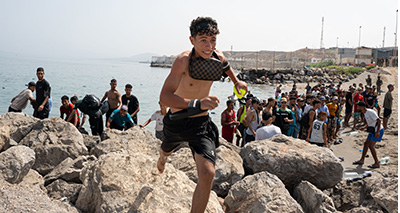
Credit Image: © Mario Moron/JNA via ZUMA Press Wire
Subscribe to future audio versions of AmRen articles here.
They came around the El Tarajal breakwater by the hundreds, then by the thousands: young Moroccan men paddling on identical cheap inflatable rings, dropping their beach toys on the sand of Spain’s North African city of Ceuta and breaking into a run. Behind them, crowds forced the land border. It was July 30, Throne Day, the anniversary of Moroccan King Mohammed VI’s accession. In roughly 24 hours, some 50,000 people entered Ceuta by Madrid’s count — 60,000 by the city’s. Ceuta has 84,000 inhabitants. The enclave’s president Juan Jesús Vivas said that proportionally it was as though 34 million people had walked into Spain in a single day.
Chaos followed. The newcomers looted stores, residents barricaded themselves in homes, the festival of the city’s patroness was canceled. Within hours, the migrant reception center, built for 512 people, held more than 1,700, and UNICEF noted that the roughly 1,200 minors among them could not legally be sent back.
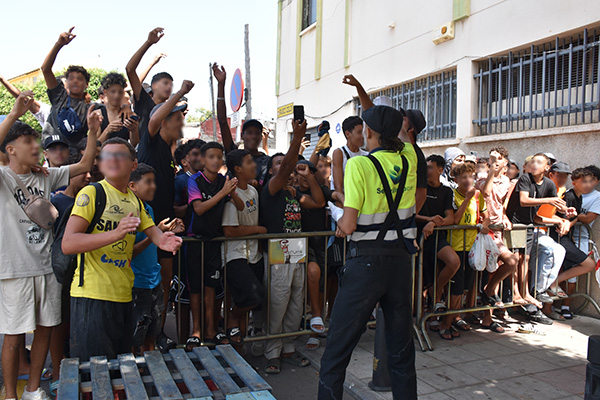
A group of minors wait to be registered at a National Police station on August 10, 2026 in Ceuta. (Credit Image: © Gabriela Sardá Núñez/Contacto via ZUMA Press)
The sea gave up bodies for days: over 80 confirmed dead within a week, with the local press counting close to one hundred — the worst migrant death toll ever recorded in Spain. By the weekend, most intruders had walked back to Morocco, hungry and disillusioned; Madrid celebrated over 48,000 “voluntary returns.” Socialist Prime Minister Pedro Sánchez refused to declare a state of emergency, though every party in Ceuta’s assembly, including his own, demanded it.
Who organizes 60,000 people — and why the identical rubber rings? It seems that nobody handed them out; the young men bought them. Vendors at the local market in Fnideq, two kilometers from the Ceuta border, did a roaring trade beforehand. “When a lot of wetsuits, fins and floats are being sold there, you know waves of entries into Spain are coming,” a National Police chief inspector told a Spanish outlet. The same gear was advertised in Moroccan migrant Facebook groups with 230,000 members, next to maps of the swim, patrol schedules, and assembly points. A wetsuit cost about 55 dollars.
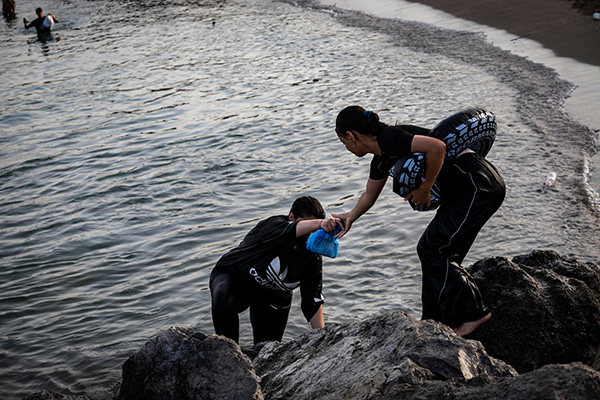
Migrants gather near the Tarajal border crossing in Ceuta, July 31, 2026. (Credit Image: © Samuel Vega/JNA via ZUMA Press Wire)
Two viral messages mobilized the invasion. One was a falsehood: that Spain’s mass amnesty for illegal aliens — which had closed on June 30, and was only for people already living in Spain — could still be applied for until July 30. The other was half true: that a July 8 Spanish Supreme Court ruling meant the border was “open.” The court had barred summary pushbacks of swimmers because, unlike at the land border, there is no physical barrier at sea to breach — while suggesting that barriers on the water would make pushbacks lawful.
The Supreme Court ruling merely upheld two lower-court rulings in a case dating from November 2024, so Mr. Sánchez’s government had well over a year to see this coming, but it installed a 500-meter floating barrier off Tarajal only after the invasion. Moroccan media even claimed the Spanish Guardia Civil itself was distributing rubber rings — a hoax the Guardia formally denied. The human flotilla assembled online, for the price of a pool toy. What did require a state decision came next: for several crucial hours on one of Africa’s most heavily policed borders, the Moroccan gendarmerie stood by “with arms crossed.”
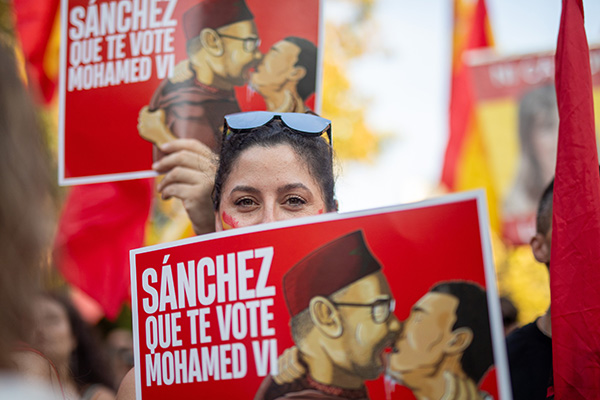
A protester holds up a banner with a caricature of Pedro Sánchez and King Mohammed VI of Morocco during a demonstration in front of the Moroccan embassy in Madrid, August 2, 2026. (Credit Image: © David Canales/SOPA Images via ZUMA Press Wire)
Cities older than Morocco
Morocco claims sovereignty over Ceuta as well as a second Spanish enclave, Melilla, but why does Spain hold these two small cities on the North African coast at all?
Ceuta was founded by Phoenicians and was passed to Carthage, then to Rome, which attached the surrounding province, under Diocletian, to the Diocese of the Spains — part of the Iberian world even then. After the Vandals came Byzantium: Ceuta was the last Byzantine outpost in North Africa when Arab armies took it around 709. The Arabs were not natives of North Africa; they arrived as conquerors in the second half of the seventh century, completing their conquest in the early eighth. The indigenous population was Berbers. It is a quiet irony that the Muslims of Melilla still speak mostly Tamazight, a Berber tongue, not Arabic. They are descendants of the colonized, not the colonizers.
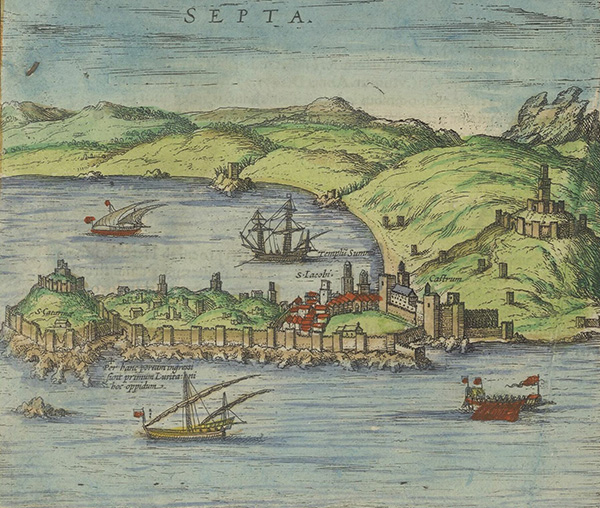
A 1572 depiction of Ceuta. (Credit: Bibliothèque nationale de France, Public domain, via Wikimedia Commons)
Ceuta and Melilla changed hands many times, but Melilla has flown a Spanish flag since 1497. The Alaouite dynasty that reigns in Morocco unified its realm only in 1666, and the country regained its independence as a modern state, after French and Spanish protectorates, only in 1956. Neither city has ever belonged to the Alaouite state that became today’s Morocco. That is why neither appears on the United Nations list of non-self-governing territories awaiting decolonization — Gibraltar does, Ceuta and Melilla do not — and why Morocco’s 1975 bid to have them listed went nowhere. These are European cities, older than the state that covets them, and Muslim-ruled for only part of their history — never by the modern Moroccan state. They are populated by Spanish citizens who vote in Spanish elections. There is no colonial chapter to close here; it is pure expansionism.
The Green March method
Morocco has done this before. On October 16, 1975, the International Court of Justice ruled that Rabat had no sovereignty over Spanish Sahara, a huge Spanish colony south of Morocco. That same evening, King Hassan II announced he would “recover” it anyway, and three weeks later sent 350,000 unarmed civilians across the border waving Korans, soldiers marching discreetly behind. It was called the “Green March.” Spain, with Franco on his deathbed, did nothing. The lesson stuck: Masses of civilians are a battering ram no European democracy knows how to stop.
Even after Spain’s withdrawal, Morocco has been unable fully to control the territory now known as Western Sahara. As soon as the Spanish left, an independence movement called the Polisario Front sprung up to claim it and controls the eastern part. In May 2021, after Spain offended Morocco by discreetly hospitalizing the leader of the Polisario, the Moroccan gendarmerie at the border with Ceuta stepped aside for two days and 10,000 people flooded the enclave. Ten months later, Mr. Sánchez dropped Spain’s neutrality on the Western Sahara question and took Morocco’s side.
This July, the timing was uncanny: the prime minister had visited Algeria, Morocco’s archenemy, on the 20th to discuss gas. The Spanish parliament also took certain measures that irritated Morocco. And so, on Throne Day, the flotilla sailed. El Mundo reported that Rabat meant “to use these young people to remind everyone that it is Morocco that organizes the migration.” The Moroccans conceded that things briefly “got out of hand” but the tap was then closed “calmly, without haste.” The same sources say Morocco “watches and observes for the day it decides to strike the final blow.” Many observers assumed smuggling mafias were behind the invasion, but Spanish police unions dismiss such talk; nobody pays a smuggler for a free swim. This, they say, was an “orchestrated invasion.” Moroccan media dropped the mask: The cost of keeping “Sebta,” as it calls Ceuta, is “unsustainable for Spain,” and the city cannot forever remain “embedded in Moroccan soil.”
Madrid’s response? Italy had argued that Spain irresponsibly let 60,000 unauthorized foreigners into Spanish territory. These people could then freely travel to Italy, so Italy suspended Schengen rules and resumed partial border control with Spain. The Spanish Foreign Minister summoned the Italian ambassador for a dressing down — but made no official protest at all against Morocco.
A blackmailed, corrupt government?
Why is the Sánchez socialist government so meek toward Rabat? One uncomfortable hypothesis is called Pegasus, the powerful Israeli spyware. In May 2021, at the height of the previous Ceuta crisis, the prime minister’s telephone was twice infected, and 2.6 gigabytes of data were exfiltrated; the defense and interior ministers were hit too. The government disclosed the hack only a year later and then fired its intelligence chief. No court has named the culprit — Israel ignored four judicial requests and the case was closed — but the infection used the same operator address as attacks in France attributed to Moroccan intelligence. Further investigations into Pegasus have found that Spain’s own classified assessments concluded the operation’s goal was to force Madrid’s hand on the Western Sahara. Even Mr. Sánchez’s coalition allies wondered in 2022 whether it is “legitimate to think” that the stolen gigabytes “have something to do with the change of position on the Sahara.” Blackmail was never proven.
Mr. Sánchez has governed since 2018 with the radical left party Podemos — party secretary Irene Montero recently called for Spain’s “fascists and racists” to be replaced by immigrants — and survives on the votes of Catalan and Basque separatists who want to dismember Spain. His entourage is collapsing under corruption. His former transport minister and party number three, José Luis Ábalos, was sentenced in June to 24 years in prison for a pandemic kickback scheme; his right-hand man and presumed successor, Santos Cerdán, spent five months in pre-trial detention and remains the prime suspect in a public-works bribery case; the prime minister’s wife has been put on trial for influence peddling and embezzlement; his brother was convicted in July for taking an “unnecessary and meaningless” government job tailor-made for him; Mr. Sánchez’s attorney general was convicted of leaking confidential data about a political opponent. Even former Socialist Prime Minister José Luis Rodríguez Zapatero is under formal investigation in a corruption case. A government this compromised does not pick fights with a neighbor that may hold its secrets.
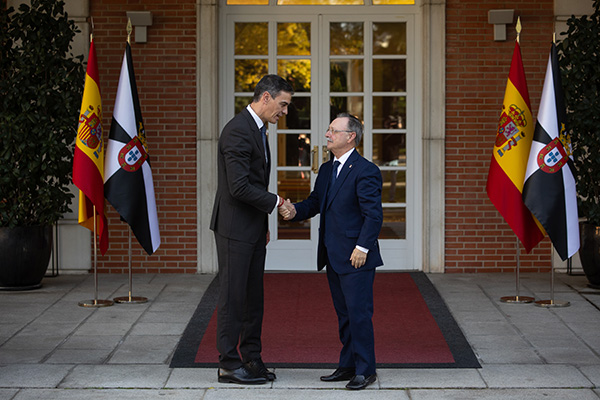
Pedro Sánchez (left), receives the President of Ceuta, Juan Jesús Vivas (right), at La Moncloa Palace, on November 22, 2024, in Madrid. (Credit Image: © Alejandro Martínez Vélez/Contacto via ZUMA Press)
A slow-motion surrender
What has this government done to secure its African cities? It has disarmed them. In 2019–2020 it removed the razor wire from the border fences as a humanitarian gesture. On the day of the assault, Ceuta’s Guardia Civil was some 100 men short; only about 40 guardsmen and 15 policemen stood in the first line, ordered not to intervene. The 3,000-man garrison came out after nine hours, with no power to detain anyone.
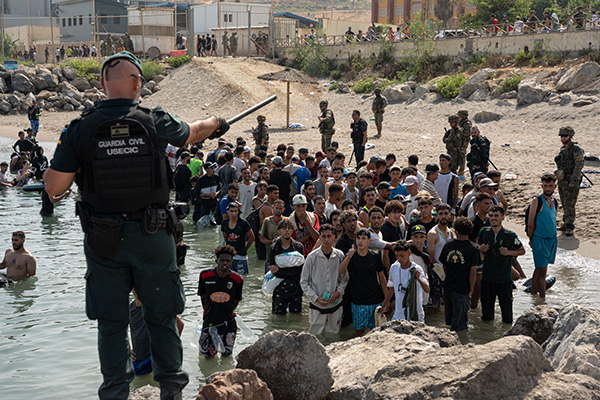
Migrants gather near the border crossing between Morocco and the Spanish enclave of Ceuta on July 31, 2026. (Credit Image: © Mario Moron/JNA via ZUMA Press Wire)
This year, intelligence had reportedly warned of trouble around Throne Day, but reinforcements sent after the Supreme Court ruling amounted to 38 officers and one patrol boat, which broke down. A study by Spain’s Armed Forces Higher School, written a year before the assault, concluded that the “relative military superiority” over Morocco — the cornerstone of Spanish deterrence — is eroding. Since 2002, Rabat has poured some 70 billion dollars into F-16s, Apaches, HIMARS artillery, drones and spy satellites, spending around 4 percent of GDP on its 375,000-man army. Spain, with 122,000 men, long sat at the bottom of the NATO spending table at less than 1.5 percent of GDP. In a crisis over the enclaves, the study warned, allies would probably offer mediation, not soldiers, because NATO’s Article 5 does not even cover the two cities, which Article 6 of the treaty leaves outside the zone of collective defense.
Demography is finishing what neglect began. A July study by the CEU-CEFAS think tank found that 81 percent of boys born in Ceuta in 2020–2024, and about 92 percent in Melilla, bear Arabic names, up from 22 percent in the 1970s. Arabic surnames are now the majority in both cities, and Spanish-born residents have been leaving continuously since 2015, pushed out by Spain’s highest unemployment rate and an ever more Islamic society. Ceuta’s public schools now serve exclusively halal meat. Morocco is taking Spanish territory without firing a shot.
Why the tap is so easy to open
Madrid turns the tap and Morocco makes the water flow. In January the socialist government announced an “extraordinary regularization” (amnesty) of illegal aliens, expected to draw 500,000 to 700,000 people. It drew 1,174,978 applications, and police estimate that 400,000 applicants had never lived in Spain — a formal requirement. Smugglers sold the amnesty as a package tour; police found hundreds of boat migrants carrying counterfeit Spanish utility bills, prepared before departure, to “prove” residence. One ring dismantled in Zaragoza had processed more than 5,000 clients at €600–900 per fake address and up to €10,000 per fake job contract. Traffickers even smuggle migrants out of Britain, promising “100 percent guaranteed work and citizenship” in Spain.
A 2022 “grandchildren law” meant for descendants of Spanish Civil War exiles was stretched to include descendants of all emigrants. This has resulted in 2.6 million citizenship applications, and over 557,000 new passports issued — new voters for the Left. Mr. Sánchez claims that Ceuta is not in the Schengen zone anyway, but his government routinely ferries migrants to the mainland to make room for new arrivals. Every bed freed is refilled.
Rabat has friends; Madrid has none
The geopolitical arithmetic is merciless. Morocco was the first state to recognize American independence, in 1777, and its 1786 treaty with the United States anchors the longest unbroken treaty relationship in American diplomacy. President Trump recognized Moroccan sovereignty over Western Sahara in 2020, in exchange for Rabat’s normalization of relations with Israel. The UN Security Council blessed Morocco’s plan for the Western Sahara in 2025, and on Throne Day this year — as the flotilla set off — Mr. Trump promised Mohammed VI that American technology and innovation would “continue to serve as your partners for the next 250 years.” Morocco named a highway after him. Rabat is Africa’s largest buyer of American weapons, with $8.5 billion in active contracts, and in 2021 it signed Israel’s first-ever defense pact with an Arab state.
Mr. Sánchez has quarreled with allies: He is the only NATO member to refuse the 5-percent defense-spending pledge (Mr. Trump’s response: make Spain “pay twice as much,” and later, “maybe you should throw them out of NATO”). Mr. Sánchez denied U.S. forces Spanish bases and airspace for the war against Iran.
His European partners have had enough, too. On August 1, the leaders of 22 EU countries — France, Portugal, Ireland, and Luxembourg did not sign — warned that amnesties like Spain’s are “pull factors” and that illegal entry must never “turn into legal residence.” When Italy suspended Schengen rules, France tightened controls in the Pyrenees. Even Portugal’s prime minister denounced “policies with a pull effect.” Poland’s Donald Tusk — lately a convert to border realism — said that “if Schengen is to survive,” Spain must copy Poland’s fences and expulsions. Warsaw urges the EU to make illegal entry an automatic bar to any residence rights.
None of this should have surprised Madrid: in March, the Ordo Iuris Institute, a Warsaw-based legal think tank, sent a letter to all 27 EU heads of government warning that the Spanish amnesty would increase migratory pressure across the whole Schengen area and violate the EU treaties’ loyal-cooperation principle. This, in substance, is what the 22 leaders wrote five months later. So, who will help Spain defend Ceuta and Melilla? On present form: nobody.
Not lost yet
There is, however, reason for hope. Spain will have a general election no later than August next year, and the last four regional elections — Extremadura, Aragon, Castile and León, Andalusia — all produced coalition majorities for the center-right Popular Party (PP) with Vox, the sovereigntist, anti-immigration conservatives. National polls give the two around 200 of the 350 seats in the Cortes, with a standalone majority for the PP unlikely. Spain’s next government will probably be a PP–Vox coalition — and with it there will be a very different policy on borders, Rabat, and citizenship-by-decree. France elects a president in spring 2027, and Marine Le Pen’s National Rally has never stood closer to power. In Poland, polls suggest the only workable majority after the next elections is the conservative Law and Justice party together with the more nationalist Confederation.
Europe is not lost yet. But the lesson of Ceuta is that the nations of Europe can count only on themselves — to defend two small cities in Africa today, and large parts of the European continent tomorrow.