Reclaiming American Trucking
Kevin DeAnna, American Renaissance, October 2, 2026
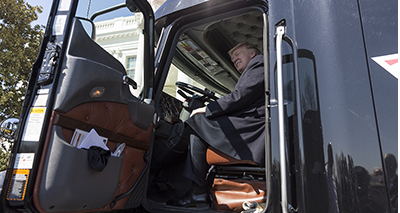
(Official White House photo by Benjamin Applebaum)
Subscribe to future audio versions of AmRen articles here.
In politics, one is allowed to be eccentric on just one issue. (I am eccentric on at least two.) The same might be true when it comes to major policy battles. One can only challenge an established system on one front at a time.
This is something the Trump Administration should remember when it comes to trucking. One of the Administration’s signature (and salutary) efforts is enforcing long-neglected rules to stop foreigners who cannot speak English from working as truckers. However, these efforts are being undermined by the Administration’s foreign policy, which has increased the price of diesel. While foreign drivers are losing their jobs, there are fewer jobs for anyone because trucking companies are going out of business.
Newsweek said at least eight major trucking companies went out of business last month, including Xoco Transport and Globemaster. Though there are other factors in the bankruptcies — notably the companies’ debt structures — the magazine reports “the broader freight sector has also seen a wave of layoffs amid the fuel surge.”
The wars in both Iran and Ukraine have contributed to the surge. The Middle East was the largest producer of diesel until recently, and Russia was third globally. However, strikes by the Houthis against Saudi Arabia have limited some exports, and Ukraine’s recent attacks against Russia brought Moscow’s exports down to just 20 percent of what they were in May. America, the globe’s second-largest producer of diesel, is in some ways ideally suited to meet this challenge, and American refineries are operating at full capacity and exporting huge amounts of diesel to Europe.
However, because of the domestic economic and political situation, the Trump Administration is weighing an export ban on diesel. This could potentially devastate the European and Latin American economies and even raise gasoline prices, defeating any political benefit. One possible salve would be for European countries to tap their own diesel reserves. President Trump is using the threat of an export ban to force Germany and France to do just that, but this would be only a temporary solution. Europeans are also reluctant to draw down reserves in case they need them during the winter. China has also rejected President Trump’s request to send more fuel, cutting off exports instead.
In a recent article, the Wall Street Journal, a publication that has traditionally lobbied for more immigration, pinned much of the blame for increased costs on the Trump Administration’s immigration efforts. “Tens of thousands of immigrants — often the ones most willing to handle the less popular long-haul trucking routes — have lost their certifications,” the Journal said. While the Journal does not seem happy about these efforts, many Americans will be.
The paper said:
The U.S. Transportation Department says it has removed more than 28,000 truck drivers from the road for failing English-proficiency tests since early 2025. It has also pushed states to cancel over 30,000 commercial driving licenses illegally issued to foreign drivers and purged over 8,000 unqualified training schools from the federal motor carrier registry. There are around 3.5 million truck drivers in the country.
The article said J.B. Hunt Transport Services “is making a big push to hire new drivers,” but the effort will be expensive. Still, this is precisely what American drivers want to hear.
It is not, unfortunately, what some in the media want to hear. Few crusading reporters call for fewer restrictions on business. Nonetheless, in a mostly negative story, NBC said that “DHS ramped up its crackdown on truckers in recent months, arresting and detaining foreign-born drivers in sweeps at rest stops and weigh stations.” However, its own reporting reveals the extent of the problem, with the US Bureau of Labor Statistics estimating nearly 20 percent of drivers are foreign-born. This does not stop the story from quoting both an “asylum seeker” who was working as a truck driver and his lawyer trying to stop DHS from enforcing these new rules. NBC suggests removing foreign drivers from the road may even make the roads less safe, because these immigrants were so experienced.
The DC Circuit Court recently heard arguments about whether the Trump Administration can ban 200,000 foreign drivers, with opponents arguing the rule has no basis in safety. Why it is ostensibly up to a court to decide what constitutes safe practices for truck drivers is left unexplained. Some comments in an article from Bloomberg Law may provide the real motivation.
“It’s a nationalist project they’re undertaking to remove foreign nationals from the workforce in the trucking industry,” said Munmeeth Soni, legal director at the Sikh Coalition, whose organization is backing the suit. He further complained that “we’ve frequently been made scapegoats and targets due to our visible articles of faith.” Clearly, and unfortunately, Mr. Soni has assimilated to the dominant anti-white culture. However, Todd Spencer, president of the Owner-Operator Independent Drivers Association, approves of the changes. “For too long, loopholes in this program have allowed unqualified drivers onto our highways, putting professional truckers and the motoring public at risk,” he said.
In the Indian publication ThePrint, Satnam Singh Chahal says that the Trump Administration’s crackdown “could have significant consequences for thousands of Punjabi and Indian-origin truck drivers.” He notes what many observers have missed, that the Administration is trying to alleviate the labor shortage by giving more jobs to Americans. “At the same time the government is removing drivers it considers unqualified; the administration has launched a campaign to recruit more Americans including veterans into the trucking industry,” he says. “On July 30, 2026, President Trump and Transportation Secretary Sean Duffy promoted the Freedom Haulers campaign, aimed at putting more American veterans behind the wheel of big rigs.” He asks whether the Administration is trying to improve highway safety or change the composition of the workforce.
Clearly, some journalists are worried it is the latter. The New York Times highlighted a recent story where a white man stabbed a Sikh truck driver at a rest stop in Wyoming. No motive has yet been identified, making this a local crime story. However, the Times linked it to the Trump Administration’s policies.
The attack occurred amid a surge in hostile rhetoric targeting Indians of Sikh faith. Members of the monotheistic religion, who traditionally wear turbans and maintain beards, have become the face of the Trump administration’s efforts to bar certain immigrants from operating commercial vehicles.
CNN said the case has led “Asian American advocates” to warn about “inflammatory rhetoric about South Asian truckers.” Raja Krishnamoorthi, ostensibly an American congressman, condemned the attack but also linked it to a Trump Administration social media post that told a fictional “Mr. Singh” to “get off our roads.”
The battle is likely to intensify before midterms. Right-wing congressman Brandon Gill, a close ally of JD Vance, introduced “Barron’s Law,” named after eight-year-old Barron Ritchey. Ritchey was killed in a 2023 crash allegedly caused by an illegal alien truck driver. It would force Commercial Driver’s License applicants to prove they can speak English, and that they are American citizens, green card holders, or authorized to work in the United States. However, the bill reportedly has just three co-sponsors. The same Republican Congress that could not bring itself to pass the SAVE Act, despite President Trump’s urging, is unlikely to act on this. Still, for desperate Republicans looking for populist credibility, Rep. Gill’s bill is a great opportunity.
Credit Image: © Mint Images via ZUMA Wire
However, it won’t pass anytime soon. This leaves the Trump Administration’s enforcement efforts unsupported. If the Democrats retake Congress in the midterm elections, they may do what Republicans refuse to do, and pass new legislation about the issue. They could potentially allow foreigners who cannot speak English to obtain CDLs. That may be a fight the Trump Administration welcomes, giving it a chance to rebuild its populist credentials before presumptive nominee JD Vance fights to keep the White House in 2028. Most media outlets seem more concerned about the fate of foreign truck drivers than Americans who need jobs; precisely the framing the White House could use.
Yet the Trump Administration’s efforts in this area have been hurt by the surging transportation costs that have crippled its larger efforts. Surging gasoline and diesel costs, with few solutions, risk hurting the trucking industry as a whole and increasing inflation. This cuts down on the supply of new trucking jobs that otherwise would be available to Americans. Worse, it forces desperate trucking companies to even more enthusiastically pursue short-sighted cost-cutting measures, adopting cheap foreign labor despite the risks to safety and efficiency. What should have been one of the Trump Administration’s greatest triumphs, comparable to shutting down the Southern border, is now just another problem area.
One cannot fight a war on two fronts, and given America’s divided demographics, domestic politics is not “home” but the most important frontline. The President needs to do what he must to bring diesel prices down so he can continue his efforts to reclaim America’s trucking industry for Americans. The midterms may be lost, but a victory here will pay major dividends in 2028 if a path to the middle class is opened for white Americans who have been turned away from good careers for so many years.