Norway: The State vs. the People
Tore Rasmussen, American Renaissance, October 23, 2026

Credit Image: © Nieboer/DDP via ZUMA Press
Official Norway always finds ways to fight white identity. Here is a small but telling example. At a public school in southwestern Norway, parents had discovered a lawful way to put their children in a class that would remain almost entirely white.
Norway has two official written forms of Norwegian, Bokmål and Nynorsk.[1] Municipalities choose the main form used in each public school, but Norwegian law gives pupils the right to a separate class if at least 10 pupils in the same grade request the other written form.
At Fjelltun Primary School in Strand municipality, the choice between the two forms acquired an ethnic meaning. The newspaper Aftenbladet reported that children of immigrants tended to choose Bokmål, which is the choice of most students. The Nynorsk classes therefore were almost entirely for ethnic Norwegians. A choice that was ostensibly about language gave native parents a way to choose the social setting of their children.
Local officials wanted the school to mix the pupils, but the state administrator warned that the municipality had to obey the law. The dispute became a question of whether the legal right to a separate class would survive in practice.
When new pupils enrolled for the next school year, the school made Nynorsk the default choice. Families who wanted Bokmål had to take additional steps to request it. Eighteen families of primarily immigrant background still expressed interest in Bokmål, well beyond the 10 needed to set up a class. This January, Principal Gerd Næss Barka publicly urged parents not to ask for Bokmål instruction. By February, only one pupil had formally done so.
The number had fallen below the legal threshold, so everyone was now taught in Nynorsk. Norwegian parents had tried to use an existing legal choice to secure a class for Norwegians, but they were thwarted. The formal right remained, but the practical opportunity disappeared.
Politicians praise diversity and inclusion, but families often make different choices. Researchers examined the residential moves of more than 20,000 Norwegian-born families in the Oslo region from 1993 to 2017. Forskning.no reports that they generally sought neighbors who were like themselves. Every economic group tried to avoid neighborhoods with large numbers of non-Western immigrants.
The researchers concentrated on income and wealth, and the ethnic finding cuts through the usual claim that residential separation is just a question of money. Rich, middle-class, and poor families showed the same preference.
This can be understood as legitimate preference — a concept developed by Tim Vorgens in his 2025 book Legitimate Preference: Reclaiming the Right to One’s Own. Mr. Vorgens argues that Europeans have a legitimate right to prefer their own people in ordinary life. This includes choices of friends, neighbors, colleagues, schools, communities, and leaders, as well as a duty to preserve a living inheritance for future generations.
Legitimate preference does not require hatred or contempt for outsiders. It begins with the simple recognition that some people stand closer to us than others. Our duties are therefore not equal in all directions.
Parents favor their children. Families pass on their names, property, values, and memories. Nations preserve their language, borders, history, and institutions. These are different expressions of the same principle.
A people that refuses to prefer its own survival will give way to peoples that have no such hesitation, but Western egalitarianism treats the natural wish to live among one’s own people as a moral defect. There is a plain and potentially fatal double standard. Immigrants build communities based on a shared language, faith, culture, and origin, and this is praised as diversity. When native Europeans seek the same continuity, they are condemned.
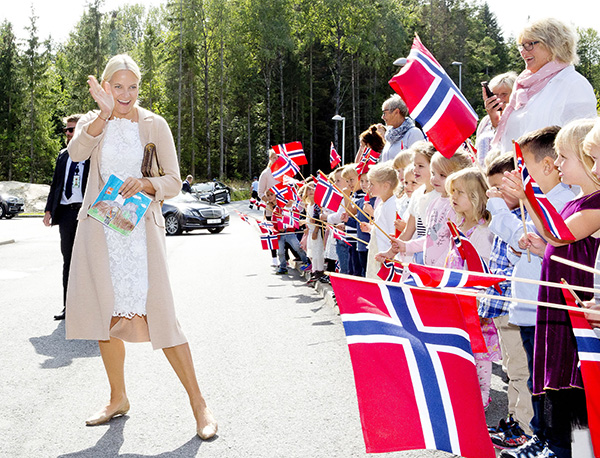
Norway Princess Mette Marit during the visit to the Glemmen Upper Secondary School in Fredrikstad. (Credit Image: © face to face/Action Press via ZUMA Press)
Legitimate preference is practical rather than abstract. The parents at Fjelltun did not issue a political manifesto. They made ordinary choices that would have produced a largely white class. Officials could not accept that result.
A preference does not cease to exist because officials condemn it. It finds another outlet. Some families move. Some pay for private education. Some choose another language group. Others withdraw from public institutions.
This has been visible in Norway for years. In 2012, an Aftenposten article noted that the number of ethnic Norwegians living in Oslo had declined since 2007, and called this “white flight.” Norwegians have also begun leaving public schools when they can afford an alternative. According to Statistics Norway, 32,500 pupils attended private primary or lower-secondary schools last year, an increase of about 50 percent in 10 years.
A recent NRK report on private-school demand found that, for example, Akademiet Lower Secondary School in Drammen accepted 55 new pupils, after getting more than twice as many applications as it had places.
Christian schools report the same demand. Secretary General Audun Raen of the Christian Independent Schools Association said that last year between 1,500 and 2,000 applicants failed to get places. About half of the association’s 150 schools had substantial waiting lists.
Private-school enrollment does not necessarily reveal racial motives. Parents may leave public schools because of poor discipline, violence, low academic standards, or for religious reasons. What the figures show is that many families will leave the public system when they have a real alternative.
Violence and disorder have become serious problems in Norwegian schools. Dagbladet drew attention to new official figures showing the scale of the problem.
Statistics Norway reported that four out of 10 primary and lower-secondary school teachers had been victims of violence, threats, harassment, or bullying at work. Some 28.2 percent of teachers had been victims of violence during the previous 12 months. For more than 11 percent, it was at least once a month. Almost 6 percent suffered physical injury or mental distress as a result.
School teachers reported more violence than nurses, health workers, security guards, military personnel, police officers, firefighters, and ambulance workers.
The problem is particularly acute in Oslo. The city recorded 5,972 incidents involving violence or threats in its primary and lower-secondary schools in 2025. During the first half of 2026, schools registered 4,696 incidents of disruptive conduct. About half of these involved violence or threats. There are only 126 public primary and lower-secondary schools in all of Oslo.
Norway’s public schools were peaceful and successful when they served a cohesive nation. Pupils shared a language, history, and a broad moral culture. Schools reflected that unity; they did not create it. Officials now expect schools to recreate the national unity that immigration has weakened, and when parents resist, the state treats their choices as a threat to integration.
Norwegians have a legitimate interest in remaining the demographic and cultural core of Norway. They also want schools where their children inherit Norwegian language, customs, history, and standards of conduct.
The demand for such schools will grow. Norwegians already choose communities according to ethnic composition. Private-school figures show that more parents are willing to pay to leave the school assigned to them. Fjelltun shows what officials may do when an internal form of exit produces the wrong ethnic result.
The answer should be clear. Norway must end mass immigration, demand assimilation, adopt remigration as public policy, restore order in its schools, permit more private schools, and defend the right of parents to choose.
But laws alone will not be enough. Norwegians must recover the moral confidence to say that Norway belongs to a historic people, and that this people has the right to remain the majority in its own country.
That is the meaning of legitimate preference. It is the right to choose continuity over displacement, order over disorder, and the future of one’s own people over an abstract demand to treat every person and every group as interchangeable.
Officials can change enrollment forms, but they cannot abolish human nature. The preference will return in the next school application, the next house purchase, and the next family that pays to leave the public system. White flight is the judgment of parents who see what is happening and act before politicians admit the problem.
If Norwegian leaders want families to stop voting with their feet, they must stop creating the conditions from which families try to escape. Norwegians should not need official permission to prefer their own neighborhoods, their own schools, their own culture, and their own future.
Other peoples take that right for granted. Norwegians must reclaim it.
[1] Norwegian has two official written standards, Bokmål and Nynorsk, reflecting two different approaches to developing a national written language in the 19th century. Bokmål evolved from Danish, which had been Norway’s written language during centuries of Danish rule. Nynorsk was developed by the linguist Ivar Aasen from Norwegian rural dialects as part of the national cultural revival. The two are mutually intelligible, differing mainly in spelling, grammatical forms, and some vocabulary. Bokmål is used by the great majority, while Nynorsk has its strongest foothold in western Norway.