Commissars of Color
Joseph Kay, American Renaissance, September 25, 2026

Racial diversity is perhaps the most sacred principle on today’s campus. Its benefits are assumed to be self-evident: Black students enrich intellectual life for everyone. Thanks to once-excluded minority students, rich white children can finally know what it’s like to survive in families barely able to afford groceries. Professors learn about the trauma of police brutality. Yes, diversity means lower academic standards, but the added intellectual value for everyone is immense.
Reality is the opposite: Putting blacks on campus virtually destroys intellectual life, at least on anything that touches race. Affirmative-action admittees, all of whom have marinated in grievance culture, are ideological commissars who subvert the university’s mission of finding and disseminating truth. There is more than a superficial resemblance to the political police of authoritarian regimes.
Race-related taboos are the most sensitive of all academic “unspeakables.” There are other “no-go” areas — “demeaning” women, for example — but nothing as dangerous as violating race taboos. Even men asking for sex get some legal protection. For violating racial etiquette, however, there is seldom, if ever, the possibility of a serious defense. The professor who accidentally lets slip even the possibility that black criminality may have a genetic component is instantly and forever guilty.
“Anti-racism” commissars — with their hostility to whites, contempt for Western Civilization, and a medley of ill-formed clichés about their victimhood — easily enforce this agenda. Professors are defenseless, and no professor would respond to student stupidity with the usual tactics of sarcasm or ridicule traditionally reserved for anyone doubting academic authority. Even polite disagreement cannot guarantee safety, so blatant falsehoods go unchallenged.
I knew a very liberal white professor who got into a heated debate with a black student about why blacks in Kenya did poorly in retail businesses. The question was whether black shopkeepers, compared to their Indian competitors, were too generous to friends and relatives. Months later, the department chair got an anonymous letter accusing the professor of “workplace violence.” The professor was eventually relieved of all his teaching responsibilities. He sued, and the incident ended up in federal court without any evidence of “violence.” The professor was forced into retirement and eventually committed suicide. Everyone learned a lesson.
I once gave a lecture on political violence and mentioned the Black Panthers as a violent group. A black girl raised her hand, and insisted that the Panthers were all about providing free breakfasts to hungry kids. I meekly said, “Others disagree,” and quickly moved on to avoid trouble.
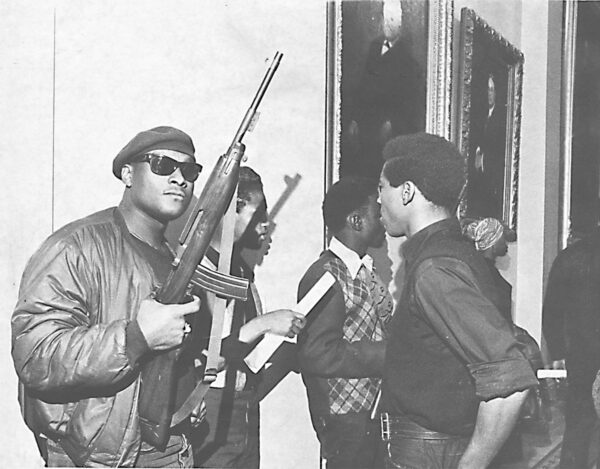
Members of the Black Panthers during the group’s protest at the California Assembly in May 1967 in Sacramento, California. (Credit Image: © Sacramento Bee/TNS via ZUMA Press Wire)
When it comes to knowledge about race, the academy is not a level playing field. It is axiomatic that on all matters touching on race, blacks possess inherently superior knowledge that trumps all evidence. Empirical statistical evidence notwithstanding, the “lived experience” of a black student proves that the police are totally racist. Arguing with this “truth” only makes things worse. Offering conflicting evidence challenges the black student’s very being. No professor would dare suggest that a black making the wildest, inaccurate claims can’t grasp statistical evidence. That would not be honest “intellectual dispute.” It would create a “hostile learning environment,” and black administrators would mobilize to defend the offended student.
Particularly troublesome is how many black students, particularly those who struggle intellectually, easily garble what they hear from whites. A simple “uncontroversial” statement can instantly be misinterpreted into alleged racism. Woe to the white professor who says, for example, that antebellum Southern plantations were generally profitable. This fact easily becomes a defense of slavery and may require a public apology.
Even seemingly neutral terminology can be infused with racism. When the eminent Harvard historian Stephen Thernstrom once said “slave” in a lecture, a black student complained to the administration that “enslaved person” was the correct term. After a long administrative quarrel, Prof. Thernstrom surrendered and decided never to teach the course again.
Reading lists can be “racist,” so no sensible professor would assign The Bell Curve or anything else that would challenge black self-esteem. If, like President Eisenhower, you hung a picture of Robert E. Lee in your office, it would be instant termination. Catering to these commissars of color is not political indoctrination per se, but it serves the same purpose by promoting a one-sided treatment of reality: propaganda by omission, and it is virtually invisible to outsiders.
Taboos also apply to accusing blacks of cheating or plagiarism. Almost no white academic will apply a school’s disciplinary rules to blacks, lest he become an evildoer. In 2022, a Claremont McKenna professor accused a black student of plagiarism, and the accused then filed a civil rights complaint, while the university itself launched a year-long investigation. This professor was also criticized for saying “Coloured” when discussing South African racial groups. The plagiarism controversy involving Nathan Cofnas and Jason Arday is only a high-profile example of what is endemic on the campus. Blatant misbehavior is covered up.
When combined with easier grading, the upshot is that academically marginal blacks stay in school, often graduate, and have more opportunities to play commissar to enforce the racial party line. As a path to graduation, filing charges of “white racism” can be a better bet than hitting the books.
The presence of these campus commissars is a formidable obstacle to creating a more open intellectual atmosphere. A high-sounding university proclamation guaranteeing “free expression of ideas” is of little value to a professor who knows that it is career suicide even to hint at race differences in IQ, much less suggest that genes contribute to them. Equally futile is hiring “conservative” professors to promote “intellectual diversity.” An “intellectual-diversity hire” may be especially reluctant to violate race taboos because he is already under a cloud as a “conservative.”
Reducing the campus black population in accordance with recent Supreme Court rulings will not help much. A single complaint of racism usually suffices to intimidate the faculty, and every professor will self-censor, regardless of the number of blacks on campus.
Nearly all of today’s universities have created a cordon sanitaire around anything that challenges racial orthodoxy. The campus becomes a fantasy world where blacks are just as smart as whites and Asians, race does not exist, every African catastrophe is due to white colonialism, the civil rights movement is a towering success, and white racism is the source of all black tribulations. Recall George Orwell’s famous quip: “There are some ideas so absurd that only an intellectual could believe them.”
From a financial perspective, especially with today’s declining enrollment and rising tuition, blacks are a huge liability. They often require scholarships, extra tutoring, and entire sham majors such as Black Studies so they can graduate. They are also unlikely to donate to the school after they graduate. The sole financial benefit to admitting them is possible higher revenues from basketball and football.
That schools continue to admit them, often violating the law in doing so, suggests that their motivation has little to do with a school’s mission to educate. Instead, they are the tip of the spear, the enforcers, as the Mob would say, of the Left’s anti-white ideology. A single highly motivated affirmative-action admittee, especially one with a “ ’tude,” can accomplish more in his four-year college life than armies of woke professors and bureaucrats. And he can do it by just sitting in class, intimidating professors — the perfect Sword of Damocles. A dean who tried to keep The Bell Curve out of a class might be chastised for violating academic freedom. Instead, there is nothing more effective than a commissar who says, “I was only bringing the perspective of a once silenced, oppressed group to the class discussion and it was important that everyone here understand that IQ is racist.” Who could argue with that?
Is there a silver lining? Professors know how little these blacks bring to classroom discussion, but they can often see the puzzled looks on white and Asian faces when a commissar rants about structural racism, toxic whiteness, and decolonizing the curriculum. If these whites and Asians had a dim view of blacks before college, these classroom encounters will confirm it. So, in a way, the champions of racial diversity are correct. Blacks can be an “educational resource” for those who had scant prior contact with them — just not in the intended way.