A Chronicle of Capitulation
Jon Harrison Sims, American Renaissance, August 2002
Collision Course: The Strange Convergence of Affirmative Action and Immigration Policy in America by Hugh Davis Graham, Oxford University Press, 2002, 227 pp.
Future historians will wonder why a country that was democratic and overwhelmingly white voluntarily opened itself to massive non-white immigration. They will wonder even more why whites then offered immigrants racial preferences. Why, in other words, did a predominantly European nation commit suicide?
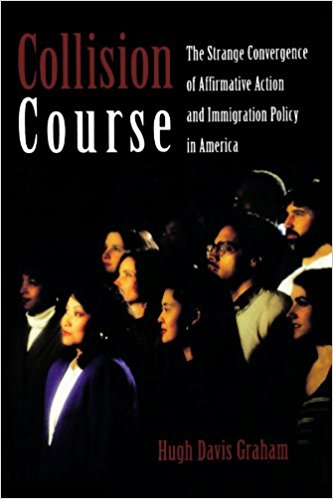
Hugh Davis Graham’s Collision Course is an excellent place to begin a study of this question. The book clearly describes how non-European immigration and affirmative action became policy despite overwhelming opposition. What interests Professor Graham is the legal and political process by which all this happened, and three questions are central to his narrative: How did the immigration reforms of 1965 lead to a revival of mass immigration when this was apparently not the intent of the reformers? Why did the policy of affirmative action emerge so soon after the 1964 Civil Rights Act? Why did the federal government grant affirmative action — intended to redress the effects of decades of discrimination against blacks — to newly arrived immigrants?
Prof. Graham, who teaches history and political science at Vanderbilt University, does not write from a racial perspective. He does not oppose the dispossession of whites by non-whites, since he believes Third-World immigration has helped compensate “for falling birthrates after 1965.” He does not understand the significance of the changes he describes, but his description of the political processes that brought them about is detailed and useful.
The Disaster of 1965
The Immigration and Naturalization Act of 1965 replaced the national origins quota system, enacted during the 1920s, with a system of visa preferences based on occupation and family connections. The 1921 and 1924 laws were surely among the most patriotic and truly conservative legislation ever enacted by Congress. Their object was to reduce immigration and to preserve the existing ethnic and racial composition of the United States. Not only would America remain a white country, it would remain predominantly Northern and Western European. The 1924 law capped total immigration at 164,000 and limited annual arrivals from particular countries to three percent of the population of that nationality resident in the US in 1890. Thus, if Italian Americans made up two percent of the US population in 1890, immigration from Italy could be no more than two percent of the total. The law also banned all Asian immigration. In 1952, Congress lifted the Asian exclusion by passing the McCarran-Walter Act — a prelude to what was to follow. The justification was that abolishing the “Asian barred zone” would help win the Cold War, since the Soviets were making propaganda in the Third World about the exclusion.
The legislators who pushed the 1965 law assured the public that although they were dismantling the national origins system, the reform would produce neither a significant increase in immigration nor any alteration in the racial composition of the country. Such assurances were necessary because polls revealed that the public opposed such changes. Prof. Graham assures us that the reformers were sincere, and that the Third-World tsunami soon to roll over the country was unintended and unexpected. Political/cultural elites simply thought the old quotas were “racist,” and had to go. Legislators were more concerned with demonstrating fashionable progressive values than in tracing out the logical consequences of what they were doing.
Some groups, however, must have known what would happen. The most influential lobbying group was the American Immigration and Citizenship Council, an umbrella organization that represented Jewish, Catholic, liberal Protestant, and southern European ethnic associations, as well as the communist-leaning ACLU and CIO. Prof. Graham names Jewish leaders and organizations as the “most important,” and “the driving force at the core of this movement.” Voting in Congress closely followed the patterns of lobbying: “Every Jewish member of Congress in both chambers voted for it, as did all Catholics in the Senate and all but 3 (of 92) in the House.”
If Prof. Graham had looked at the sectional pattern of the vote he would have found that the chief opposition came from the South and the Mountain West, the two regions least affected by the mass immigration of the late nineteenth century. Old-stock Protestants living in those parts of the country relatively untouched by the previous wave of immigration wisely voted to keep their country as it was. The immigration reform of 1965 was therefore passed by the descendants of the “new” immigrants who came to America 50 to 80 years earlier. This means that even after half a century and a 40-year moratorium on new arrivals, these new arrivals had been only partially assimilated. Patrick Buchanan has often proposed a five-year moratorium on immigration to permit assimilation of the 35 million post-1965 immigrants. If 40 years was not enough for a largely European population, five years will have little effect on non-whites.
The 1965 reform capped annual immigration at 290,000 (170,000 for the eastern hemisphere and 120,000 for the western). Within these two quotas, visas would be awarded according to one of seven preferences (one refugee, two occupational, and four family preferences). These seemingly simple provisions set up the conditions for endless chain migrations from the Third World. First, professionals (doctors, scientists, and engineers), most of whom were educated in the West, applied for skilled occupational visas granting permanent residency. They could then request visas for their spouses and unmarried children. Refugees could do the same. Once our new residents became American citizens, they could get visas for their brothers and sisters. The brothers and sisters then repeated the process by requesting visas for their spouses and children. By the 1980s, the admissions of brothers and sisters of US citizens accounted for two-thirds of all family visas. This was the main form of chain migration.
It is important to remember that once an immigrant has American citizenship, he is entitled to bring in his wife, minor children, and parents automatically, and they do not count toward filling quotas. The result was that by the 1980s immigration exempt from the quotas was greater than immigration under the quotas themselves. For example, in 1985, the ceiling for immigration was 254,000 but total legal immigration was 570,000. Prof. Graham explains that immigration expansionists invoked family reunification as a mantra to disarm opponents. This defense was false and misleading, because “every act of immigrant admission in effect broke up a family and created a chain of potential ‘reunification’ claims.” If the goal was to keep families together, a better policy would have been to prevent Third-World immigration in the first place. And, of course, if their families are so important to them, immigrants can always go home.
At the same time, ever-larger numbers of foreigners were entering illegally. Many millions, mostly Mexicans and other Central Americans, simply sneaked across the southern border. Others overstayed various temporary student or tourism visas, and the INS made only perfunctory efforts to find them.
Prof. Graham fails to point out that the refusal of the federal government to enforce immigration laws was, in effect, a policy decision common to every administration since Lyndon Johnson’s, to increase immigration beyond the legal limits. He also fails to explain the effect of granting automatic citizenship to children born on US soil even if their parents were here illegally. Since they were now parents of US citizens, they could not be deported. Their children had a legal right to attend school, and the family was eligible for welfare.
By the mid-1980s, the public was beginning to notice the country was filling up with foreigners, and that Mexicans were spreading everywhere. Congress responded by passing the Immigration and Refugee Control Act of 1986 (also known as the Simpson-Mazzoli Act). Despite the reassuring title, it increased immigration. The law had three major provisions: a “temporary” guest worker program, an amnesty for illegals who had lived in the country since 1982, and sanctions for employers of illegals. Because the public was opposed to amnesty, congressional supporters promised there would never be another, and that employer sanctions and guest worker programs would deter future illegal immigration. They were, to put it charitably, mistaken.
Prof. Graham argues that Congress deliberately vitiated employer sanctions by creating a new justice department agency — the Office of Special Counsel for Immigration Related Unfair Employment Practices — to prosecute and fine employers who “discriminated” against “foreign-looking” workers when verifying their legal status. Congress also required employers to accept any two of 30 possible documents (all easily obtained illegally) as proof of identification. The much-vaunted employer sanctions were a sham, and the government sent a coded message to the effect that it would look the other way if companies hired illegals.
Big business had wanted a pool of low-wage, docile, union-resistant immigrant labor, and Congress obliged. Virtually every major employer organization supported Simpson-Mazzoli: the US Chamber of Commerce, the National Association of Manufacturers, the National Council of Agricultural Employers, the United Fruit and Vegetable Association, the National Restaurant Association, and the Associated Builders and Contractors.
Over the next ten years, no fewer than one million guest workers received legal residency, three million illegal aliens were amnestied, and two to three million illegals who had arrived after 1982 were also allowed to stay. Just as opponents of amnesty had predicted, illegals poured into the country, and employers rushed to hire them. The new influx was so great that by 2001, there were at least ten million illegals in the country, and the Bush administration was pushing for another amnesty.
If the 1980s were a decade of defeat, the 1990s were a rout. Only four years after Simpson-Mazzoli, Congress raised the legal ceiling from 500,000 to 700,000, created new “diversity visas” for people from “underrepresented countries,” and launched a new “temporary” worker program (H-1B) to issue 65,000 visas a year to high-tech workers. Polls continued to show the public wanted less immigration, but Congress gave it more.In 1998, it raised the annual number of H-1B visas to 115,000, and in 2000 increased the figure to 195,000. In late 2000, Congress passed, and President Clinton signed, a law granting permanent legal residency to 500,000 illegal aliens and refugees from El Salvador, Guatemala, Honduras, and Haiti.
Why does Congress continue to defy the will of the majority? Prof. Graham’s answer is that the coalition of interest groups in favor of immigration had grown so powerful by the 1990s that it could dictate policy. The left wing of the coalition included the same groups as in 1965 — the ACLU, Jewish organizations, the US Catholic Conference, the National Council of Churches, Northern Democrats, the congressional Black Caucus — and had grown to include immigration lawyers, the AFL-CIO, the congressional Hispanic Caucus, and the new Arab, Asian, and Hispanic ethnic lobbies produced by the post-1965 immigration. Even the Sierra Club, the nation’s most powerful environmental lobby, joined the open-borders coalition after opposing immigration for decades.
The “right” wing of the coalition included the US Chamber of Commerce, the National Association of Manufacturers, fruit and vegetable growers, the meat and poultry processing industry, the business press (especially the Wall Street Journal), conservative think tanks (Heritage, American Enterprise Institute), libertarian think tanks (CATO, the Foundation for Economic Education,) the Christian Coalition, and the Republican Party. In the face of all these and a hostile media as well, it is clear why groups like the Federation for American Immigration Reform and the American Immigration Control Foundation have had so little effect.
Business and the Republicans are now squarely on the side of more immigration. Not only have corporations funded the pro-immigration lobby, they have themselves lobbied to open the floodgates. Since the 1980s, every immigration expansion and amnesty has either been passed by a Republican Congress or signed by a Republican president. Corporations want more pliant workers, and many Republicans simply vote the way the Chamber of Commerce tells them. At the same time, Republicans crave respectability, and nothing so terrifies them as the cry of “racism.” When corporate interests and politically correct ideology converged in the 1980s, Republicans were quick to betray their white voter base.
The Civil Rights Revolution
Because so many post-1965 immigrants were non-white, immigration inevitably became caught up in the “civil rights” and preference debates. Still, Prof. Graham first wants to know how the civil rights movement, which he believes was about individual rights, equal opportunity, and color blindness, so quickly turned into demands for group rights and racial preferences. His account of how it happened is quite good.
The Civil Rights Act of 1964 was a revolutionary piece of legislation. It banned racial discrimination in all public accommodations (restaurants, hotels, etc.), in the workplace (in companies with 25 or more workers), and created the Equal Employment Opportunity Commission to root out discrimination. It was a huge expansion of government power that subjected private business and employment decisions to government scrutiny. Still, Section 703 (j) stated that the law did not require employers “to grant preferential treatment to any individual or group on account of an imbalance which may exist with respect to the total number of or percentage of persons of any race, color, religion, sex, or national origin.” Supporters cited this language to deny charges that the law would lead to racial quotas. Sen. Hubert Humphrey dismissed such fears as a “bugaboo,” and vowed famously to eat the pages of the civil rights bill “one after another” if there were ever quotas. Yet before the end of the decade, the federal government was pressuring private employers to adopt racial quotas (disguised as goals and timetables), and to give preferences to non-whites.
Prof. Graham is shocked that “the EEOC, which in adopting race-conscious remedies in the late 1960s, indisputably violated its own founding charter, Title VII, and got away with it.” He does not understand that the logic of quotas and preferential treatment was inherent in the act itself. The only way to be certain an employer was not discriminating was to count his employees and make sure there were enough non-whites. Because blacks were broadly less competent than whites, the only way to hire enough of them was to discriminate against whites.
This, of course, was not a publicly acceptable justification for preferences. The theory was that because of the lingering effects of past discrimination, it was unfair to expect minorities to compete equally with whites. Prof. Graham recognizes that preferences were a departure from the liberal ideals of color blindness, but he is far from displeased with the results.
As Prof. Graham points out, it was not Congress but the civil rights bureaucracy that started affirmative action, and did so before any theoretical justifications had even been proposed. In 1968, the Small Business Administration (SBA) created the Section 8 (a) program to award grants and low-interest loans to “socially disadvantaged” persons, a euphemism for blacks and other non-whites. In the same year, the EEOC began to investigate businesses not just for overt discrimination but for “underutilization” or “underepresentation” of minorities.
The Office of Federal Contract Compliance at the Labor Department formulated what became known as “the Philadelphia Plan.” Federal contractors in Philadelphia had to take immediate steps to ensure that their work forces mirrored the proportion of minorities in the Philadelphia area, which was then 30 percent. Opponents of the Philadelphia Plan realized that if the program survived it would establish a precedent for proportional representation and preferential treatment for minorities. Public, congressional, and business opposition was so great that the Labor Department quickly withdrew the plan. However, President Nixon revived the program his first year in office, and used all his influence to fight off congressional attempts to kill it. It was thus Richard Nixon and the Republicans who saved the Philadelphia Plan, which became the model for all subsequent racial preferences.
The Nixon Labor Department quickly issued Order No. 4 requiring all federal contractors everywhere in the country to submit goals and timetables for minority hiring. It would not be long before the EEOC was requiring private businesses to do the same. Why did Nixon do this? Prof. Graham reports that he suffered from the same delusion that plagues all Republicans: He thought he could win the black vote in 1972.
Various forms of affirmative action could not have survived had the federal courts not upheld them. Although the Civil Rights Act of 1964 forbade preferential treatment on the basis of race, the courts disregarded this plain language and ruled frequently that race-conscious remedies were constitutional. Soon it was not enough for companies to prove they did not intend to discriminate; they had to avoid practices that had an “adverse” or “disparate impact” on non-whites. This principle was established by the 1971 Supreme Court case Griggs v. Duke Power, in which the Duke Power Company of North Carolina was forbidden to use IQ tests to evaluate management trainees because blacks got lower scores. IQ tests had a “disparate impact” and were therefore illegal. Employers soon learned that in order to convince the civil rights police they were not discriminating against blacks they had to discriminate against whites.
Prof. Graham appears to be shocked that preferences were then extended to non-white immigrants. After all, the theory of compensation that supposedly justified remedies for blacks did not apply to foreigners just arriving in the United States, but it didn’t take long for other non-whites to get in on the action. In 1967, the EEOC considered whether Asians should get preferences. At the time, the median family incomes of Japanese — and Chinese-Americans were well above the national average, so the EEOC chairman decided they should not. All the same, he reclassified Asians as a protected class for fear of pressure from Asian-American interest groups and the press. Needless to say, there was no press or interest group pressure to protest this additional discrimination against whites.
In 1978, when Congress passed the Small Business Investment Act, which for the first time provided a legal basis for the SBA’s 8(a) preferences program, it left Asians out of its definition of the “socially disadvantaged.” Asian groups pressured the SBA for re-inclusion, and within a year, the SBA not only reinstated Chinese and Japanese but included newly-arrived Oriental immigrants such as Vietnamese, Koreans, Laotians, Cambodians, and Taiwanese.
As immigration continued to grow, both in numbers and variety during the 1980s, more groups lobbied to become government-recognized minorities. Hasidic Jews (1979) and Iranians (1989) were turned down on the grounds they were white, but East Indians, Pakistanis, Bangladeshis (1982), and Indonesians (1989) joined the Asian category.
All this was a natural outgrowth of the revolutionary 1964-65 legislation. Since the 1964 law said discrimination was unlawful on the grounds of “race, color, religion, sex, or national origin,” — and this was the basis for establishing protected classes — all non-white immigrants could be protected. At the same time, the civil rights bureaucracy created in the 1960s had the incentive of all government bureaucracies to expand, so it was natural for it to extend programs to newly-arrived immigrants. Third, the same apathy, lack of white racial consciousness, and white guilt that kept whites from mounting any real resistance to black affirmative action led to acceptance of the same preferences for other non-whites. Whites preferred not even to notice that immigrants were getting affirmative action.
Of course, by this time, racial preferences had a new justification. It hardly made sense to claim that young blacks — who had lived their entire lives in the age of affirmative action — deserved preferences to make up for past discrimination. The new theory that emerged in the late 1980s was that universities and corporations would benefit from the mere presence of non-whites. This “diversity” justification could also serve to explain why Cambodians and Guatemalans deserved preferences over whites.
Prof. Graham’s book explains how absurdities of this kind come into being: The bureaucracy, judges, corporations, and interest groups have far more political power than the general public, and when the four act together, as they have on immigration and affirmative action, they can ignore the majority. Prof. Graham ably discusses how “iron-triangles,” composed of federal agencies, interest groups, and congressional committees, have largely made government policy. When the public has tried to roll back racial preferences by legal challenge or popular referendum, federal courts have stepped in to protect them, as happened in California during the 1990s.
These racial policies are prime examples of a “democratic” country flouting the will of the people. Neither mass non-white immigration nor government-imposed preferences for blacks and immigrants has ever enjoyed majority support, nor have political leaders ever been open about the full reality of these two policies. There has not been a single national referendum or election campaign that has centered on these issues. When affirmative action and forced integration have crept into a campaign, the public verdict has been negative.
The votes for Nixon in 1968 and 1972 were, at least in part, against school busing, but in return the public got busing and affirmative action. The vote in 1980 for Ronald Reagan was, at least in part, a vote against affirmative action, but Republicans have taken every opportunity to betray whites. President Reagan could have significantly reduced federal affirmative action and “civil rights” enforcement but did not. President George Bush went on to sign the Civil Rights Act of 1991, which finally gave legislative sanction to the pernicious theory of “disparate impact.” Newt Gingrich’s 1994 Contract with America ignored immigration and affirmative action. Colin Powell even endorsed racial preferences to great applause at the 2000 Republican convention.
Corporations have been as destructive as the Republicans. They have funded non-white, anti-majority pressure groups (including: La Raza, MALDEF, LULAC, NAACP, and PUSH), lobbied the Reagan administration not to scale back affirmative action, embraced the new “diversity” rationale for preferences, and groveled to black and Hispanic shakedown artists.
Needless to say, Prof. Graham does not grasp the deeper cause of the racial revolution his book describes — the inability of whites to think in racial terms or to believe they have a right to defend their country from invasion. And because he cannot understand the aggressive racial consciousness of non-whites, he cannot see the larger pattern of events. He is shocked that the non-discrimination movement of the 1960s grew so quickly into one of blatant racial preferences, and is baffled that non-white immigrants demanded the same preferences. There is no mystery here. For blacks, whose racial hatreds have been fed for decades on liberal anti-white propaganda, preferences were just another advantage to be wrested from demoralized whites. Preferences need never end, and if they can be supplemented with reparations for slavery or anything else that comes to mind, so much the better. Like most whites, Prof. Graham does not understand that blacks seek advantage and gain, not justice.
Other racial groups behave the same way. If the white majority can be made to discriminate against its own children in favor of non-whites just off the boat, immigrants are delighted to reap the benefits. Preferences for foreigners are just one more example of what happens when whites lose any conception of their legitimate group interests.
The political details of how capitulation takes place are interesting and instructive, and Prof. Graham describes them ably, but without grasping what is at stake. He is like a scientist studying a beast of prey — without realizing that he himself is its favorite food.