The Wrongful Conviction of Derek Chauvin, Part III
F. Roger Devlin, American Renaissance, November 25, 2026
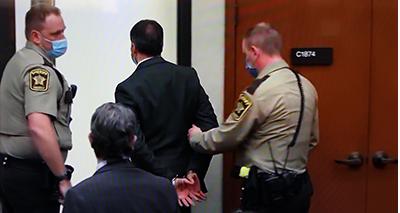
Credit Image: © Court TV/POOL via ZUMA Press Wire
Continued from Part II.
So how did George Floyd die?
The actual cause of George Floyd’s death was a combination of three elements: sudden cardiac arrhythmia, excited delirium, and a drug overdose.
Testifying for the defense to the first of these causes was Dr. David Fowler, who had worked in the field of forensic pathology since 1986, reviewing more than 500 homicide cases per year. Dr. Fowler testified that “Mr. Floyd had a sudden cardiac arrhythmia due to his arteriosclerotic and hypertensive heart disease.”
A “cardiac arrhythmia,” he explained, is an irregular heartbeat caused by a problem with the heart’s electrical system. In a normal heartbeat, first the atria contract and then the ventricles contract. This order is essential and is controlled by the sinoatrial node, which Dr. Fowler called the “cardiac pacemaker.” The sinoatrial node or cardiac pacemaker generates the initial electrical activity that causes the atria to start contracting. If the “cardiac pacemaker” is impaired, “orderly contraction of the heart” ceases. The lack of orderly contraction is a cardiac arrhythmia. The cardiac pacemaker itself needs blood. If it doesn’t get blood, or if the flow of blood is severely restricted, it will malfunction. The cardiac pacemaker “is supplied by a small branch that comes off the right coronary artery.”
Floyd’s autopsy revealed that his right coronary artery was narrowed by 90 percent.
Indeed, all of his major arteries showed “significant narrowing.” His “left anterior descending coronary artery” was 75 percent narrowed. Worse still, the narrowing in Floyd’s major arteries was “close to the aorta, where the blood comes from.” This is called proximal narrowing. “Anything downstream from that [proximal] narrowing is subject to decreased supply of blood.” In Floyd’s case, this meant that “all of his heart, unfortunately” was “subjected to reduced supply.”
Dr. Fowler testified that a narrowing of 70–75 percent is considered the standard range “for a risk of sudden cardiac death.” Floyd’s autopsy also revealed that his heart was twice the average size. This was due to years of high blood pressure. About a year before his death, a paramedic asked him whether he had medication for it. “I don’t really take it,” he replied.
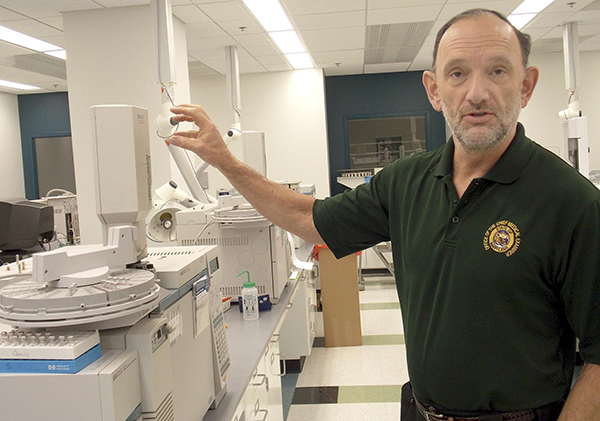
Dr. David Fowler discusses equipment and procedures at the office’s toxicology lab in November 2012. (Credit Image: © The Baltimore Sun/TNS via ZUMA Press Wire)
These circumstances might have been enough to account for George Floyd’s death even in the absence of other aggravating factors. But there were aggravating factors. For example, Floyd had methamphetamine in his system. “Methamphetamine is dangerous at several levels,” Dr. Fowler testified. “One, it has known arrhythmogenic potential,” meaning “people on methamphetamine have an increased risk of arrhythmia.” In addition, “as a stimulant, it pushes the heartbeat rate up . . . so therefore the heart is going to . . . demand increased oxygen.” Methamphetamine is also a vasoconstrictor, “a substance which causes blood vessels, usually arteries, to narrow.” This “can become dangerous” because “too much contraction . . . can slow down the blood beyond what is necessary.”
And Floyd struggled with police for several minutes before they restrained him. Such physical exertion, Dr. Fowler explained, “increases the demand for oxygen throughout the entire body. . . . As we exercise, our heart rate and our breathing rate normally compensate to increase . . . the amount of oxygenated blood.” Floyd’s struggle with officers increased “the demand and the stress on his heart.” That “stressful situation” caused the “secretion of adrenaline.” Adrenaline, like methamphetamine, is “a potent vasoconstrictor” and caused Floyd’s “blood vessels to constrict” even further than severe heart disease had narrowed them. The adrenaline also caused Floyd’s “heart to increase the cardiac output to maintain the oxygenation of [his] brain.”
Dr. Fowler further testified that when a cardiac event turns lethal, a “sudden change” results, and the transition from fully functional to unconscious happens “very rapidly.” Floyd went from making clear and intelligible statements to unconsciousness in a period of not more than 54 seconds. A period like that is “sudden” for purposes of cardiac events, Dr. Fowler said. Asphyxia would not have brought about Floyd’s death that quickly.
The second factor contributing to George Floyd’s death was his state of “excited delirium.” This is “a state of severe agitation that can lead to . . . lactic acidosis,” according to emergency room doctor Brad Langenfeld, who testified on the subject. Dr. Langenfeld told the court that when the body doesn’t receive enough oxygen, it produces energy through “anaerobic metabolism,” which creates “lactate” that builds up in the blood and “can lead to an acidosis.” The result can be cardiac arrest culminating in death.
The Minneapolis Police Department trains its officers to recognize the symptoms of excited delirium. Officer Nicole Mackenzie, who taught the course, lists these symptoms as psychomotor agitation, psychosis, hyperthermia, incoherent speech, superhuman strength, and bizarre behavior. Excited delirium is often triggered by the use of stimulants, such as the methamphetamine listed in George Floyd’s toxicology report. Officers who perceive the relevant symptoms are taught to call for EMS right away because “people that are experiencing . . . excited delirium syndrome . . . can rapidly go into cardiac arrest,” according to Officer Mackenzie. The officers present at Floyd’s arrest were certainly aware of the issue; Officer Lane’s bodycam shows him saying: “I just worry about the excited delirium or whatever.”
The third factor in George Floyd’s death was the fentanyl in his system:
The toxicology report showed that Floyd’s blood contained 11 ng/mL [nanograms per milliliter] of fentanyl, 19 ng/mL methamphetamine, and other substances besides. Dr. Daniel Isenschmid, the senior scientist at NMS Labs who oversaw the toxicology analysis, testified that these levels were dangerous. Dr. Isenschmid was well-versed in fentanyl overdose deaths; his lab reviewed nearly 20,000 cases in 2020 alone. Of that sample, the median fatal concentration of fentanyl was 10 ng/mL, well below Floyd’s level. In fact, Isenschmid noted in his report that “blood concentrations . . . as low as 3 ng/mL” can be fatal.
The prosecution denied that fentanyl was a factor in Floyd’s death on two grounds: 1) it is a respiratory depressant, while Floyd’s respiration appeared from the video evidence to be a normal twenty-two breaths per minute; and 2) fentanyl is fast-acting, so that peak respiratory depression occurs within about five minutes of ingestion. Floyd already appeared high while in CUP Foods, some 33 minutes before officers restrained him. So peak respiratory depression should have been long behind him during his restraint.
But both of these objections can be answered. While fentanyl depresses the respiratory system, methamphetamine and vigorous activity such as resisting arrest — including the release of adrenaline which accompanies it — stimulate respiration. So George Floyd’s “normal” respiratory rate was actually rather low for someone in his condition.
Secondly, there is evidence that George Floyd consumed fentanyl shortly before his death:
In addition to the presence of fentanyl and methamphetamine in Floyd’s blood, the toxicology report noted two other curious results. First, there was 5.6 ng/mL of something called “norfentanyl.” Norfentanyl is a “metabolite” of fentanyl and is created as the body breaks down the drug. But that takes time. Dr. Isenschmid testified that “we frequently see fentanyl with no norfentanyl” in overdose deaths because “the body doesn’t have time to break it down.” Since there was norfentanyl in Floyd’s blood, that might be consistent with the conclusion that he didn’t die of a fentanyl overdose. On the other hand, as Dr. Isenschmid explained, the presence of fentanyl and norfentanyl “also could mean there was preexisting norfentanyl with additional fentanyl given on top of that.” Had Floyd taken fentanyl on two separate occasions, the second dose could have killed him even after his body metabolized the first dose into norfentanyl. Moreover, there were no metabolites of methamphetamine in Floyd’s blood. This indicated that Floyd took methamphetamine just once, “probably” shortly before he died.
There is plentiful evidence that Floyd was high before officers ever arrived:
CUP Foods employee Christopher Martin said Floyd was “high” and having difficulty forming words. Shawanda Hill, one of the two passengers with Floyd in the SUV, testified that Floyd “fell asleep” in the car before the CUP Foods employees approached. When they got to the car to confront Floyd about the counterfeit twenty-dollar bill, Floyd “was already asleep,” she said. “They tried to wake him up, over and over.” Floyd woke briefly, made some gesture, then “nodded back off.” This routine happened “a couple times,” Hill said.
However,
for the toxicology results to make sense, Floyd must have taken methamphetamine at some point. That point could only have been shortly before he died, since there were no methamphetamine metabolites in his blood. This meant that he must have put both fentanyl and methamphetamine into his mouth no later than the moment Officer Lane approached his vehicle. As it turns out, there’s a name for this concoction of a depressant like fentanyl and a stimulant like methamphetamine. It’s called a “speedball.” “It’s essentially a combination of an upper and a downer,” Officer Nicole Mackenzie testified.
Speedballs were later recovered from George Floyd’s SUV. Officer Lane’s bodycam showed a white pill in his mouth while he was still seated in the car. It appears he ingested it impulsively at this time in order to hide them. This was not new behavior for Floyd; he had done exactly the same thing during a drug arrest the previous year.
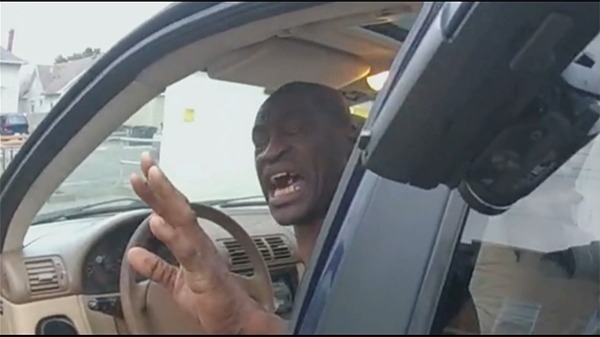
Furthermore, two speedballs were recovered in partially dissolved form from the back of police cruiser 320. They appear to have been spat out at 8:19, when officers attempted (but failed) to put Floyd back in the cruiser after he had launched himself through it. He may have sensed that he had ingested too much. This was less than five minutes before he spoke his last words.
From Officer Lane’s bodycam it also appears that Floyd says “I ate too many drugs” while officers were restraining him. A witness named James Reyerson testified to the remark in court. It dovetails perfectly with Floyd’s having spat out two speedballs two minutes before.
But a strange thing happened at this point in the trial. Following Reyerson’s testimony, Judge Cahill called a recess, which lasted 24 minutes. When the parties returned, the prosecutor announced: “We are recalling agent Reyerson . . . to re-address the . . . clip that was played.” The author comments:
In every criminal trial I have ever conducted or observed, this additional questioning of Reyerson would have been barred. Not only had Frank said he had “nothing further,” but “re-redirect examination” is not a thing. The rules of criminal procedure are crystal clear on this point. For some reason, though, Judge Cahill allowed it.
Under renewed questioning, Reyerson now stated that George Floyd said not “I ate too many drugs” but “I ain’t do no drugs.”
This about-face was incredibly suspicious. A witness had testified in a way that favored the defense. The parties then took a break. During that break, the witness met with prosecutors privately. After the break, the witness returned and changed his testimony to favor the prosecution.
In criminal trials, prosecutors are not permitted to talk to their witnesses during breaks between testimony. This rule is intended to prevent the prosecution from making improper suggestions to a witness about what his testimony should be. In this case, it is obvious that prosecutors met with Reyerson. It seems likely that they coached him to reach a different conclusion.
Due to cross-talk, the audio recording is not perfectly intelligible. While it’s very likely that Floyd said “I ate too many drugs,” it’s not clear-cut. What is certain, however, is that the likelihood of Reyerson “re-hearing” something different — something that just happened to benefit the prosecution — is essentially nil.
Officer Thao also testified of Floyd at a later trial: “I heard him say he ate drugs.” He was standing just 10 feet away from Floyd at the time. But Mr. Reyerson’s highly irregular contradiction of his own previous testimony was allowed to stand, and defense attorney Eric Nelson failed to challenge this.
There is further evidence pointing to fentanyl consumption as a causal factor in George Floyd’s death:
Dr. Baker found that Floyd’s “lungs were quite edematous, meaning they had a lot of fluid and congestion in them.” According to his autopsy report, “the right and left lungs” weighed “1085 and 1015” grams, respectively. That was two to three times heavier than normal, even after adjusting for a man of Floyd’s stature. This is relevant because, as Dr. Baker told prosecutors shortly after the autopsy, the level of fentanyl in Floyd’s blood (11 ng/mL) “can cause pulmonary edema,” which is a leading indicator of fentanyl overdose. At the subsequent federal trial, Dr. Baker testified that “when somebody overdoses, we see very wet, heavy lungs like this.”
However, the cardiopulmonary resuscitation (CPR) administered to Floyd in the ambulance would also have tended to bring fluid into his lungs, so this line of evidence may be more ambiguous than the others.
Fentanyl can also produce “intense fear, paranoia . . . or anxiety,” and this is consistent with Floyd’s words and behavior throughout his arrest.
He said “I’m scared, man” several times. As the officers started to walk toward Squad 320, Floyd said, “God dang, man. Oh, man, God, don’t leave me, man. Please, man. Don’t leave me, man. Please, oh, please don’t leave me, man.” After they got to Squad 320, Floyd repeated his plea: “Mr. Officer, please, God, please, man. Don’t leave me by myself, man. Please.” A few seconds after that, while officers attempted to coax Floyd into the back seat, his anxiety reached fever pitch. “I’m going to die in here. I’m going to die, man,” he said. And then, a minute after that: “Stay with me, man. Please stay with me, man.” Lane responded to that plea with a simple and reassuring, “I will,” to which Floyd responded, “Thank you.”
His fear seems to have been caused by his ingestion of fentanyl, which even he seems to have understood had been excessive, since he spat out two speedballs less than a minute later.
Moreover, shortly before passing out, Floyd said, “I’m through, I’m through . . . my stomach hurts . . . I need some water or something, please, please.” The author reports that “both stomach pain and dehydration or dry mouth are signs of fentanyl toxicity.”
In sum, the evidence indicates overwhelmingly that George Floyd died from a combination of three factors: sudden cardiac arrhythmia, excited delirium, and a fentanyl overdose. The contrast between the cogent explanations just given and Dr. Tobin’s meandering attempts to prop up the asphyxiation theory speaks for itself.
Morries Hall: The man the jury never heard from
George Floyd visited CUP Foods in the company of 42-year-old Morries Hall, who was sitting in the passenger seat next to him when police arrived. He had frequently sold drugs to Floyd, and was almost certainly the source of the speedballs Floyd swallowed as police approached. Under Minnesota’s controversial felony murder law, Mr. Hall could have been prosecuted for Floyd’s murder, since Floyd died as an unintended result of Hall’s predicate felony of supplying him with those drugs. Both prosecuting and defense attorneys were well aware of this. But
there was never any chance Hall would be prosecuted for Floyd’s death. This was first and foremost a scapegoating ritual. Political considerations would not allow for the prosecution of a black drug dealer to replace or even supplement the prosecution of a white police officer for Floyd’s murder.
The prosecution’s main concern in the Chauvin trial was keeping Mr. Hall away from the witness stand and out of jurors’ minds. This was not too difficult, since the answer to virtually any questions he might have been asked could have incriminated him. His public defender acknowledged Mr. Hall’s intent to invoke his Fifth Amendment privilege liberally, including in response to any questioning about “drug sale and drug use” and “any personal knowledge that he has of drug use by George Floyd up until and including May 25.” For this reason, Eric Nelson urged the state to grant Hall immunity, but, of course, it refused. Therefore, jurors never learned that
there was enough evidence to convict another man for George Floyd’s murder. This was an open secret, known to almost anyone in the world who wanted to know, since the hearings regarding Hall’s Fifth Amendment privilege were streamed globally. The only people who didn’t know were the jurors responsible for deciding Derek Chauvin’s fate.
Unreasonable force?
As explained earlier, Minnesota’s felony murder law required prosecutors to argue that the police officers’ restraint of George Floyd became “unreasonable” at some point. This was the basis for claiming they had “assaulted” him, supplying the predicate felony necessary for a charge of felony murder. They called seven expert witnesses to testify to the matter, but these witnesses could not agree with one another — or even with themselves — as to when the restraint of George Floyd became unreasonable. One said it was when he was handcuffed, even though Floyd continued to struggle with officers long past that point. Another testified that “there’s an initial reasonableness in trying to just get him under control in the first few seconds.” But this same man had told the FBI in June of 2020 that the force officers used had been reasonable for four minutes, that is, until after Floyd had stopped resisting.
Another witness was a trainer for the Minneapolis Police Department. She was shown a photograph of officer Chauvin kneeling on George Floyd’s neck and asked: “Is this a trained technique by the Minneapolis Police Department?” She answered: “It is not.” This is directly contradicted by the previous testimony of Lt. Johnny Mercil, as well as by a slide from a Minneapolis Police Department training presentation itself depicting three officers arresting a suspect using the same positions Chauvin, Kueng, and Lane used to arrest George Floyd. Fourteen officers later accused this witness of perjuring herself.
Another witness acknowledged under questioning that “he had never been qualified as an expert in police use of force and had never testified as such in any state or federal court anywhere.” It was unclear why prosecutors had paid this man $12,950 to fly across the country to testify at Derek Chauvin’s trial.
The final witness testified that “putting [Floyd] in the prone position, especially on the street side of the car, was unreasonable, and excessive, and contrary to generally accepted police practices,” as well as constituting “deadly force.” This was contradicted not only by all the other witnesses, but by an opinion piece the man himself had written for The Washington Post on May 29, 2020, acknowledging that “officers might need to hold someone down in the prone position.”
As defense attorney Eric Nelson asked: “If these ‘experts’ couldn’t agree among themselves, how were jurors supposed to conclude beyond a reasonable doubt that Chauvin’s force was unreasonable?”
The US Supreme Court has ruled that use-of-force reviews “must be judged from the perspective of a reasonable officer on the scene, rather than with the 20/20 vision of hindsight.” Reviewers are to consider “the amount and type of force that would be considered rational and logical to an objective officer on the scene, supported by facts and circumstances known to an officer at the time the force was used.” Monday-morning quarterbacking is not allowed.
The prosecution violated this standard when criticizing the arresting officers for not performing chest compressions on George Floyd, as we noted earlier. It told the jury that the scene was sufficiently safe, even though “every first responder on scene, including the four officers and the two trained paramedics, believed the scene was not safe and that medical intervention could not be provided there.”
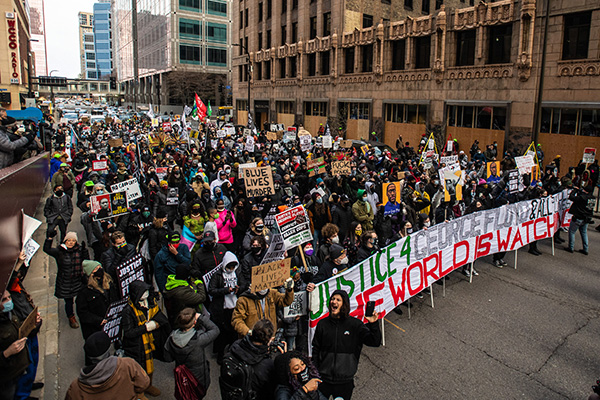
Credit Image: © imageSPACE via ZUMA Press Wire
For the jury to have reached an objective judgment regarding whether police officers’ restraint of George Floyd was — or at some point became — “unreasonable,” defense attorney Nelson
needed to vividly describe the physiological symptoms that accompany deadly situations: raised pulses, dilated pupils, stomach-dumping cramps, throat-gripping anxiety. He needed the hair on the back of jurors’ necks to stand up. He needed them to feel as if they were about to be attacked by a menacing and physically volatile stranger, because that’s who George Floyd may have been. That’s what real-world policing feels like.
Instead, what jurors got was largely “dry, formulaic use-of-force testimony by bureaucrats and academics.” They were asked to act as Monday-morning quarterbacks.
In dealing with this six-foot-four, 223-pound suspect in a state of “excited delirium,”
officers Chauvin, Thao, Kueng, and Lane didn’t use mace or pepper spray. They didn’t fire a TASER, stun gun, or other conducted energy device. They didn’t sic a canine on him, or throw him into a wall, or tackle him onto the ground. They didn’t deploy collapsible batons. They didn’t punch, kick, or elbow Floyd; they didn’t use any striking techniques at all. Nor did they use a chokehold or neck restraint.
They didn’t even use that hobble which officer Thao retrieved from the trunk of cruiser 320.
Given Floyd’s refusal to comply with Lane’s commands and his subsequent struggle with multiple officers, most police department use-of-force policies would have authorized many or all of the aforementioned techniques. The prone restraint used on Floyd was the minimum force necessary to restrain Floyd while officers waited for EMS. If anything was unusual about the arrest, it was that the officers used so little force despite the justification for using much more.
But seventeen-year-old Darnella Frazier and the millions of people who watched her video had never been confronted with the task of arresting a man like George Floyd. And neither had the jury charged with deciding the fate of Derek Chauvin.
A miscarriage of justice
No later than the evening of May 26, 2020, within about twenty-four hours of George Floyd’s death, prosecutors had all the evidence they needed to see that Derek Chauvin was not responsible for it. They also had a pretty good idea of how Floyd did die. The obvious decision — and the only ethical decision — was not to bring charges. Prosecutors Amy Sweasy and Patrick Lofton saw this and resigned from the case within a few days. The subsequent prosecution “evaded nearly all of the safeguards built into our criminal law.” This was because of
the premise that Derek Chauvin, a white male police officer, was the embodiment of everything wrong with our systemically racist nation. He was guilty because the country was guilty.
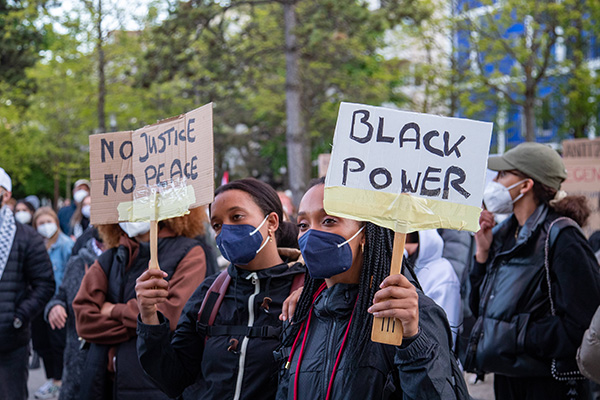
“No justice, no peace” had become the rallying cry of a loosely organized cabal of angry citizens, professional agitators, and opportunistic politicians. By “justice,” they did not mean due process. They did not mean that Derek Chauvin must be given a fair trial. They demanded a guilty verdict, process be damned. And they were willing to burn Minneapolis and the nation to the ground if they didn’t get it. The threats, the harassment, the looting and riots, the violence, death, and destruction — all of it hung over the jury like a Sword of Damocles.
Deliberations took nine hours. No riots ensued. No police stations were burned. Nobody was killed. None of that was necessary. The jury found Officer Derek Chauvin guilty on all counts.
Credit Image: © Imago via ZUMA Press
Afterword
In a brief Afterword, the author brings home the message that no bad deed goes unrewarded. The prosecutors responsible for this shameful show trial have been “celebrated by national media, showered with awards and accolades, and appointed to prestigious and powerful positions.”
No one profited more than Keith Ellison. The conviction made him a national figure. He won reelection in 2022, and in 2023 he published Break the Wheel: Ending the Cycle of Police Violence, a memoir in which he cast himself as the mastermind behind Chauvin’s conviction.
Following his successful attempt to influence Dr. Andrew Baker’s autopsy findings, Dr. Roger Mitchell was named president of Howard University Hospital. NBC is producing a drama series about his life. Darnella Frazier received a special citation from the Pulitzer Prize Board for her “courageous journalism” and was recognized by the NAACP as the “Humanitarian of the Year.”
Those who did the right thing, on the other hand, have mostly suffered. Amy Sweasy was demoted after objecting to Keith Ellison’s elevated charging decisions. Barry Brodd, a use-of-force expert who testified that Chauvin’s actions were justified, was targeted for attack by activists: a place he had previously lived was smeared with blood and a severed pig’s head was left on the front porch. Following his testimony on Floyd’s death from cardiac arrhythmia, Dr. David Fowler was subjected to a review of all the in-custody death reports issued during his tenure as Maryland’s chief medical examiner.
A Hennepin County Commissioner claimed that Dr. Andrew Baker’s autopsy report “has done irreparable damage to the Black community” because it “insinuated that George Floyd died from causes of his health.” Two county commissioners tried to have him removed from his position, but were unsuccessful.
Derek Chauvin was not the only officer who went to jail.
It is rare for federal authorities to prosecute conduct already prosecuted by state authorities. This is especially true when, as here, the federal case involves less serious charges that won’t result in additional prison time. In this case, though, federal prosecutors couldn’t resist. Amid the global frenzy to scapegoat Officer Chauvin, the Department of Justice piled on by indicting him and officers Tou Thao, Alexander Kueng, and Thomas Lane with superfluous civil rights charges. [Chauvin’s colleagues] were convicted, and received substantial prison sentences. All have now been released.
After conviction in his state trial, Derek Chauvin agreed to plead guilty to federal charges as part of a plea deal that would allow the two sentences to run concurrently and let him serve his time in the relative safety of a federal prison. He is currently serving a 22.5-year sentence. The author does not hold out much hope for any future rectification of this injustice:
Activists needed a conviction because a jury trial would implicate the entire nation in Chauvin’s scapegoating. By forcing everyone to participate in the ritual sacrifice of two American symbols — the beat cop and the jury trial — everyone would share in the complicity, and a reconsideration of the verdict against Chauvin and against America would be nearly impossible.