The Wrongful Conviction of Derek Chauvin, Part II
F. Roger Devlin, American Renaissance, November 20, 2026
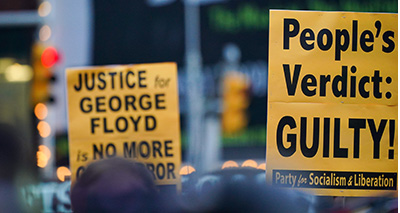
Credit Image: © John Nacion/NurPhoto via ZUMA Press
Continued from Part I.
The trial begins
Derek Chauvin’s trial took place on the 18th floor of the Hennepin County Government Center,
which was locked down as tightly as an embassy in a war zone. Concrete blocks and coils of razor wire fortified the building. Industrial metal screens were strung together to control entry and exit. About 3,500 National Guard troops and two armored personnel carriers maintained a perimeter around the facility. In total, Hennepin County spent $3.7 million on trial security, while the state of Minnesota spent $25 million deploying the National Guard.
Jurors’ identities were protected during the trial, but were to be made public “when it is safe to do so,” in Judge Cahill’s words. They were not reassured.
Dozens of potential and actual jurors expressed concerns. Juror 44 said she was “terrified” to serve. Number 55 also expressed concerns for her post-trial safety, since jurors’ names “would be public information, and it really depends on how the trial — the end results.” A third juror ended up having several panic attacks. Juror 27 emailed the court eleven days after trial started. He wanted off the jury because of mounting safety concerns. Cahill then questioned him under oath. Due to juror 27’s noticeable accent, coworkers had discovered his identity. As a result, “people have called me [from] out of state” and “my wife doesn’t feel safe,” he testified. But Cahill couldn’t remove him. If he did, he might have to remove every last one of the jurors.
Personal security concerns were just one facet of the problem. All of the jurors lived in Minneapolis or nearby. Rioters threatened to burn their city down if Derek Chauvin wasn’t convicted. Since the city itself was being held hostage, the wrong verdict could prove costly to the jurors’ families and friends — and no amount of security could protect all of Minneapolis.
Dozens of attorneys worked on the Derek Chauvin case, nearly all of them for the prosecution. “So-called ‘notices of appearance’ announcing each new lawyer joining the prosecution were filed routinely in the months leading up to trial.” The defense referred to the resulting swarm as an “army of lawyers,” an expression that annoyed the prosecution so much that it filed a motion to prohibit the defense from using it.
These prosecutors were assisted by countless special agents from the FBI and the BCA — Minnesota’s Bureau of Criminal Apprehension. FBI Special Agent Blake Hostetter testified that the case “was so large” that “maybe over a hundred agents” came in “from around the country and throughout the Minneapolis division . . . along with the BCA throwing resources at this investigation.”
Mr. Harker considers that Eric Nelson, the defense attorney who stood alone against this onslaught,
defended Chauvin with energy and alacrity. What distinguished Nelson’s performance was his ability to maintain focus on legal arguments despite the intense public scrutiny and emotional weight of the case. He came across as an obviously intelligent man who must have worked with very little sleep, as he was often filing and responding to motions in the middle of trial while also preparing cogent direct- and cross-examinations. Still, it must be said: Nelson made some crucial mistakes. And had Derek Chauvin received a fair trial, those mistakes may have made the difference. In this case, however, it is unlikely that any defense attorney would have performed better. Most would have performed worse.
Intent is irrelevant
The prosecution had no evidence of any intention on Derek Chauvin’s part to kill or even harm George Floyd. But it hit upon a legal approach that exempted it from having to demonstrate intent:
In Minnesota, “whoever . . . causes the death of a human being, without intent to effect the death of any person, while committing or attempting to commit a felony offense” is guilty of “felony murder.” Felony murder is a legal doctrine that imposes “murder liability for some unintended” deaths that happen “in the course of some felonies.” This doctrine requires that the defendant also commit what’s known as a “predicate felony.” For example, if a teller dies from a fear-induced heart attack during a bank robbery, the bank robber is guilty of felony murder. In that example, bank robbery is the predicate felony, and the teller’s death allows prosecutors to bring a felony-murder charge.
As SUNY Distinguished Professor of Law Guyora Binder has written: “Felony murder imposes undeserved strict liability for accidental deaths,” and for this reason is “one of the most widely criticized features of American criminal law.” But because of Minnesota’s Felony Murder law, prosecutors
merely had to prove that Chauvin intended to restrain Floyd and that, at some point, the restraint became unreasonable. Once it was unreasonable, it was no longer a lawful arrest. Instead, it was an unlawful restraint. And an unlawful restraint is an “assault.” The lawful arrest became unlawful when the force became unreasonable. The state’s experts did not agree when that transition happened, but all agreed that it did. Once the force became unreasonable, Chauvin’s actions were no longer a lawful arrest but an unlawful assault. Then, when George Floyd died, the lawful-arrest-turned-unlawful-restraint-turned-assault became the predicate felony that transformed a minor assault charge into second-degree murder. Intent mattered for nothing.
An article on the case in The New Yorker stated:
It is especially controversial for prosecutors to use an assault as the underlying felony for felony murder, because that means that they may treat any assault that results in death as a murder, effectively undoing the grading scheme for greater and lesser degrees of homicide that legislatures have carefully created. But, unlike that of most other states, Minnesota law allows prosecutors to charge felony murder using assault as the predicate crime.
Prosecutors had no choice but to do exactly that against Derek Chauvin, since they had no evidence he intended to harm George Floyd. They repeatedly emphasized to the jury that his intent was irrelevant.
Collapse of prosecution’s first cause-of-death theory
Prosecutors began the trial by accusing Officer Chauvin of killing George Floyd by using his knee to apply pressure to Floyd’s carotid artery, cutting off the supply of oxygen to his brain. The difficulty here is that everyone has two carotid arteries:
If one is obstructed, the body compensates through a process called “collateral flow” in which the second artery makes up the difference. The brain remains unaffected.
It would have been physically impossible for Derek Chauvin to obstruct both of George Floyd’s carotid arteries with his left knee alone. (In fact, the video evidence shows that Officer Chauvin’s knee was on the back of Floyd’s neck, not obstructing either carotid artery.)
And so it was that on the third day of the trial, prosecutors arrived at a devastating conclusion: They had to reconstruct their entire argument, top to bottom. They had to come up with a new theory of the cause of death for George Floyd — one that would implicate Chauvin, facts and evidence be damned.
So the prosecution would later cobble together — on the fly, in a trial already underway — an entirely new argument that Officer Chauvin had cut off Floyd’s breath with his knee. The author comments: “From a prosecutor’s perspective, this kind of volte-face isn’t merely unprecedented. It’s unfathomable. . . . The prosecution was able to perform a midcourse correction — the most remarkable one-eighty I’ve ever witnessed in a trial.” Mr. Harker believes Chauvin’s defense attorney Eric Nelson was insufficiently aggressive in emphasizing the prosecution’s inconsistency.
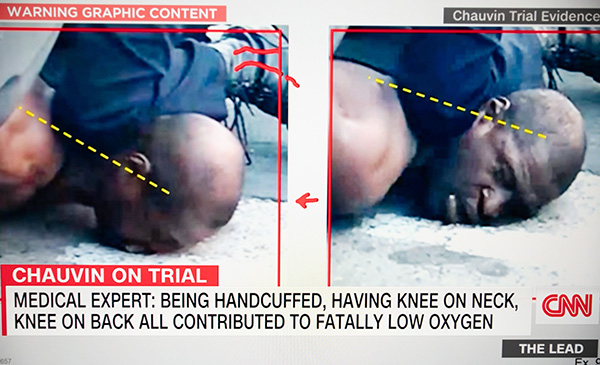
Credit Image: © Pool Video Via Court Tv via ZUMA Wire
Distracting the jury with racial irrelevancies
But before shifting their ground to the new theory, the prosecution temporarily dropped the whole cause-of-death question. Instead, on day four, it began to distract the jury with “prejudicial testimony about race.”
Derek Chauvin was never officially accused of having had a racial motive for killing George Floyd for the simple reason that no evidence supported such an idea. If they had possessed such evidence, prosecutors would certainly have charged him with a “hate crime.” And, since race wasn’t an element of any charged offense, courtroom rules did not allow them to ask about the subject directly.
Of course, the news media do not operate under any such restrictions, and countless stories on the case practically screamed about the racial angle. Nearly everyone in America, certainly including the jurors and witnesses at the trial, had been steeped in this coverage for months. As Mr. Harker writes, “the jury expected to hear testimony about race.” Prosecutors managed to smuggle the subject in by means of “suggestible witnesses and leading questions.”
Though testimony about race per se is inadmissible, testimony about a person’s emotional response to seeing an event may be admissible. Prosecutors capitalized on this evidentiary loophole by asking their most suggestible eyewitnesses how they felt when watching Floyd’s arrest. The responses amounted to the same thing: They felt fear because of their race.
Darnella Frazier, responsible for the viral video of Floyd’s death, was up first.
A substantial portion of her testimony related to how she felt as opposed to what she saw. “Did you feel threatened by the police officers?” “Yes.” “Did you feel threatened by Officer Chauvin?” “Yes.” The problem was that much of this “fear” appeared to have been manufactured after the fact. Darnella watched and filmed Floyd’s arrest from about ten feet away, seemingly without concern.
The prosecutor then
asked Frazier how George Floyd’s death had affected her life. Crying, Frazier told the jury: “When I look at George Floyd, I look at . . . I look at my dad, I look at my brothers, I look at my cousins, my uncles, ’cuz they are all black. I have a black father. I have a black brother. I have black friends. And I . . . I look at that, and I look at how that could have been one of them.” This irrelevant, cloying testimony transformed the trial into a farce. Judge Cahill should have prohibited it categorically. Instead, the jury sat in silence as a black prosecutor asked a young black female witness about how her life had been affected watching a white man kill a black man.
Eyewitness Donald Williams, a 33-year-old black man, also testified that he was
“totally scared for my safety” and for “the people around me.” “I could have” engaged the officers, he opined, “but it was, um, a fear factor as well.” And then he added that “seeing another man like me, you know, being controlled, in a way where . . .” at which point Judge Cahill interrupted him. Why? Because his meaning was clear: Williams meant that he was afraid because he witnessed another black man “like me” “being controlled” by a white cop. Like Frazier, Williams was reduced to tears when prosecutors played a recording of his 911 call from the day of the arrest.
As with Frazier, Williams’s supposed “fear” was inconsistent with the facts. The video of his on-scene behavior does not show a fearful man. Quite the opposite. He threatened “to slap the fuck out of” the officers and called them “fucking bums” and “fucking pussy-ass bitch[es].” Williams told officers: “I’m not scared of you, bro. You’re a pussy-ass dude.”
Other witnesses went on to testify to a similar race-based “fear” they had supposedly felt, a fear conspicuously absent from the video record in their cases as well. As Mr. Harker writes, all of this testimony “should have been excluded. None of it made any fact or consequence more or less likely. It didn’t explain how George Floyd died or whether Chauvin’s use of force was objectively reasonable.” But it certainly affected the jury emotionally, not to mention distracting their attention from the collapse of the carotid artery theory.
Derek Chauvin’s actions consistent with police department policy
On the trial’s seventh day, the prosecution called Lieutenant Johnny Mercil to the stand. He had instructed Minneapolis police officers on the proper use of force since 2010, and helped to develop the department’s training program. The prosecution hoped to use Lt. Mercil’s expertise to show that Derek Chauvin’s placement of his knee on the back of Floyd’s neck was dangerous to Floyd and contrary to police department policy. Their evidence was slide 49 from Lt. Mercil’s own police training presentation, entitled “Striking Zones — Probability of Injury.”
It included a diagram of the front and back of a human body with various anatomical zones color-coded in red, yellow, or green. Red zones indicated areas of the body where “injury tends to range from serious to long lasting.” Injuries to red zones of the body “may include unconsciousness, serious bodily injury, shock, or death.” The front and back of the neck were colored red.
The prosecution thought this demonstrated that Chauvin’s training had taught him that restraint applied to the back of someone’s neck could result in “unconsciousness, serious bodily injury, shock, or death.” But Lt. Mercil pointed out that the slide’s warnings referred explicitly to striking. Chauvin never struck Floyd’s neck, and the restraint he applied was in perfect accord with police policy on use of force. As when their carotid artery theory fizzled, the prosecution was forced to retreat with its tail between its legs.
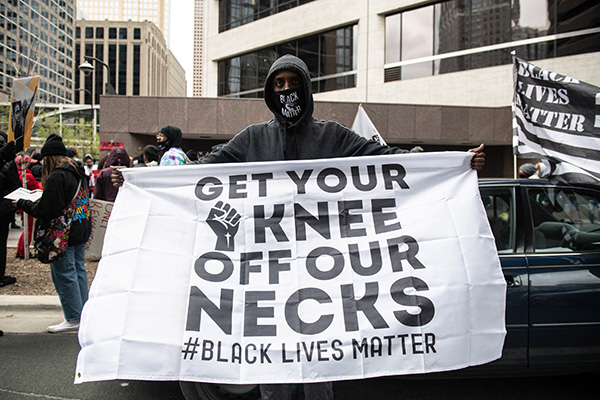
Credit Image: © imageSPACE via ZUMA Press Wire
Building the asphyxia theory
The prosecution’s next witness was Dr. Martin Tobin. He was clearly not meant to be an important witness when the trial began, when the prosecution still intended to attribute George Floyd’s death to the blocking of his carotid artery. But now that theory lay in ruins, and it needed a new explanation. It decided to argue that Derek Chauvin asphyxiated Floyd. And he had to have done so in a way that left no physical evidence, since the autopsy found “no injuries of anterior muscles of neck or laryngeal structures.” This left them heavily dependent upon expert testimony.
The result was that Dr. Tobin, whose area of expertise was sleep apnea, became “far and away the most important witness for the prosecution.” He testified for two days — “on direct examination, cross-examination, redirect examination, re-cross-examination, re-redirect examination, rebuttal direct examination, and rebuttal cross-examination.” By the time he was done,
the State’s theory had become mind-bogglingly complex. . . . It seemed as if his willingness to testify to an almost farcically elaborate cause of death was the only requirement that mattered to prosecutors. And boy, was Dr. Tobin willing. He said everything the State needed him to say, and he ruled out everything the State needed him to rule out.
George Floyd spoke at least 256 words over a period of four minutes and 56 seconds after Derek Chauvin began restraining him, and any theory of asphyxiation had to be able to account for this. To begin with, Dr. Tobin attempted to square the circle with a theory of “low tidal volume” or “shallow breaths.” In normal respiration, air
goes down through the back of the throat, down through the windpipe, out through the bronchial tubes and then down at the bottom down to the alveolar air sacs . . . small, grape-like structures at the bottom where all the gas exchange takes place — where oxygen gets in and carbon dioxide is removed.
In a case of “shallow breaths,” however, air would be unable “to reach those air sacs.” It might enter the lungs, or even pass all the way down the bronchial tubes. “Once it reached that point, Floyd could expel the air, pass it over his vocal cords, and make sounds.”
At the same time, prosecutors needed the air to stop at that point. Basically, oxygen had to reach every part of Floyd’s respiratory system except the alveolar sacs. It had to get to the finish line but not cross it. Lastly, all this complicated stopping and starting of air flow had to be attributable to the arresting officers, specifically to Derek Chauvin. In short, the prosecution needed the jury to believe that Derek Chauvin asphyxiated George Floyd by applying pressure in an anatomically precise way such that oxygen could reach all parts of Floyd’s lungs except the parts that absorb it into the bloodstream.
Implausible as all this sounds, there is another problem with it:
Floyd wasn’t just making sounds. He was speaking intelligible words. This required that his brain keep working — by receiving oxygenated blood. For the blood to be oxygenated, air had to reach the alveolar sacs; it had to cross the finish line.
Under challenge, Dr. Tobin admitted this: “You cannot speak if your brain is not alert. So, when you see somebody speaking, you know . . . that there is oxygen going to the brain.”
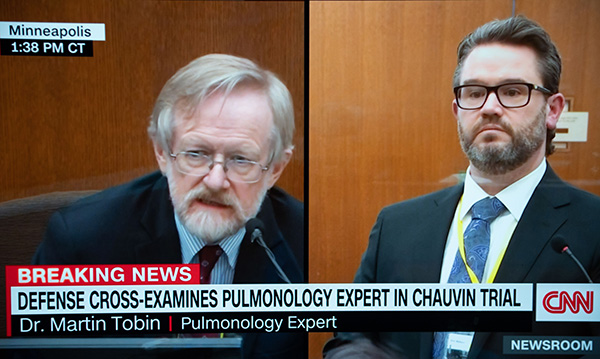
Pulmonology expert Dr. Martin Tobin and defense attorney Eric Nelson. (Credit Image: © Pool Video Via Court Tv via ZUMA Wire)
At this point, Mr. Harker writes, the prosecution should have
moved to dismiss the charges against Officer Chauvin with prejudice. Doing so was their duty. Rule 3.8(a) of the Model Rules of Professional Conduct requires that a “prosecutor in a criminal case shall . . . refrain from prosecuting a charge that the prosecutor knows is not supported by probable cause.” This duty applies through trial and even after conviction. Rule 3.8(g) states “when a prosecutor knows of clear and convincing evidence establishing that a defendant in the prosecutor’s jurisdiction was convicted of an offense that the defendant did not commit, the prosecutor shall seek to remedy the conviction.” Dr. Tobin’s admission easily reached the “clear and convincing” threshold.
Instead, prosecutors continued questioning Dr. Tobin who, without missing a beat, shifted his theory from “shallow breaths” to “compression of the hypopharynx.”
Sleep apnea occurs when the hypopharynx collapses during sleep. This collapse obstructs the passage of air into the lungs. According to Dr. Tobin, something similar happened when Chauvin’s left knee “compressed” Floyd’s hypopharynx. This compression “occlude[d] the air getting in through” the hypopharynx.
Such a thing can easily happen when pressure is applied to the soft, unprotected front of the neck: this is just what is commonly called “strangulation.” But Chauvin’s knee was on the back of Floyd’s neck, where his hypopharynx was protected by his spinal column and the nuchal ligament.
The nuchal ligament is the massive ligament on the back of the neck that holds up the head and limits flexion of the neck. During cross-examination, Dr. Tobin conceded that this ligament is very strong and can withstand a great amount of pressure. The same goes for the spinal column. Therefore Dr. Tobin had to argue that Chauvin’s left knee applied so much downward force that it overcame the two powerful structures protecting Floyd’s hypopharynx.
Dr. Tobin claimed that Chauvin’s knee put 91.5 lbs. of pressure on Floyd’s neck, a figure he arrived at by estimating the total weight of Chauvin’s body and equipment and dividing by two for his two legs. But in fact,
Chauvin had four points of contact with the ground during the restraint, not two. Both of Officer Chauvin’s feet were on the ground almost the entire time. Meanwhile, his right knee was shifting from the ground to Floyd’s arm, and occasionally to his back. His left knee was applying weight to Floyd’s shoulder blade, trapezius, and neck. Four points of contact.
So there was something closer to
45 pounds applied to the back of Floyd’s neck, where the nuchal ligament and spinal column protected his hypopharynx from compression. For a man of Floyd’s stature, this was an insignificant amount of weight. Dr. Tobin admitted as much, saying that when “the nuchal ligament is underneath Officer Chauvin’s knee, there’s going to be very little compression of the hypopharynx.”
Moreover, during the restraint, Floyd varied the position of his head, and Chauvin varied the position of his knee, so the pressure was not continuous. Nevertheless, Dr. Tobin alleged that this intermittent pressure of 45 pounds to the back of a six-foot-four, 223-pound man
was “almost like a surgical pneumonectomy — it was almost to the effect as if a surgeon had gone in and removed the lung.” As a result, there was “fairly little opportunity” for Floyd “to get any air to move into the left side of his chest,” making him “totally dependent on what he’d be able to do with the right side.” In other words, a mere forty-five pounds of weight applied intermittently to Floyd’s back was the equivalent of removing his left lung.
The defense had no fewer than twenty-three separate clinical studies contradicting this testimony. In one, 225 pounds was applied to the backs of test subjects held in the prone restraint, and researchers still found no significant disturbance to their ability to breathe. Dr. Tobin airily dismissed all these studies as “highly misleading” and “not relevant.” The jury received no information about them at all.
Moreover, Dr. Tobin told the jury that it didn’t matter whether Chauvin’s right knee was on Floyd’s back, “down on the arm, or in against the chest.” They all “would have the same effect.” When not on Floyd’s back, the knee “was placed on his arm and then rammed into Mr. Floyd’s left chest.” This meant that Floyd’s “ability to expand his left side” was “enormously impaired.” “It’s like the left side” of Floyd’s lung was “in a vice,” he said.
But a vice has two sides, and there was nothing applying pressure on Floyd’s right side. So Dr. Tobin appealed to the positioning of the handcuffs behind (not to the right of) Floyd’s back. By some mechanical force known only to Dr. Tobin, “the handcuffs combined with the street” to prevent Floyd from expanding his chest laterally.
Then Dr. Tobin alleged that the prone position in which George Floyd was held in itself prevented him from getting enough oxygen. This was directly contradicted by two expert witnesses for the defense. One study was produced involving “3,000 or so interactions” when police placed suspects in the prone position: “No deaths . . . occurred.”
But the height of preposterousness in Dr. Tobin’s testimony came when he was shown Exhibit 942, two still frames from Officer Kueng’s bodycam footage. On the left was a picture of Floyd’s right hand with one or more fingers extended toward the street. On the right side was another picture taken a few seconds later [showing] a single knuckle on Floyd’s right hand touching the rear passenger-side tire of Squad 320. Dr. Tobin explained that
you see his knuckle against the tire . . . to most people this doesn’t look terribly significant. [However,] to a pulmonologist, this is extraordinarily significant because this tells you that he has used up his resources, and he is now literally trying to breathe with his fingers and knuckles.
Nobody bothered to inform the jury that timestamps on these images revealed they were taken less than one minute into the officers’ restraint of Floyd, when he was still talking volubly.
In sum: air that stops just short of the alveolar sacs but somehow still lets oxygen reach the brain, lethal compression of the hypopharynx through 45 pounds intermittently applied to the back of the neck, a vice that compressed the chest from the left side only, and an effort to breathe with the fingers and knuckles — such was the farrago of absurdity Dr. Tobin conjured up to help the prosecution convince a jury that Derek Chauvin had asphyxiated George Floyd. I felt ashamed just reading it.
Dr. Andrew Baker and the autopsy on George Floyd
As chief medical examiner for a three-county area around Minneapolis, Dr. Andrew Baker had personally conducted “in the neighborhood of thirty-two, thirty-three hundred” autopsies in the Twin Cities area. He was certified by the American Board of Pathology in anatomic and clinical pathology and had a special certification in forensic pathology. Previously he had served in the US Air Force medical corps. “So accomplished and respected was Dr. Baker that he was the youngest person ever to serve as the President of the National Association of Medical Examiners.” Having performed the autopsy on George Floyd, he was the only expert witness at the trial who had more than the video evidence to go on.
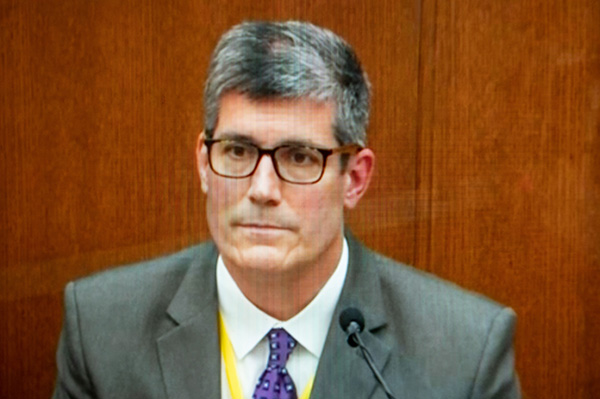
Dr. Andrew Baker testifies during the trial of Derek Chauvin. (Credit Image: © Pool Video Via Court Tv via ZUMA Wire)
Dr. Baker initially found that Floyd died from “cardiopulmonary arrest complicating law enforcement subdual and restraint.” At trial, he would testify that “complicating” means “occurring in the setting of.” In other words, his verdict was that “cardiopulmonary arrest” was the cause of Floyd’s death, adding that this happened to occur while he was being subdued and restrained by law enforcement.
Dr. Baker told jurors that to minimize the risk of “any preconceived notions,” he chose not to watch Darnella Frazier’s video until he had completed the autopsy, though he was aware it had gone viral. He was thus able to perform the autopsy free of narrative contamination. Dr. Baker was aware, however, that George Floyd’s neck and back were the subject of special attention. For that reason,
in Mr. Floyd’s case, I did make a special incision from the back of his head all the way down to his buttocks . . . and I dissected underneath his skin all the way out to the sides of his neck, all the way out to his shoulders, and all the way out to his flanks. . . . You might ask why we would do something like that. The answer is because sometimes fresh bruises can be difficult to see in some people, and so we look underneath the skin to make sure we haven’t missed something. . . . Those last few steps wouldn’t be part of a typical autopsy.
This especially thorough autopsy was accompanied by copious photography and written up in a detailed 13-page report. The goal was to document everything so thoroughly that another pathologist could look at photos and “feel like they’ve been there for the autopsy.”
Dr. Baker noted plenty of bruises and abrasions on Floyd’s body, but none was in the neck or upper back region where the prosecution needed them to be. As he observed to the jury, sometimes the most important findings of an autopsy are “the pertinent negatives, meaning . . . places where you might expect to see an injury, but you don’t.” In George Floyd’s case, “the lack of petechiae [pinpoint-sized spots on the skin caused by minor bleeding from broken capillaries]” is “a strike against the hypothesis that his airway or . . . the blood vessels in his neck were actually being compressed.”
Dr. Baker dissected the part of Floyd’s neck to which Chauvin had applied his left knee using force that Dr. Tobin characterized as “huge.” Dr. Baker’s dissection revealed “no areas of contusion or hemorrhage within the musculature.” Cutting deeper, Dr. Baker observed “the thyroid cartilage and hyoid bone [were] intact” and the “larynx [was] lined by intact mucosa.” Similarly, the “spinal column” was “stable and free of hemorrhage.”
Dr. Baker also inspected “the posterior neck, right and left lateral neck, shoulders, back, [and] flanks,” the areas Dr. Tobin claimed had been “compressed.” Yet he found “no areas of subcutaneous hemorrhage, soft tissue contusion, or other occult injury.” In short, “The autopsy revealed no physical evidence suggesting that Mr. Floyd died of asphyxiation.”
The autopsy was performed on May 26, the day after George Floyd’s death. Later that same day, Dr. Baker communicated his findings in the course of a virtual meeting with prosecutors Amy Sweasy and Patrick Lofton and agents from the FBI and Minnesota’s Bureau of Criminal Apprehension. But he submitted his final autopsy report six days later, on June 1. The final version attributed George Floyd’s death to “cardiopulmonary arrest complicating law enforcement subdual, restraint, and neck compression.” Those last three words were absent from his initial assessment. Why did he add them?
We do not know for sure, but there were at least two possible sources of pressure on him to do so.
First, a memo shows that on May 27, Dr. Baker took part in a meeting with prosecutors Amy Sweasy and Patrick Lofton as well as Mike Freeman and Andrew LeFevour, the most senior representatives of the Hennepin County prosecutor’s office. Other than Dr. Baker, all these participants were prosecuting attorneys. As the author explains:
This was either gross incompetence or intentional misconduct. Prosecutors do not meet with trial witnesses unless an officer, detective, special agent, or other non-attorney witness is present. Ever. To do otherwise risks turning the prosecutor into a witness in his own case. The reason for this is simple: If the witness makes any statement that he later contradicts, the prosecution is required to turn it over to the defense. The defense can then use that statement to impeach the witness at trial. The only way to do that is to call the non-attorney who witnessed the earlier inconsistent statement to testify. If there was no non-attorney witness present at the earlier statement, the prosecutor himself could be called to the witness stand in the very trial the prosecutor is prosecuting! This would likely result in a mistrial or worse. Every prosecutor knows this.
When this highly irregular meeting came to Judge Cahill’s attention the following September, he disqualified all four prosecutors from participating in the case, calling their conduct “sloppy” and “careless.” Mr. Harker adds:
Depending on what was said, their conduct may have been far worse than “sloppy” or “careless.” If they attempted to pressure Dr. Baker into changing his findings, their conduct would have been criminal, though it’s unlikely we’ll ever know.
There is a second possible explanation of Dr. Baker’s decision to add the words “and neck compression” to the cause of death in his final report: two telephone calls he received between May 29 and June 1 from a man named Dr. Roger Mitchell, chief medical examiner for Washington, DC.
In those two phone calls, Dr. Mitchell attempted to coach Dr. Baker on the cause of George Floyd’s death. I use the word “coach” to be judicious. Officer Thao’s attorney Robert Paule wasn’t so judicious in his 2021 motion for sanctions. There, Paule claimed that Dr. Mitchell “coerced” Dr. Baker “into changing his findings.” There is evidence to support this conclusion.
During their first conversation, Dr. Baker told Dr. Mitchell he “didn’t think the neck compression played a part” in George Floyd’s death.
Over the weekend, “Mitchell thought about Dr. Baker more” and “decided he was going to release an op-ed critical of Dr. Baker’s findings in” The Washington Post. But first, Dr. Mitchell “called Dr. Baker to let him know.” During that call, Dr. Mitchell told Dr. Baker he “was going to be critical of Baker’s findings.” In a more menacing tone, he also said, “You don’t want to be the medical examiner who tells everyone they didn’t see what they saw.” He added that “there was a way to articulate the cause and manner of death that ensures you are telling the truth about what you are observing on the body.” In case the point wasn’t clear, Dr. Mitchell added, “Neck compression has to be in the diagnosis.”
These words from the second telephone call are quoted from a memo written by prosecutors based upon a meeting with Dr. Mitchell on November 5, 2020.
There was public pressure as well:
Dr. Baker and his office received many threats from the public. At the federal trial of officers Thao, Kueng, and Lane, Dr. Baker testified that in the days after the initial complaint against Chauvin was filed, anonymous thugs inundated his office with calls. “By a very large margin” these calls “were threatening,” Dr. Baker said. “They were harassing. They were calling people out by name, threatening families, threatening to out people by home address.” Many were specific to him. “I’m sure it was in the hundreds, if not more,” Dr. Baker revealed. “There were days when the phone was ringing off the hook around the clock.”
Whatever the explanation, the words “and neck compression” were added to the final autopsy report — despite the report itself documenting a total absence of injuries attributable to such compression. This was a win for the prosecution, and may well have influenced the jury.
To be continued.