The Wrongful Conviction of Derek Chauvin, Part I
F. Roger Devlin, American Renaissance, November 13, 2026
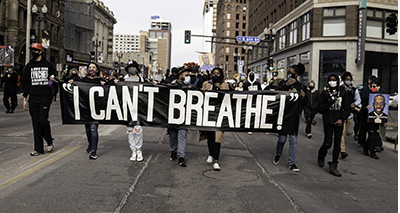
Lorie Shaull from St Paul, United States, CC BY-SA 2.0, via Wikimedia Commons
T.J. Harker, American Scapegoat: How a Corrupt Justice System Sacrificed Derek Chauvin to the Mob, Passage Press, 2026, $34.95 hardcover, $14.95 ebook
Nearly everyone who has written about the death of George Floyd and the trial of Minneapolis Police Officer Derek Chauvin agrees on one thing: that the significance of the case went well beyond the fate of two individuals. The events triggered a wave of rioting, looting, and arson across the United States, accompanied by weird, quasi-religious rituals such as “taking the knee,” serious calls to abolish police departments, and countless millions of dollars flowing into “antiracist” organizations and projects. I consider it the largest mass psychosis in American history.
But whatever the larger significance, the first and fundamental purpose of any criminal trial is to come to a sound decision regarding the guilt or innocence of the defendant. American Scapegoat explains convincingly and in great detail that the trial of Derek Chauvin was a serious miscarriage of justice: the officer can be proven not to have caused the death of George Floyd.
The author gets drawn into the case
At the time of Floyd’s death, author T.J. Harker was an assistant United States attorney in Tennessee, and had little leisure to examine the case. His first impression, based on early news reports, was that no reasonable prosecutor would bring an indictment over what “had all the trappings of an ordinary arrest.” Having participated in use-of-force reviews earlier in his career, he knew what rose to the level of criminal intent, and Derek Chauvin’s behavior clearly did not.
Of course, Mr. Harker was not entirely naïve about the realities of racial politics in America. He knew that
cases are brought to trial not only on the strength of their legal merits [but] when it is politically expedient to do so. And in this case, a white cop had detained a black suspect in a manner that appeared cruel and unusual to anyone unfamiliar with the unsavory realities of policing. Floyd had died in the process. Bystanders had filmed videos that captured some but not all of his arrest, and those videos had been circulated around the world, sparking protests that caused billions of dollars in damages.
An official narrative was quickly constructed that ran something like this:
George Floyd was suffocated by a bigoted peace officer who served to protect the system of white supremacy that upholds our structurally racist country. Floyd’s murder (for that’s what many public servants and elected representatives called it immediately after the fact — “murder”) was thus a revelatory event which exposed the evil at the heart of American life.
So, the author was not overly surprised when the trial went ahead anyway. He recalls that the little he could learn of it from news reports “looked farcical — an obvious show trial.”
Only in 2023 did Mr. Harker leave the Department of Justice to return to private practice. This gave him the leisure to read up on the case and the freedom to speak and write about it. From one little-publicized document he soon learned that Dr. Andrew Baker, the man who performed the autopsy on George Floyd, had asked Amy Sweazy, the original lead prosecutor: “Amy, what happens when the actual evidence doesn’t match up with the public narrative that everyone’s already decided on?”
Mr. Harker published a preliminary account of the “legal travesties” he uncovered in a pair of articles for The American Mind (americanmind.org):
As soon as these stories were published, I was flooded with emails and social media messages, all of which conveyed the same sentiment: Thank you for writing this. I feel the same way, I noticed the same things, but I can’t say it out loud. I can’t risk losing my job, my friends, my life.
Now, after two and a half years of further research, Mr. Harker has produced American Scapegoat, a book of 342 closely-printed pages.
The trial of Derek Chauvin took place amid what the author aptly describes as a “delirious atmosphere of misplaced credulity and misdirected rage.” Rioting in the immediate aftermath of George Floyd’s death was severe, and everyone knew worse was in store should the jury return a “not guilty” verdict. The truth of the case was thus hardly uppermost in the minds of either activists or prosecutors:
Derek Chauvin was convicted largely because bad-faith actors succeeded beyond their wildest dreams. Thanks to their efforts, millions of Americans now have entrenched beliefs about Derek Chauvin’s culpability for George Floyd’s death. These same Americans also have entrenched beliefs about racism and injustice in this country. They hold these beliefs not because they know the facts [but] because they have outsourced their critical thinking to a powerful political narrative.
The author understands that such powerful forces cannot be overcome by a single book, however carefully researched and cogently argued. He quotes the old observation that people go mad in herds, but recover their senses slowly, one by one: American Scapegoat was written for readers who can be reached by facts and reason.
The death of George Floyd
On the evening of Memorial Day, May 25, 2020, George Floyd went to CUP Foods, a convenience store on Chicago Ave. in Minneapolis. He arrived in the company of a friend named Morries Hall, and while there met a lady friend and agreed to give her a ride home. Cashier Christopher Martin noticed that Floyd was behaving oddly, and concluded that he was “under the influence.” After about 10 minutes in the store, Floyd bought a pack of menthol cigarettes from Martin with a $20 bill and left. He and his two friends walked across the street and got into his Mercedes-SUV.
Martin thought the $20 bill looked suspicious, and told the store manager. After making two attempts to speak to Floyd, still seated in his car outside, the manager had an employee call the police.
At approximately 8:00 p.m., officers Derek Chauvin and Tou Thao were dispatched to CUP Foods on a report that an individual was suspected of using a counterfeit bill. Before they could make their way to the scene, dispatch informed them that officers Thomas Lane and Alexander Kueng would handle the call instead. Lane and Kueng pulled up to the intersection of Chicago and 38th in their cruiser, Squad 320. This was only Lane’s fourth day on the Minneapolis police force. For Kueng, this was his third shift as a Minneapolis police officer.
Mr. Harker describes the ensuing arrest and Floyd’s bizarre and erratic behavior in detail, but nothing can replace the original police bodycam video. When he saw officer Lane approaching, Floyd quickly swallowed a white substance later identified as “speedballs” — fentanyl laced with methamphetamine. With great difficulty, the officers persuaded the six-foot-four, 223-pound Floyd to get out of his vehicle as they radioed for backup. They noticed foam at the corners of his mouth, a symptom of fentanyl intoxication (likely from a previous dose). Handcuffing him, they led him around the corner to their cruiser, which he refused to enter, claiming to be claustrophobic: “Jackknifed in the open door, wheezing, George Floyd appeared to genuinely believe that something physiologically catastrophic would happen to him if he entered the police car.”
At this stage, officers Derek Chauvin and Tou Thao arrived:
These two were old hands compared to Lane and Kueng. Thao, a member of the Hmong refugee community, had been with MPD for nine years. Chauvin, on the other hand, was a nineteen-year veteran who had personally trained Officer Kueng. He wasted no time in taking charge of the situation. “We’re gonna pull you in,” Chauvin told Floyd. Then he circled to the far side of Squad 320 and began to yank Floyd into the back seat with Lane’s help.
At this point, George Floyd said “I can’t breathe!” He repeated the claim eight times before officer Chauvin ever put a knee on the back of his neck. As the officers struggled with him, Floyd wriggled through the back seat and pushed his way out of the passenger side. While briefly inside the cruiser, he
smashed his face against the safety partition, bloodying himself and the interior of the vehicle. From their vantage point, the officers couldn’t see what Floyd was doing with his mouth. They did not notice that he was chewing, spitting, swallowing — he had managed to ingest something. Only George Floyd knew what the next five minutes would bring: a massive influx of drugs into his already overtaxed system.
Passing out the rear passenger side of the vehicle,
Floyd went belly-down on the pavement. He kicked at Lane, twice, and lost a shoe in the process. Chauvin asked the other officers if they had a restraint known as a “hobble” on hand; they could use it to limit Floyd’s mobility by tethering his legs together. “I can’t breathe,” Floyd called out. “I can’t breathe. I can’t breathe!”
While Thao went to search for a hobble in the trunk of Squad 320, Lane, Kueng, and Chauvin subdued Floyd by kneeling on top of him as he lay prone next to the cruiser’s rear right tire. Lane pinned his legs, Kueng pinned his lower back, and Chauvin pinned Floyd’s shoulders and neck. Lane used this moment of relative calm to radio in an EMS “Code 2,” signaling that emergency medical services were needed but not urgently.
Thao found the hobble, passed it to the officers kneeling on Floyd, and wondered aloud if they should call EMS. Lane and Kueng explained that they already had done so. In that case, the officers agreed, they didn’t need to use the hobble on Floyd. They would simply hold him in the prone restraint until help arrived, which their training and experience told them would be within a couple of minutes.
Help did not arrive. A seventeen-year-old black girl named Darnella Frazier came strolling along at this point and began recording events on her cellphone. Floyd, now with Derek Chauvin’s knee on the back of his neck, kept repeating: “I can’t breathe.” The officers responded that he seemed to be talking just fine, proof that he was getting oxygen.
Growing uneasy about the delayed EMS response time, Officer Thao radioed in “Code 3,” the highest-level alert, which required Emergency Medical Services to employ lights and sirens while arriving as quickly as possible. The officers had been restraining Floyd in the prone position for three minutes. The ambulance should have been arriving any second now.
It still did not appear. The crowd of observers on the sidewalk gradually grew larger and more hostile. Floyd went silent. A woman bystander demanded they check his pulse. Thao reassured the crowd that EMS was on the way.
After several more tense minutes, an ambulance finally arrived. The three officers got off Floyd and helped load him onto a stretcher. Paramedics chose not to perform emergency care on the spot in view of the hostility of the bystanders; instead, they took Floyd down the street in a precautionary maneuver known as a “load and go.”
Over two and a half minutes after the ambulance rolled off, the firefighters finally showed up. They are normally the first medical personnel to appear at an emergency, within two or three minutes of a call. That night, they arrived two minutes and eighteen seconds after being dispatched, but they were dispatched nine minutes after Officer Thao radioed for Code 3 emergency assistance. To this day, the delay has never been explained. Had it not occurred, the fire department’s emergency medical technicians would have found George Floyd still alive.
Whatever the explanation for the exceptional delay, it was clearly not the fault of Derek Chauvin or the other officers.
Yet prosecutors would later tell the jury that the scene was sufficiently safe; officers should have been confident that Floyd needed chest compressions; and they should have started those chest compressions earlier. This was unfair, ex post facto criticism. Every first responder on scene, including the four officers and the two trained paramedics, believed the scene was not safe and that medical intervention could not be provided there.
A lie travels the world before the truth gets its boots on
About four hours later, at 12:45 AM on the 26th, Darnella Frazier posted her 10-minute cellphone video documenting George Floyd’s death, accompanying it with the hashtag #POLICEBRUTALITY. Within minutes, Minneapolis’s police chief received a text message asking: “Chief have you seen the video of your officer choking and killing that man at 38th and Chicago?”
He watched Darnella Frazier’s video, by then “in the process of going as viral as few videos have before or since,” and informed Mayor Jacob Frey. The mayor spent the night conferring with lawyers. At a predawn press conference, he stated:
For the better part of the night, I’ve been trying to find the words to describe what happened. And all I can keep coming back to is he should not have died. What we saw was horrible. Completely and utterly messed up. Being black in America should not be a death sentence. For five minutes, we watched as a white officer pressed his knee to the neck of a black man.
The author comments:
Mayor Frey was telling the world that Darnella Frazier’s viral clip was exactly what it looked like: video evidence of the extrajudicial killing of a black man by a white cop. Even if Frey did not consciously intend to stoke moral fury and civil unrest, his statements and accusations — his presumption of guilt on Chauvin’s part — did exactly that.
That morning, Black Lives Matter celebrity lawyer Ben Crump awoke to several messages from relatives of George Floyd seeking his help. He watched Miss Frazier’s video and agreed to take the case.
Crump explained to Floyd’s family that his strategy for the case would involve drawing as much media attention as possible to the alleged murder — a tactic Crump had learned from the Reverend Al Sharpton. Narrative control was paramount. Crump would seek to humanize Floyd and vilify Chauvin. “Systemic racism” would be the watchword. The goal was to make George Floyd a household name.
The American Civil Liberties Union publicly urged that the case be removed from the slated Hennepin County prosecutor and handed over to Minnesota Attorney General Keith Ellison. A number of “black community leaders” demanded that the four police officers involved be fired, which they promptly were.
By the next day, May 27,
Darnella Frazier’s video was picked up by local and national news programs, as well as daytime and late-night talk shows. The entire mainstream media apparatus devoted itself to the Floyd case, discussing it ad nauseam and broadcasting snippets of video over and over again. What they had in the Frazier clip was evidence that appeared to confirm a certain political narrative about systemic racism and police brutality. Online, celebrities from Dwayne “The Rock” Johnson to Beyoncé to Kim Kardashian were venting knee-jerk anger about the case. So were millions of ordinary people.
On May 28, a crowd worked to a fever pitch by Al Sharpton breached the Third Precinct Police headquarters in Minneapolis, ransacked the armory, and set the building on fire. Riots and arson attacks began breaking out in other cities across the country. Demonstrations were held even in Great Britain, Germany, and Australia. Corporate America rushed to get involved, canceling Aunt Jemima and Uncle Ben as a supposed blow against “white supremacy,” and donating millions to Black Lives Matter and other “antiracist” organizations. “Defund the police” became a popular slogan. A murder that had not even happened was provoking a nationwide hysteria. The author comments:
To a disinterested observer, these protests appeared to function as a kind of mass atonement ritual. To cleanse their guilty consciences, countless individuals took to the streets to decry the supposed system of white supremacy. Identification with George Floyd, and with victims of “systemic racism” more broadly, proved an irresistible attraction. Claiming victim status — or claiming “allyship” with victims — was seized upon as a means of absolving oneself of moral culpability for participating in an unjust system.
Millions of people were seeking to affirm their own innocence by baying for the blood of an innocent man.
Conscientious prosecutors quietly withdraw from the case
The Hennepin County Attorney’s Office learned as early as May 26 from the doctor who conducted George Floyd’s autopsy that there was no physical evidence he had been asphyxiated. Accordingly, on May 28, Hennepin County Attorney Mike Freeman publicly cautioned that evidence did not support a charge against the arresting officers. Under public pressure, he later backtracked and recommended charges. His subordinate, Amy Sweasy, filed them on May 29, officially accusing Derek Chauvin of third degree murder.
On June 1, Gov. Tim Walz stepped in, appointing Minnesota Attorney General Keith Ellison to take over the case from Freeman. Miss Sweasy later testified: “June 1 had been another absolutely crazy day.” It began “with the information that the governor had stepped in . . . and given the case to Attorney General Ellison” while removing the county attorneys. Later that same day, however, authorities reversed course. Miss Sweasy and her colleague Patrick Lofton “were back on the case” and required “to start working . . . with the Attorney General’s office.” Sweasy confirmed this point personally with Attorney General Ellison.
During these days, Miss Sweasy and Mr. Lofton documented what was happening in a series of memos. The author explains:
The numerous memos that Hennepin County prosecutors Amy Sweasy and Patrick Lofton wrote in late May and early June 2020 are known as “memos to file.” It’s rare for prosecutors to write memos to file. When they do, it is a clear sign of underlying ethical concerns. Prosecutors write them when they are concerned that supervisors, appellate court judges, ethics committees, or others may revisit earlier decision-making by the line prosecutors.
A memo to file is a kind of whistle-blowing, and “it takes some courage to write one.” Sweasy and Lofton were the attorneys with the most knowledge of the facts in late May 2020, and their memos show they did not believe George Floyd had been asphyxiated. They emphasize other possible causes of death such as his severe heart disease and use of fentanyl. The author states: “When prosecutors put information damaging to a state’s case in a memo to file, it indicates an ethical concern, such as an improper charging decision by their superiors.” And indeed, Miss Sweasy later testified she believed the charges Mike Freeman had recommended against Derek Chauvin “violated professional and ethical rules.” As a result, she “withdrew from the case” on June 3. She also mentioned that “a male Assistant County Attorney . . . also stated [his] disagreement” with the charging decision “and refused to work on the case.” The man was Patrick Lofton.
Keith Ellison did not share their scruples. The same day Miss Sweasy and Mr. Lofton resigned from the case, he upgraded the charges against Chauvin from third degree homicide to second degree homicide, and filed similar charges against Thao, Kueng, and Lane.
Grounds for a change of venue
In August 2020, Gov. Walz stated: “I think certainly if the verdict comes out a ‘not guilty’ . . . it will be challenging.” Indeed, there was already rioting outside the courthouse September 11 on the occasion of a mere preliminary hearing. On October 15, an armed protestor made his way into the courthouse, bypassing security protocols; he was arrested “with a loaded handgun and several knives.” Protestors in the courthouse lobby shouted “fuck Chauvin” and even “kill Chauvin.” Officer Lane’s attorney was punched.
The defense reached the obvious conclusion: their clients could not obtain a fair trial in Hennepin County. As Officer Kueng’s attorney put it:
The jury will be influenced by the screaming of the crowds. Witnesses will be intimidated as they have to walk the gauntlet before they testify. Defense witnesses will be reluctant to testify if providing exculpatory evidence will subject them to rioting, assaults, and doxxing attacks. Chants and crowds will impact the decisions of the judge and jury. The defendants and their lawyers [will not be able to] safely enter and exit the courthouse.
Judge Peter Cahill admitted the validity of these concerns and even added some of his own; but he still refused a change of venue, saying that “better safety planning” would be sufficient. This ignored the defense attorney’s main point. Security protocols within the immediate vicinity of the courthouse were secondary to the concern that a Hennepin jury might convict out of fear an acquittal would rekindle riots in Minneapolis. But Judge Cahill said that “no corner of the State of Minnesota has been shielded from pretrial publicity regarding the death of George Floyd,” so that “a change of venue is unlikely to cure the taint.” This was a serious error: nearly any judicial district in the state would have been less biased than Hennepin County.
Suspicious leaks and a suspicious settlement decision
News stories based on leaks from unnamed “law enforcement officials” were published on the eve of the trial, including a Minnesota Star Tribune article headlined “Officials: Chauvin Was Ready to Plead to 3rd-Degree Murder.” Such plea negotiations are common but never made known to juries because they might bias them against a defendant (“why would he attempt to plead guilty if he were not guilty?”). Furthermore, in this case, the plea negotiations were alleged to have occurred on May 28, 2020, only three days after Floyd’s death. Mr. Harker states:
In my years as a state and federal prosecutor, I never heard of a defendant entering into plea negotiations three days after an event. Three days is often not enough time to retain a lawyer, let alone enough time for that lawyer to learn the facts of the case, assess various defenses, and give practical legal advice on whether to accept a plea deal. [Moreover,] prosecutors didn’t charge Chauvin with their first complaint until the next day, May 29, 2020. It’s rare for anybody to enter into plea negotiations when they haven’t been charged with a crime.
That this story was at least partially false, however, did not keep it from suggesting to jurors that Chauvin had been willing to accept a 10-year sentence, presumably because he thought the case against him was so strong. As Officer Thao’s attorney remarked: “it is impossible to overstate the magnitude of this misconduct or its prejudicial effect on the defendants’ constitutional rights.”
Less than three weeks before the trial began, the City of Minneapolis announced it had agreed to pay George Floyd’s family $27 million in damages for depriving him of his civil rights. Harker comments:
Filing a civil lawsuit against a sovereign entity like the City of Minneapolis should have been a time-consuming affair. Pretrial litigation typically involves filing the complaint, making interrogatories, conducting discovery, filing motions, attending hearings, conducting depositions, and more. Even if a defendant has a very weak case and is inclined to settle quickly, the process can still take years.
Cities also generally avoid publicizing such settlements. But in George Floyd’s case, they voted quickly and unanimously, arranging a press conference at which (according to the Associated Press) “City Council President Lisa Bender choked up.” There were no legal reasons either to settle the case so quickly or to announce the settlement publicly, but as Harker acidly writes,
there were political reasons to do both. There is little doubt the jurors heard about the settlement. And the message itself was beyond doubt: City officials had determined Chauvin was guilty. That’s why they agreed to pay $27 million to Floyd’s estate without attempting to defend the case. If Chauvin weren’t guilty, why would the city put its taxpayers on the hook for this enormous bill? If there were any doubts about his guilt, wouldn’t the city wait until after the criminal trial?
To be continued.