A Voice for Canada
Jared Taylor, American Renaissance, September 1, 2026

Last Saturday, after battling intense opposition from both local and federal governments, the Dominion Society of Canada held its first and very successful conference. By my guess, at least 250 people braved the media hysteria to attend what one speaker called the first truly nationalist meeting in Canada in three generations.
The conference was near Hamilton, Ontario, and the opposition from local government was hysterical. Mayor Andrea Horwath boasted about her “diverse city” and sent letters to local businesses, urging them to refuse to host a “white nationalist,” “anti-immigration group.” It added that venue owners should “understand that . . . this event may cause fear, anger and uncertainty,” and police contacted owners urging them to deny access.
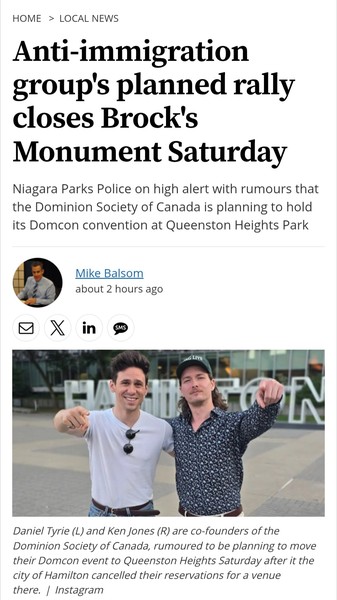
A coalition of 20 “watchdog” organizations brayed and hooted about “a hate-based group that explicitly targets Black and racialized immigrants and organizes around denying genocide and settler-colonialism in Canada.” Venues that had contracted to host the meeting backed out one after another, and the society was finally able to secure a site only three days before the meeting. As a diversionary tactic, members hinted they might meet in Brock’s Monument Park in Queenston, Ontario. On the day of the conference, the terrified city blocked public access to the entire 255-acre park.
At the federal level, authorization for Austrian activist Martin Sellner to enter the country dragged on long after the usual 72-hour consideration period, effectively banning him. Restore Britain spokesman Charlie Downes had his authorization “reopened” after an initial approval, forcing him to fly to the United States before crossing a land border that did not require the same formalities. Canadian police nevertheless held him for three hours, while they searched every corner of his car and even brought out narcotics-sniffing dogs to see if they could find some reason other than pure censorship to keep him out. They found nothing.
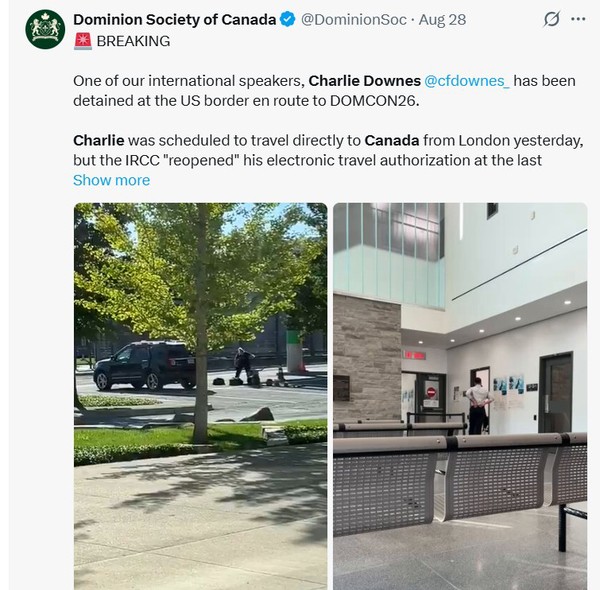
The member of parliament for Hamilton — Aslam Rana, wouldn’t you know it — intoned that “there is no place for hate and white supremacy in Hamilton,” or for “intimidation and violent extremism.”

Aslam Rana
The usual beauties showed up to protest.

So it was with a sense of exhilaration that we stepped into the beautiful venue for the conference, which began with a rousing chorus of “O Canada.”
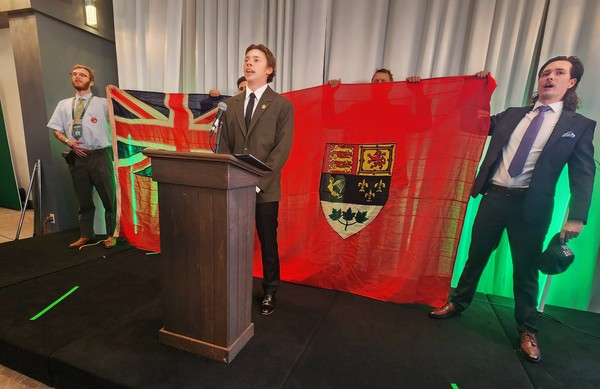
Matthew Baker, conference MC, leads the singing, with the Red Ensign, the traditional flag of Canada behind him.
Master of ceremonies and Dominion Society director Matthew Baker pronounced an ironic “land acknowledgement” that began with, “Hamilton was a barren wilderness.” It continued through the stages of European settlement and civilization, and ended with “We are a nation of settlers, explorers, and soldiers.”
The first speaker was Substack author John Carter, who gave a serious talk about loyalism versus liberalism. He argued that liberalism means the moral equality of men, but of replaceable men, shorn of all roots and loyalties. Liberalism keeps working towards what it calls emancipation, originally from “unchosen bonds,” such as nation, race, and culture. Now it seeks to emancipate us even from chosen bonds, such as marriage. Rights expand and duties disappear. Liberation from all bonds means that even art and poetry become rubbish.
A liberated man in a society in which the order imposed by ancient loyalties has been dissolved is without moorings. Our rulers therefore try to impose order and become themselves illiberal, resorting to censorship, debanking, and vilification.
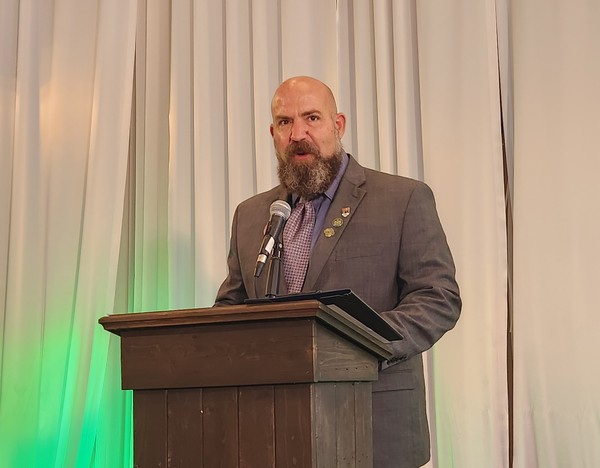
John Carter
Loyalism resists liberalism. It is not general or abstract; it celebrates bonds, and everything flows from that. Family, faith, language, nation, heritage — these are bonds to be cherished, not broken. Monarchy is based on loyalty. If you can be loyal to your sovereign, you can be loyal in life, because the crown represents attachment to a nation’s history and past. Alas, Charles II is hardly worthy of a subject’s loyalty. There are still a few loyalist institutions but even the Church of England is “a relic haunted by elderly lesbians.”
Mr. Carter argued that loyalism need not exclude every aspect of liberalism, which is so much a part of our thinking that even people who call themselves post-liberal or illiberal define themselves in its terms. It has certain worthwhile insights.
Mr. Carter reminded us, however, of the great importance of the Empire Loyalists — the 50,000 people who fled the American colonies to Canada because they were loyal to Britain. Like the Ancien Régime settlers who scorned the French Revolution, they were deeply conservative and helped set the tone for a Canada that was founded on tradition. Mr. Carter called for a return to loyalism, noting that it will be men who are rooted who will be the ones to overthrow liberal regimes.
Alexandre Cormier-Denis, a Quebec sovereigntist and founder of Horizon Quebec, is descended from 16 generations in North America. “Quebec is to the French Canadian what Israel is to the Jews,” he said, and “our friends at B’nai B’rith should understand this.” He explained that when Quebecers talk about the importance of language, what they really mean is a much deeper identity they dare not promote openly. There have been times when language was given so much prominence that Quebec was willing to welcome francophone Algerians, Haitians, and Malians, but there is now less enthusiasm for unassimilable newcomers.

Mr. Cormier-Denis and Daniel Tyrie.
Mr. Cormier-Denis decried the omerta that prevents the Anglo-Canadian ruling class from even talking about the replacement of its people. He noted that as populations change, politicians recalibrate to suit new clienteles, and this leads to fundamental changes in institutions. Now, it is unconstitutional to oppose even the idea of multicultural Canada. He ended with a stirring appeal to Anglo-Canadians. He recited many great victories and achievements of English-speakers all the way back to the Napoleonic Wars and concluded, “Anglo-Canadian man! Roll up your sleeves and take back what is yours!”
Martin Sellner spoke by video, but with a full-sized cutout behind the podium. He poured scorn on Canadian authorities who have let in criminals and terrorists, but who kept him out without a word of explanation. Every year, hundreds of thousands of foreigners arrive to replace Canadians. Canada must remain Canadian, but to that end, there must be remigration. He noted that the word first came into public discourse in 2016, but the seed was planted and is now growing into a healthy tree.
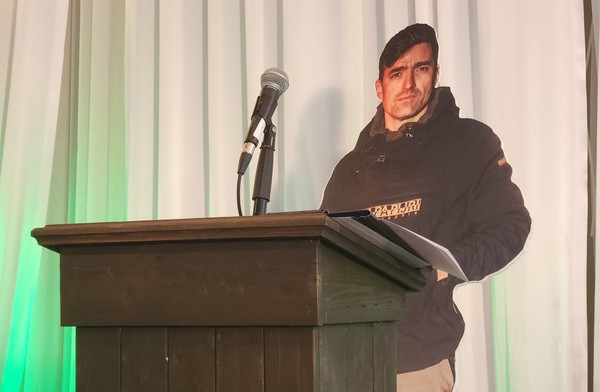
Martin Sellner
Mr. Sellner reminded the audience that it is all very well to talk about immigrant crime and welfare use, but that dodges the question. The basis of nation and policy can only be identity; only identity can maintain solidarity across generations. That is why liberals who steadily dissolve this intergenerational solidarity are destroying the basis of their own regimes. Mr. Sellner concluded with an appeal to what unites patriots in Europe, Canada, and the United States. We must act now before all is lost.
Ken Jones is a co-founder of the Dominion Society. The goal of the day, he said, was to unite foundational Canadians — French- and English-speakers — and that is why elites were terrified: “This day should be the shot heard across the nation.” Mr. Jones listed some of the obstacles the society faced just to hold a meeting, and its success was testimony to the Canadian spirit of “Get ’er done.” But in order to get ’er done in the larger sense, “We need more heritage Canadian white children. We are focused on remigration, but who is going to fill the void? We need more white babies.”
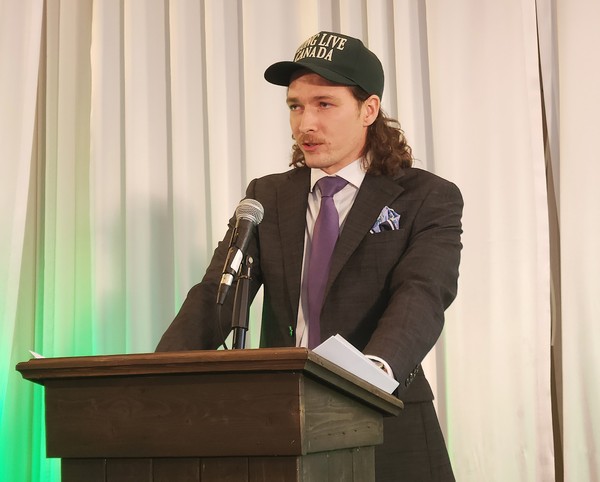
Ken Jones
The next speaker goes by the name of Fortissax. It was he who said this was the first time in three generations that Canadian nationalism has found its voice. “For most of our lives,” he said, “we have been told that the old Canada was finished. We refuse to accept that verdict.”
Fortissax listed several decisive moments in Canadian history, as the nation cut itself off from its roots. 1963 was a decisive year. Lester Pearson took office and made it a priority to get rid of the Red Ensign with the symbols of the four founding nations: English, Irish, French, and Scots. He badly wanted the culture-free maple leaf that now stands for everyone and no one. In 1967, Canada adopted the “points” system for immigration, explicitly abandoning any preference for the founding stock, and in 1971, Pierre Trudeau officially declared Canada multicultural. “We had been the political expression of Britain and France in Canada,” said Fortissax, and Justin Trudeau only accelerated that betrayal of the founding peoples; the process began well before him.
It has been a long time — 120 years — since Prime Minister Robert Borden articulated the then-prevailing view that Canada must remain British and French and maintain the best of both. “We inherit what our ancestors created,” said Fortissax. “A nation has an ancestry and a memory, and we will not be denied.”
Charlie Downes of Restore Britain, fresh from his adventure with Canadian Border Services, noted that Restore is now officially the fourth largest party in Britain, with 150,000 members, but the nation it means to restore is committing suicide. “Once it pursued it power,” he said. “Now we pursue pleasure.” Mr. Downes argued that the system in England is beyond redemption and its destruction must be based on what he called The Creed of the Revolutionary Right. This will be the spirit of the 2030s, which he predicted will be the most consequential decade since the 1940s. He argued that the creed has two foundations: European identity and Christian faith. It should be obvious that every European nation has an identity. If anyone from anywhere can become a Frenchman — or just as easily a German — is there no difference between French and Germans?
A nation is not an idea, but a distinctive national culture with a distinct people. Once the people are lost, the nation ceases to be, and is nothing more than a market, valued only for what it can produce and consume. Every man is a mobile unit of labor, and the family is sapped by market and government forces. Lebanon, Yugoslavia, and South Africa show us the chaotic result of mixing contending peoples. Politics becomes a profession rather than fulfillment of a duty, and government must try to reconcile the unruly forces diversity has unleashed.
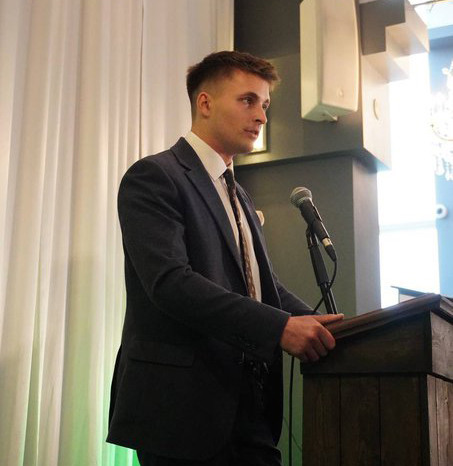
Charlie Downes
Christianity is our religion because it is true, said Mr. Downes. It is our duty to embrace its tenets because the highest truths are revealed by God. We must live in a sacral realm that stretches from marriage to household to tribe to nation to kingdom to the universal church. Without faith, there is no place for the supernatural or the soul. Christian morality has been displaced by a new moral order that denies enduring truth. Liberalism leads to emancipation from God himself. Once God is rejected, man’s desires become his sole guide. “Progress” is now our god, but Western Civilization imbued with the Christian faith is the strongest force in the world.
Daniel Tyrie, founder of the Dominion Society, was the final speaker. He was almost overwhelmed with emotion as he recounted the endless struggle and sleepless nights he endured to make the conference a success. He praised everyone in the audience for attending despite intimidation and threats. “The entire establishment tried to stop us,” he said, but “we are here to push the boundaries and set new standards.” He reminded the audience that the society is only a year old, “but look what we’ve done. What will it be like a year from now? There is a measure of Providence in our success.”
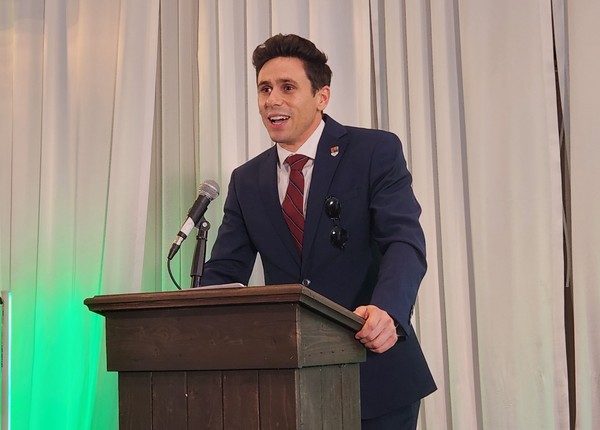
Daniel Tyrie
“And we are not going to stop,” he added. “We have burned our boats. We have nothing left to lose. My entire adult life has been devoted to preserving Canada. I have no other option.” Mr. Tyrie brought the conference to a close with passionate chants of “Long live Canada.”
After the conference, there was a dinner for VIP guests, where I gave a short talk. Lucy White of White Papers Policy Institute spoke on Canada’s need for remigration. She noted that in 1971, Canada was still 96 percent white, but in the 1980s, immigrants poured in, often more than 200,000 a year. Now, whites are only 64 percent, a catastrophic 30-point drop. However, with a firm, 12-year remigration program, the white population could be restored to at least 81 or 82 percent, with 7 percent Eskimo/Indian, and a residual non-Western 12 percent.
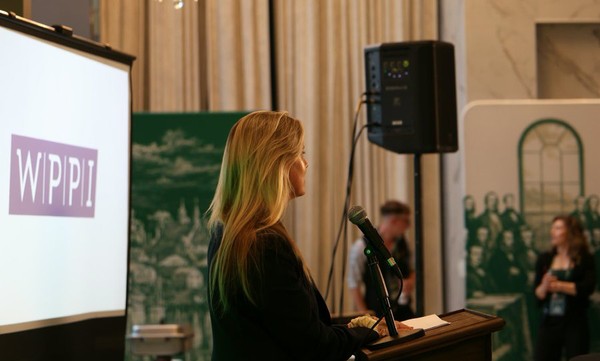
Lucy White
This was a truly remarkable conference, full of passion and commitment. I was immensely heartened to see the spirit of our people expressed so ardently and eloquently. The men and women of the Dominion Society can be justly proud of giving Canada a voice that has been silenced for so long.