‘Wypipo Do Season Dey Chicken’
Peter Bradley, American Renaissance, October 16, 2026
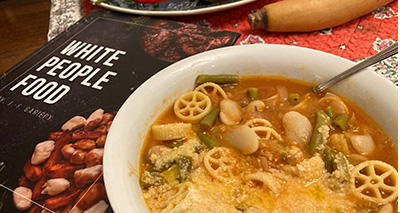
Photo credit: Amélie (@AmeliePathways on X)
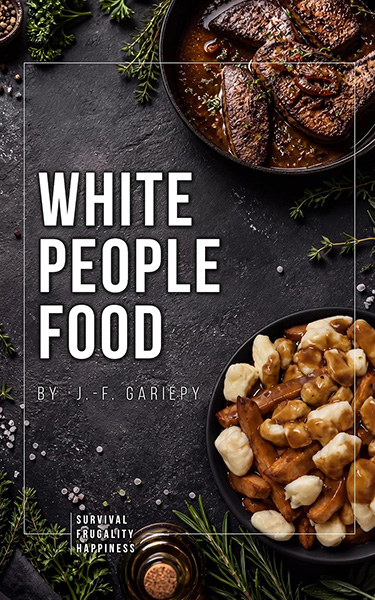
J.-F. Gariépy, White People Food, Independently published, 2026, 320 pp, $58 hardcover, $43 softcover, $29.99 Kindle.
One of the more puzzling stereotypes about whites is that we eat bland, tasteless food. French and Italian cuisine have worldwide reputations, so one would expect people to dismiss this idea as typical non-white envy. Yet, the stereotype persists. In White People Food, J.-F. Gariépy debunks this by collecting recipes from Europe, the United States, his native Canada, and beyond. More than a cookbook, it is an exploration of the history behind these dishes, tracing their origins to specific places and periods.
Mr. Gariépy is a biologist with a doctorate in neuroscience, but he is perhaps best known as a streamer who discusses politics, race, and science. He began researching this book after seeing a question on Reddit: “Are there foods that are known as white people foods?” Shepherd’s pie was one of the few examples people on Reddit could name.
Reflecting on this, Mr. Gariépy remarked:
I thought to myself, isn’t it ironic? In all likelihood, most of the things these people ate throughout their lives are European-descent foods. They just don’t know.
It’s time we started appreciating the foods produced by people of European descent across the planet as a unique expression of the ingenuity and historical conditions in which we live.
The author sees European cuisine as a blend of survival, frugality, and enjoyment. As he explains, “Every European dish tells the story of its makers’ desire to communicate a way of life in which we seek joy, fun, quirkiness, curiosity, communion, practicality and exceptionalism.”

J.-F. Gariépy
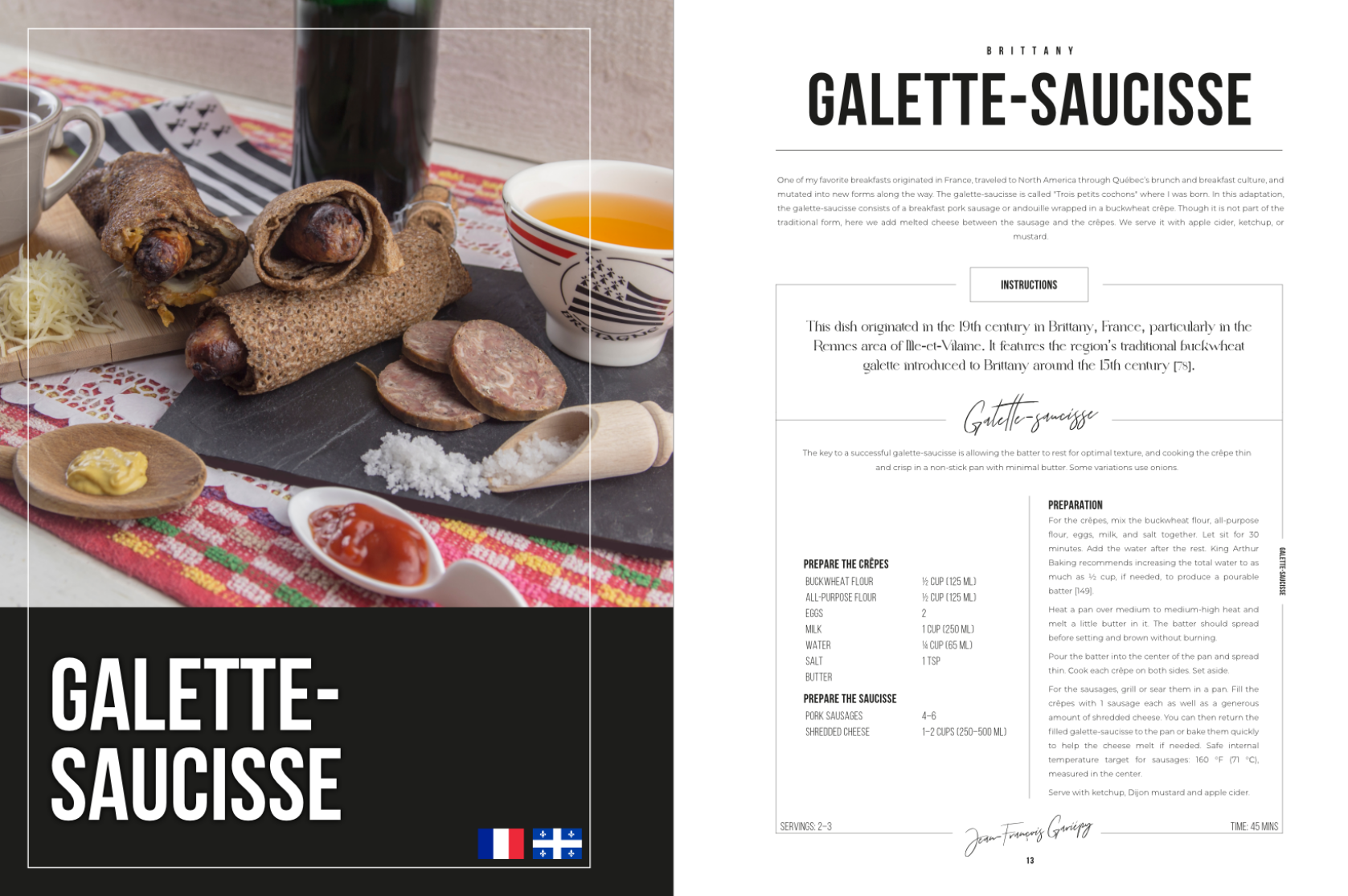
The book has chapters on breakfast foods, sandwiches, salads, soups, breads, braised dishes, fish and seafood, preserves, desserts, and much more. Alongside brief histories of these foods, he includes photographs and practical tips for preparing them. Most of the recipes appear straightforward enough for readers to make at home, and his passion for cooking shines through, as does his vast knowledge.
While some of these dishes are served at top restaurants (steak tartare, escargots, cashew duck), most are simple foods, including hamburgers, hot dogs, and pizza. There are many American foods from all regions in White People Food and many from the author’s native Quebec.
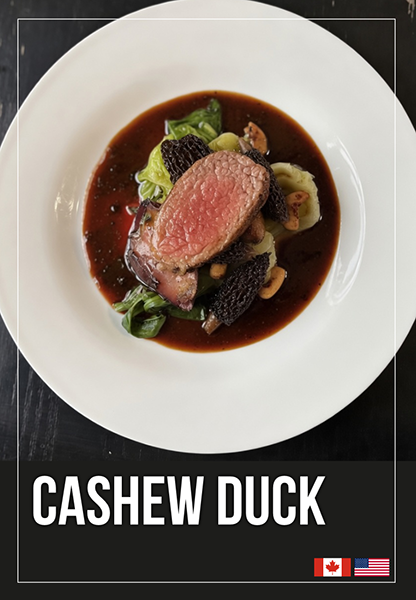
Credit: J.-F. Gariépy. Used with permission.
Who fried first?
Many attribute the origins of many American foods to blacks in order to claim whites have a meager culinary tradition. Mr. Gariépy dispels this myth.
The earliest known printed recipe for fried chicken appeared in 1691 in a cookbook by French chef François Massialot: “Let your chickens be cut into quarters […] marinate for 3 hours […] Make a clear batter with flour, white wine and egg yolks; dip your chickens into it, then fry them in lard.”
The first American recipe appeared in 1824 in The Virginia Housewife by Mary Randolph, a white Virginian. Her recipe closely resembled earlier European versions. However, because the Randolphs owned slaves, critics accuse her of stealing a black recipe.
Mr. Gariépy considers whether black cooks contributed to or improved fried chicken recipes. Here, too, he points to European precedents: cooks had begun incorporating spices such as cayenne and paprika into recipes in Europe during the 1800s. In 1937, an American, Mrs. E.D. Rivers, was the first to publish a recipe that added buttermilk. Later, Harland Sanders, better known as Colonel Sanders, founded KFC and developed his famous “secret recipe” in 1939.
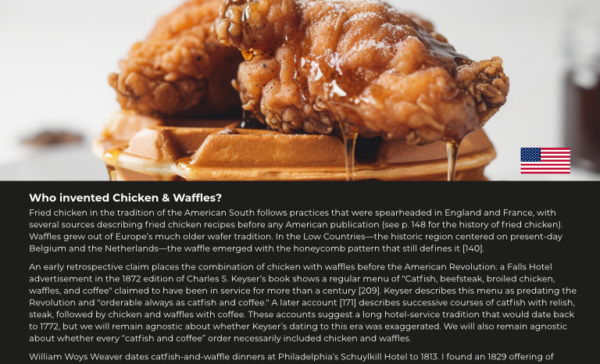
Credit: J.-F. Gariépy. Used with permission.
Mr. Gariépy acknowledges that black Americans have long cooked fried chicken, but he finds no major innovations that they introduced:
Had the Black community been immersed in a bustling world of inventive fried chicken culture, we’d expect unique innovations to show up in the early recipes of African American authors of the time, but they don’t. The techniques, toppings and spices described historically in African American recipes can all be traced back to methods previously developed by European-descent people and institutions.
Hot sauce has an interesting history. Indians in the New World cultivated capsicum peppers long before whites arrived. Archaeologists have found evidence of capsicum cultivation in Mexico from more than 6,000 years ago. The Portuguese and Spanish carried the plant to Europe, Africa, and Asia. In 1550, Italian cook Girolamo Cardano documented a sauce combining capsicum with vinegar. The sauce soon gained popularity in Italy and Spain, and English colonists commonly used it by 1684. In 1868, Edmund McIlhenny, a white Louisianan, began selling Tabasco sauce.
Why, then, do some people credit blacks with coming up with hot sauce? Mr. Gariépy points to a 1707 report from Jamaica stating that capsicum was “used extensively by Indians and Blacks.” The report also describes “putting it into pickle of vinegar and salt,” but does not identify who prepared the mixture. Mr. Gariépy remarks that “one unfortunate taboo of modern history is the possibility that the white man may have taught a thing or two to Africans and natives over more than a century of contact.”
Fish and chips is one of the quintessential foods of the British Isles, yet accounts of its origins often credit it to Jewish immigrants in the 19th century. Mr. Gariépy points to earlier European precedents, including a 1691 French recipe for “wet-battered pike fillets” and a beer-batter recipe published by Hannah Glasse in 1747. Both fried fish and fried potatoes had long histories in European cuisine, but the earliest record he cites of the two being sold together comes from an 1879 advertisement for an establishment in Manchester. If Europeans had prepared both foods for centuries, he asks, why do accounts of this quintessentially British food emphasize its immigrant origins?
According to White People Food, the story stems from a marketing gimmick in 1968. That year, the National Federation of Fish Friers named a London shop once owned by Joseph Malin, a Jewish immigrant, as “The World’s Oldest Fish and Chip Business,” dating its establishment to 1860. Yet no evidence shows that Malin sold fish and chips together at that time. He died in 1867 and never claimed to have invented the dish. His descendants, who still owned the shop in 1968, welcomed the publicity and even filed a patent that year for a process for preparing battered fish.
What about hybrid foods such as cevapi (started by the Turks but enjoyed throughout eastern Europe) and Tex-Mex creations such as chili con carne? Mr. Gariépy writes:
The outer borders of White People Food will always be blurry. Do not be offended if I include a food in here that has mixed history. Instead, understand the mixed history, understand the role of White people in it, and make up your own mind about where the border of your own food world lies. I tried casting the widest net possible. This book is intended as a thinking machine, not a certificate of approval. Don’t think, “these foods are purely a White European phenomenon.” Think “These foods all tell us something about White People. Let’s find out what it is.”
Nor does he frown on sharing cuisines.
We should celebrate when European-descent culture is being appreciated by people from all walks of life. When I enjoy Chinese or Japanese food, I do not abandon my culture, nor do I violate theirs. But when I eat sushi, I know that it comes from people with different traditions than mine. Tasting their food gives me greater reverence for their culture. Conversely, there is a lack of reverence in viewing European food as an unlabeled “default” food, without properly tying it to the people who created it.
White People Food does not try to catalog every white recipe. It only scratches the surface of Europe and her descendants’ vast culinary tradition. Mr. Gariépy lists many foods he would have liked to include but for which he lacked space. Perhaps he will explore them in a second edition.
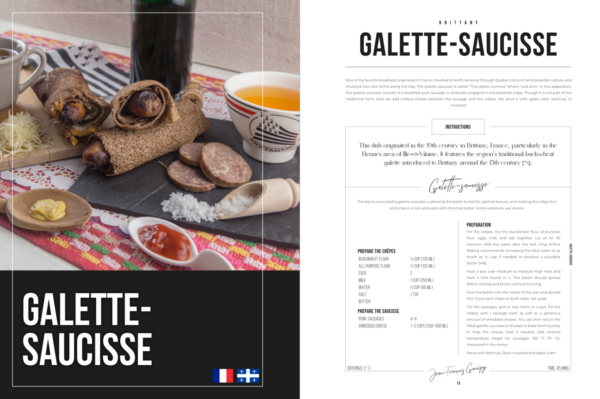
Click here for a full-size version. (Credit: J.-F. Gariépy. Used with permission.)
Mr. Gariépy included photographs, ingredient lists, and detailed cooking instructions for hundreds of recipes. He also explained how he used AI. In a comment to American Renaissance, Mr. Gariépy said:
We are staring at more than a century of efforts by food historians to obfuscate the role of Europeans in their own culinary culture. Everyone wants these dishes to have been contributed to by someone other than a White cook, and there are prizes and awards for those who can bend history in that direction. However, with the emergence of AI, we can now debunk the mainstream narrative by examining large historical datasets that would have been impossible to browse for a human historian. This allowed me to track all occurrences of an ingredient in the evolution of a recipe across centuries of cookbooks and newspaper publications. Many of the sources I identified in researching these dishes are novel and had never been cited by food historians. White People Food is an academic work disguised as a cookbook, but the disguise is good enough that you can cook with it.
To those who object to using AI, he writes in the book:
For those who would be worried that anything touched by AI is not genuine, all I can say is that the book, as it stands, is exactly what I wanted to communicate. I would argue that AI got me closer to my genuine vision than what I could have done without it.
Many cookbooks celebrate individual European cuisines and ethnic traditions, but Mr. Gariépy’s work celebrates the entire white culinary heritage. Despite its price, the book is worth considering, if only for its fresh perspective on arguments that denigrate our rich traditions.
After a year of work, I have received a first physical proof copy of White People Food.
This is the paperback, the hardcover should arrive soon. https://t.co/0Dz1cfZ28z
— Jean-François Gariépy 🧬 (@JFGariepy) August 11, 2026