A World History of Slavery, Part I
Michael Walker, American Renaissance, May 8, 2026
Subscribe to future audio versions of AmRen articles here.
Egon Prof. Flaig: Weltgeschichte der Sklaverei (A World History of Slavery), Verlag C.H. Beck 2018 Third Edition, 245 pp., €11.96 (softcover)
Egon Flaig’s Weltgeschichte der Sklaverei (A World History of Slavery) was first published in paperback in 2009 by C.H. Beck, a prestigious German publishing house, and is now in its third edition. The writer is a professor of ancient history at the University of Rostock. With his fondness for bow ties and mannered speech, he presents himself as an old-fashioned, eccentric academic. He is no stranger to controversy, however, and his is a familiar name in Germany. The publishers may have hoped that his renown would help to compensate for the disadvantages of a subject too comprehensive to appeal to most specialists, yet too academic to draw a large readership. If so, they were not disappointed.

The title of this book suggests that it is a chronological account of slavery down the ages, but that is not Prof. Flaig’s intention. He writes in his introduction that his focus will be on three slave systems only: that of the ancient world (principally Greece and Rome), slavery in the Islamic world, and the transatlantic slave trade. Prof. Flaig states that the Islamic slave system was the most comprehensive slave system and the transatlantic the most significant, which is why he focuses on them. He argues that the transatlantic slave system is particularly significant because its morality was hotly contested from the beginning, and hostility in France and Britain eventually led to its abolition. Prof. Flaig explains that the Islamic system was the most extensive in human history, and he believes that the moral worldview that powered Islamic slave systems persists in Islam to the present day. He offers no explanation for his focus on slavery in Greece and Rome. They may be good models for comparison, because material on slavery in Greece and Rome is plentiful; besides, ancient history is Prof. Flaig’s special field of study.
This is the summary on the back of the book:
It is not a matter of course that we live in societies without slavery. That we do so is the result of a historical achievement, and that achievement can be lost. The number of those who fall into a state of subjugation is increasing by the day, a subjugation that threatens to make human rights nothing but a worthless piece of paper. This book shows what is at stake. It describes what slavery consists of, how it formed in different cultural conditions, it explains the manner in which supply zones for an increasing demand for slaves arose, why enslavement in such zones had worse consequences than trading and dealing in slaves, the link between slavery and racism, and lastly what efforts were needed to abolish that system. [All translations by this reviewer.]
The titles of some of his other books point to Prof. Flaig’s concerns in this one: The Decline of Political Reason: How We Are Squandering the Achievements of the Enlightenment; In Search of Lost Truth: Disputes over Fundamental Questions in Historical Science. The opening words of his introduction emphasize what seems to be his principal purpose in this book: to draw attention to the historical importance of the abolition of slavery as a decisive moral turning point in human history and to urge opposition to anything that could lead to its return:
Human rights emerged in the struggle against slavery; they will exist so long as that worst of all forms of human bondage continues to be ostracized, and they will be abandoned should slavery ever return. This is where the chances of political universalism can be measured, a universalism which can unite the human race. (p. 11)
Prof. Flaig goes on to advise his readers that not only has he not written an exhaustive chronological account, he believes such an account would be pointless:
World history never means a collection of empirical data compiled from all epochs and cultures in the manner of an encyclopedia. Such an undertaking would not only be doomed to failure; it would also be, as Max Weber noted, entirely pointless. . . . Since the term “world history” first came into use in the 18th century, it has been used to refer to the consideration of human cultures understood in terms of an over-arching tendency as they progress in the course of time . . . . Part of humanity has come close to abolishing slavery all around the world. That achievement constitutes a major watershed in human history. (p. 11)
Although neither Oswald Spengler nor Samuel Huntington is mentioned in this book, their concepts of incommensurate cultures, and clash of civilizations, respectively, underlie Prof. Flaig’s thesis. He describes on the one hand the cultural force that worked towards the abolition of slavery: an ever-growing stigmatization of slavery in Western nations, notably Britain and France. He contrasts this with the Islamic slave system and notes that it was not challenged from within. Prof. Flaig further argues that Islam from its inception was driven and characterized by a slave economy and that it is intrinsically liable or even likely to legitimize slavery again in the future. It was, he believes, Western idealism that eventually led to abolition throughout the world.
The word “slavery” is defined and interpreted differently by different people. Sometimes it includes debt bondage, human trafficking, and serfdom. In the traditional radical and Left view, wage dependence under capitalism was described as a form of slavery, and Karl Marx described the relation of the proletariat to the owners of the means of production as that of “the slavery of the worker.” Orthodox Marxism defines the proletarian class as one of “wage slaves.” People write of addiction as a kind of slavery of the body or soul. Feminists have written of a married woman being in a state of household slavery.
Prof. Flaig’s understanding of slavery and therefore a slave system (nowhere does he concisely define either term) emerges in the chapter, “Political Anthropology of Slavery.” There, he explains which systems of what he calls “unfreedom” (Unfreiheit) are not slave systems and in that roundabout way he explains what he believes are the criteria for “slavery” or a “slave system.” Slavery is something more than the violent removal of an individual’s freedom (by which definition prisons could be called slave systems). In his own words, “Slavery is a social and political institution.” (p. 15)
Based on the assertion that slavery is an institution, Prof. Flaig identifies three defining practices of a slave society. First, slaves are widely recognized as such and are bought and sold legally, that practice being regarded without opprobrium by the majority of non-slaves. Second, trading in slaves — buying, selling, and exchanging them and making use of them to run a household or the economy or both — is an integral part of the culture and prevailing social system. Finally, the people who are sold and used have no voice in these transactions, and are denied all control over their destiny and their very lives. They are property, and quintessentially distinct from non-slaves. Slaves will not be regarded as entirely human by those who believe that a slave system is legitimate. Without social recognition as a human being, the slave is deprived of an essential spiritual component of life. Prof. Flaig cites the Imperial Roman jurist Domitius Ulpianus — “slavery is comparable to death” — and the Jamaican sociologist Orlando Patterson, who wrote that being a slave amounts to being dead to society, in a condition somewhere between chaos and death. (p. 16)
Prof. Flaig uses a fundamental distinction, also taken from Orlando Patterson, between “intrusive” and “extrusive” slavery. In intrusive slavery, slaves are introduced from outside. The slave in a system of intrusive slavery was and is a political, social, and even ethnic alien. A system of extrusive slavery, by contrast, is one in which slaves are former members of a society who, by becoming slaves, have lost their social identity and their rights as members of society.
Prof. Flaig spends comparatively little time on the extrusive form. He notes that it is inherently unstable because it undermines loyalty to the state from within by creating the fear of enslavement among a section of the population. People in that section live in fear of being dehumanized, of being forced through misfortune or, at the will of a judge, to abandon their humanity. However, he elsewhere acknowledges that extrusive slaves were more highly prized in Greek society for having several important advantages over intrusive slaves. They were familiar with the ways of the society, were often trained in appropriate skills, and they spoke the same language. In both extrusive and intrusive forms of slavery, the slave experiences a kind of death:
Strictly speaking they are lost to the world, for the world for humankind is not primarily the material world but the semantic: a world of meaning, value, and purpose. The enslaved are thrown into an environment where the sense of life is lost. The extent to which this loss of meaning is beyond recall depends on the extent to which the enslaved become reconciled to their new situation. (pp. 20–21)
Writing on slavery in ancient Rome and Greece, Prof. Flaig stresses that it is a popular misconception that slavery began there. Slavery existed in very early times, in Ancient Egypt and Persia and in the Mycenaean so-called “palace culture.” But the evidence of slavery in Ancient Greece and historical accounts of it are readily available. Homer, especially in the Odyssey, describes at some length the condition and roles of different kinds of slaves. The thousand or so city-states that existed in Hellas in the sixth century BC were all slave societies, albeit to varying degrees. Prof. Flaig pays particular attention to Sparta and the helots.
The helots were an aboriginal caste ruled by Sparta. Helots were bound to the land and condemned to forced labor. They were not free citizens, yet the Spartans did not individually own them, for they were collectively regarded as the property of the Spartan polis. Were helots slaves at all then in Prof. Flaig’s view? Since they had a collective identity, were not objects to be bought or sold, produced their own food and honored their ancestors, and thus had some control over their own destiny, helots were presumably not slaves. He nevertheless writes as though he thinks they were:
Unlike all other kinds of slave in Greek culture, they indisputably formed their own social class and were able to develop a clearly drawn collective class identity — one able, when the opportunity arose, to pose a real threat to their masters. . . . The English historian de Ste. Croix put them in the category of state serfs. Classical writers saw it very differently — being a helot was to be the worst kind of slave because the Spartan state regarded the helots as a group to be publicly and even ritually humiliated and killed. (pp. 39–40)
However the helots are classified, their status bore marks of both intrusive and extrusive slavery. They were regarded as outsiders (intrusive), yet they lived in Sparta and were not introduced from outside (extrusive). They were seen as entirely inferior, without political rights and subject to repeated and ritual humiliations of different kinds, including murder, constantly to remind Spartan citizens of the fundamental and unchangeable inferiority of the helot. Helots had the strong sense of a collective identity that Prof. Flaig claims slaves must have before they will so much as conceptualize a revolt — and there were helot rebellions. Prof. Flaig writes that in the revolt of 464/465 BC, the Spartans, very much in the minority, were unable to put down the revolt by themselves, although he does not say who helped Sparta suppress the revolt or how.
Crucially, the principal role of helots for Sparta — and slaves for other city-states — was to free up time for the citizen to attend to duties of state and undertake military training. Slavery releases free citizens from many physical tasks, notably agricultural, in order to have adequate time to exercise democratic duties. To be an active participant in democracy, notes Prof. Flaig, “the poorest citizen in multifarious aspects of his life had to be freed from the compulsion of work.” (p. 48) The historian Moses Finlay argued that this was a prerequisite for Greek democracy, and Orlando Patterson went further, asserting that the two conditions (slavery and extensive free time for the citizen) were prerequisites for a functional democracy in pre-industrial societies. Prof. Flaig notes that:
Greek slavery in most respects was not different from other historical forms of slavery. When one excludes the Sparta helot system, which Patterson does not consider to be a slave system, the Greek form was not worse than other forms and not more extensive. Nevertheless, neither democracy nor any ideology of civic freedom arose elsewhere which might be compared to that of Ancient Greece. (p. 49)
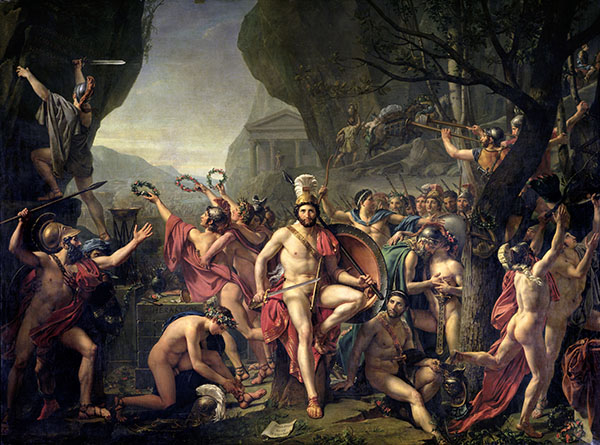
Leonidas at Thermopylae, 1814 painting by Jacques-Louis David.
Prof. Flaig argues that most slave societies in history were in no manner of speaking democracies. Conversely, there was no slavery in early democracies such as those of the late-medieval Swiss cantons, but slavery was essential for Athenian democracy, which required intense participation by the citizen, who was duty bound to attend assemblies 40 days in the year and legal procedures 150 days a year, in addition to many other mandatory meetings. In Sparta, the citizen was utterly dedicated to military training, with no time left for other matters essential to the order and survival of the state. Prof. Flaig concludes that at least in the case of Athens and probably other city-states, a slave system was indispensable to social and economic order and also because “Greek culture held freedom [for citizens] in such high esteem that they regarded restrictions on freedom as akin to slavery.” (p. 49).
Prof. Flaig is underlining here something he identifies as characteristic of Western culture, namely a faith in the supreme value of individual freedom, and a human right to it. Such a faith is incompatible with a tolerance of slavery. Prof. Flaig fully endorses this faith in freedom, without explaining why Western culture should be so attached to it and other cultures not. Not only slavery is fundamentally immoral from this viewpoint, so are all forms of culturally accepted “unfreedoms,” (Prof. Flaig’s word) of which slavery is just the most complete manifestation. Prof. Flaig points to serfdom as a kind of “slavery lite.” The serf, unlike the slave, possessed a degree of human and social autonomy, but the serf’s lot was not necessarily better than the slave’s.
Prof. Flaig notes that citizens writing about their slave society (including Islamic writers) were often uncomfortable with the notion that fellow “true believers” could be slaves. People sharing faith in the same God are already bound by faith. How can that be reconciled with severing the slave from fully human social engagement? Is this justifiable before God? Intrusive slavery is easier to accept because the slave is already different and alien, and therefore more easily seen as naturally inferior. Extrusive slavery will therefore tend to cause more social unease than intrusive slavery.
In ancient Greece, measures were taken to limit extrusive slavery. Solon’s reforms in Athens in 594 BC abolished debt slavery, the principal form of extrusive slavery in Athens at the time, and other city-states followed his example. However, reducing extrusive slavery in societies dependent on slaves inevitably leads to more intrusive slavery. Demand for slaves thus tends to incentivize military conquest, piracy and colonization. Intrusive slave societies are predatory by nature.
According to Prof. Flaig, the number of slaves in the Greek states increased rapidly after the defeat of the Persian Empire in 480–478. He says that this was also a result of increased Greek commercial and economic activity, urbanization, and a heightened participation by Greek citizens in democratic procedures, which led to an increase in the demand for slaves. If this is true, it is ironic, given the popular view that the victory of the Greek alliance over the Persians was the triumph of a free people over a slave empire.
What of slavery in the Persian empire? Prof. Flaig regrettably does not discuss it. A comparison between Greece and Persia might have given him the opportunity to distinguish between a slave society dependent on slaves (the Greek), from one in which slaves were not indispensable (the Persian) — assuming he believes there is such a distinction.
In this short book, Prof. Flaig cannot be expected to offer an in-depth analysis of Roman slavery, but what he does say gives further credence to his thesis that a demand for intrusive slavery fuels imperial conquest and vice-versa. He notes that from the third century BC onward, the once-sporadic influx of enslaved prisoners of war into the Roman Republic rose continually. The 55,000 survivors of defeated Carthage were all enslaved, and 150,000 were enslaved after the fall of Epirus (now in northwestern Greece and southern Albania) in 167 BC. Prof. Flaig quotes the Soviet historian Schtarjeman, who calculated that between 200 and 60 BC, half a million slaves were imported by the republic into Italy.
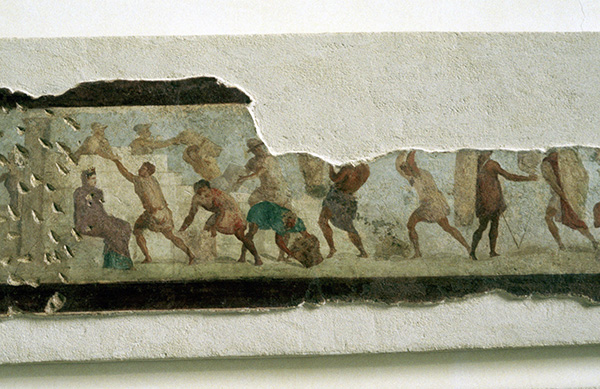
Slaves building a wall, watched by a taskmaster. Fragment of a mural from the Esquiline columbarium, porta Maggiore (or Porta Prenestina). (Credit Image: © PHOTO12 via ZUMA Press)
Rome used the threat of enslavement in its military campaigns: Cities that surrendered were not enslaved, while those that resisted were. A dramatic increase in slaves changed the Roman economy, especially agriculture. Small farmers could not compete against wealthy landowners with armies of slaves. Smallholdings also struggled to endure the long absence of farmhands to fight in the very wars that enriched major landowners.
In Roman society, it was common to set slaves free. The wealthy and powerful, according to Prof. Flaig, sought to build up a large following of loyal supporters, and freed slaves would be devoted to them, because their newly acquired freedom could be revoked. If former slaves were not loyal, a praetor had the right to decree them enslaved again. From 60 to 20 BC alone, Prof. Flaig gives a figure of 10,000 freed slaves per year.
The state came into conflict with private slave owners because of the large numbers of slaves freed, and as a countermeasure, the Lex Fufia Canina of 2 BC regulated the proportion of slaves whom a slave owner could free each year. Prof. Flaig does not explain why manumission was regarded as a danger by the state, but it is reasonable to infer that the creation of large numbers of devoted personal followers might be regarded as a potential challenge to state authority.
The Roman Empire was a slave society when it was pagan and when it was Christian. The famous slave revolts of ancient Rome took place between 135 and 71 BC in the days of the republic. In the years of the still-pagan empire, the rights of the master over the slave were reduced, in some ways dramatically. Prof. Flaig here recognizes an example of a current of thought that saw a slave as a sensitive living being and not merely a piece of property. Likewise, “It is very clear that considerable efforts were made to ‘humanize’ slavery and thus to stabilize it. Antoninus Pius forbade the killing of slaves without reason.” (p.68)
Slaves in imperial Rome had a higher chance than in other slave societies of finding a sympathetic ear in public, and slaves came to run the imperial bureaucracy and could assume substantial responsibilities and authority:
It was normal, especially in Imperial Rome, to hand over responsibility for running the household to slaves. They ran shops and stores, bought livestock, real estate and slaves, managed money and granted credit.” (p. 64)
Under Constantine the Great, killing slaves was permitted, although the new Christian dispensation led to a provision as bizarre as it was cruel. It was unlawful to kill a slave in rage, since wrath was a deadly sin. However, it was permissible to whip a slave to death, since the slave owner would not then be acting in a state of blind anger.
There was a decline in the proportion of slaves in the later centuries of the Roman Empire, which Prof. Flaig does not believe had anything to do with Christianity. He instead attributes the decline to the diminished value of Roman citizenship and the increase in the number of those who were practically unfree, reducing the demand for slaves:
[Roman slavery] changed in the third century from intrusive to extrusive slavery. . . . The privileges of citizenship lost their value and the erstwhile state of free citizens came to an end. When the Emperor Caracalla awarded Roman citizenship to all non-slaves, Roman citizenship had effectively lost its protective function and the population of the Empire, except for a small superior caste, had become potential forced laborers. . . . The condemned were doomed to servus penae, forced labor for life. They built and repaired public buildings, cleaned the streets, worked in mills and especially in mines, where life expectancy was very short. Slaves were no longer distinguished as those who were unfree but were those at the lowest level of unfreedom. The conversion of the Roman Empire to Christianity had no effect at all on this change.” (pp. 71–72)
Prof. Flaig does not mention that from the time of Hadrian onward, intrusive slavery declined because the Roman Empire had ceased to expand. This helps explain the blurring of the distinction between slave and convict.
Prof. Flaig also cites the role of epidemics in devastating traditional slave-owning estates in the Roman Empire, also reducing the importance of any distinction between slave and propertyless citizen. He makes it clear that economic forces were the prime movers that determined the status of slaves, the role of slavery in society, and the decline in the numbers of slaves.
Prof. Flaig describes attempts by thinkers in slave societies to justify slavery. In Jewish tradition, it was explained as the result of Noah’s curse of his grandchild, Canaan. The Ancient Jews named their slaves “Canaanite slaves.” Some Jewish prophets, however, envisaged a utopia in which all men would live free and no one would be a slave. The idea of this messianic utopia persisted in Jewish society.
Prof. Flaig records three Ancient Greek explanations for slavery: fate, race, and injustice. Homer writes of individuals being doomed to the fate of slavery. Although according to Prof. Flaig, there is no evidence of a racial determination of slave status, the Hellenes did regard slaves as inferior by nature, and Plato and Aristotle sought a scientific explanation for the origin of what they believed was their natural inferiority. According to Plato, human beings are apportioned different quantities of three principal human characteristics: good sense, courage, and appetite. Slaves belong to the category of men in which appetite is stronger than courage or sense, and therefore they are slaves because their destiny should lie in the hands of those who are not principally driven by appetite.
Aristotle wrote in a simpler vein, arguing that the difference between those who should be free and those who should be enslaved is that the latter lacked the ability to plan ahead and thus needed to be commanded. In Aristotle’s view, the relationship between slave and master was, in the widest sense, symbiotic. Aristotle also sought geographical, quasi-evolutionary explanations for the lower mentality of the slave. Prof. Flaig calls this “philosophical racism” (p. 74).

Aristotle with a Bust of Homer. Rembrandt, 1653.
Prof. Flaig counters Aristotle by quoting Alkidamas from the fourth century BC, who affirmed in terms later echoed by Rousseau, “God created everyone free, nature did not create any slaves. . . . Nature does not acknowledge a distinction between slave and freeman. The distinction is created through force.” For Prof. Flaig, this was a historically significant statement: “For the first time in world history we have the core principle of the abolitionist: Slavery is an injustice.” (p. 75) Prof. Flaig also quotes Cicero: “There is no human in the world who is incapable of developing his potential when he has found the appropriate guiding light.” (p. 76)
Prof. Flaig comments briefly on the interpretation of some Christian theologians who, like Philo of Alexandria, believed some people were predestined by an inscrutable fate to be slaves. An example is the story of Jacob and Esau. Esau, unlike Caanan, is predestined to be a slave to his brother Jacob, a fate predetermined for him in his mother’s womb. It was not his “fault,” any more than it is a donkey’s “fault” not to be a human being.
Prof. Flaig highlights three ways thinkers tried to justify slavery: A slave is punished for what he is or has done, a slave is predestined to be a slave from an inscrutable will or rule of fate, or finally, slavery is to be accepted as part of another way of life, respected in the name of equality between different cultures. Roman jurists distinguished between ius naturale, natural right, according to which each individual is free and has the right to be free, and ius gentium, the rights of peoples, which may include the right to own slaves. One might despise slavery in one’s own society but accept that in other societies “they do things differently,” and this should be accepted in the name of “the right to be different.”
In outlining arguments in ancient societies for and against the tolerance of slavery, Prof. Flaig raises a fundamental issue about the rights of individuals and the rights of peoples and different cultures. This is why his book is not only a work of history but also a polemical challenge. This becomes clearer when he describes transatlantic slavery and abolition. Far from considering transatlantic slavery as especially onerous, he highlights its significance as the system the West abolished and, applying the same humanist principles, worked towards abolition on a global scale. He strongly rejects the argument taken from economics and favored by Marxists, that slavery was already in decline and that abolition by Britain and France in the 19th century was preemptive and Western moral arguments disingenuous. Also, in placing ethics above cultural rights or the rights of peoples, Prof. Flaig rejects the notion dear to much of the Left and also to the French New Right, that societies enjoy collective rights, and their right to be different overrides the individual human rights of members of those societies.
Prof. Flaig takes a clear position against what he sees as the cultural relativism expressed in “the rights of peoples” and “the right to be different.” He also deplores the fact as he sees it that the Left has turned away from a former faith in the global rational progress of mankind, favoring instead culture wars and siding with anti-Western forces, even when those forces act for religious or nationalistic reasons, or both. In interviews Prof. Flaig has singled out Frantz Fanon and Michel Foucault for what he believes was their especially deleterious influence on the Left in this respect. He believes they helped pave the way for the Left’s benign attitude towards Islamic traditions in the name of an uncompromising respect for non-Western cultures. The Left once regarded Islam as another opium of the people and deeply reactionary. Not anymore.
Whoever regards the diversity of cultures as a thing of indispensable value must necessarily place cultural particularity above all universal considerations, in the name of the uniqueness of every culture not only to tolerate but recognize that the most extreme prejudices may prevail, that religious or ethnic discrimination may do their worst, that the most appalling oppression and frightful crimes may take place. Then it would be patronizing to even call such crimes crimes at all, that would be “foreign interference” and “disrespect towards the cultural identity of others.” (p. 220)
Continued in Part II.