Finland for the Finns
Jared Taylor, American Renaissance, April 23, 2026
Subscribe to future audio versions of AmRen articles here.
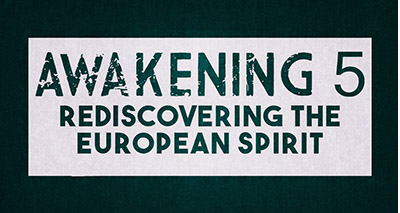
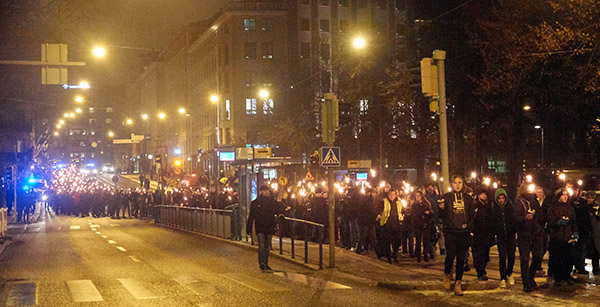
Tuukka Kuru is a lifelong Finnish Nationalist, and chairman of Sinimusta Liike (Blue-and-Black Movement) party. He is one of the organizers of the annual Finnish Independence Day torchlight marches, and has held five “Finnish Awakening” conferences.
This year, I was one of the speakers at the conference, held just north of capital, Helsinki. Finland is a beautiful country, still relatively untouched by “diversity,” and the Blue-and-Black Movement means to keep it that way. The conference theme was “Rediscovering the European Spirit,” and offered perspectives rarely heard in the United States.
The first speaker was Stefan Brakus, of Serbian heritage but reared in London, who described his own awakening. He noted that growing up, he knew no one who was a nationalist, but began to notice the population shifts of Hounslow, where he lived (now only 44 percent white British). He read widely, and believes that people who read books develop critical minds. We should all be revisionists, he said, in the sense of questioning everything mainstream media take for granted. Mr. Brakus said that it was the sorry tale of South Africa since apartheid that opened his eyes to race, and that the work of Romanian nationalist Corneliu Codreanu helped sharpen his views. He now calls himself a Serb, an Orthodox Christian, and a follower of the Third Position.
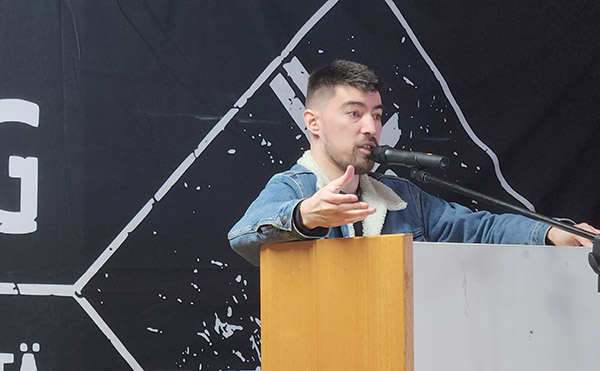
Stefan Brakus
Mr. Brakus concluded by noting that we are what we are through blood and heritage — that we incarnate our ancestors. In this era of threats to Europeans everywhere, it is easy to lose heart, but he reminded us that the Reconquista on the Iberian Peninsula took 800 years, and it was 500 years before his ancestors finally threw off Turkish dominance. We must have the same spirit: Never submit. “We must and we will endure,” he said. “Each of us lives as he does because of the sacrifices of our ancestors.”
Greg Johnson of Counter-Currents began by pointing out that if we do nothing, our race has no future. Education and metapolitics will not be enough. We need political leaders, and whoever reverses our march to extinction will be the world’s greatest hero. Why, asked Dr. Johnson, are there so few contenders for this role?
Of course, he noted, it will not be just one person. There are 52 white countries, by his count, so we might need 52 heroes who will save our race, one white country at a time. And, in fact, our movement is attracting more and more first-rate people. This may be because we are doing a good job; leftists seems to think that it is only the beguiling message of dissident activists that brings people our way. They are wrong. The “push factor” of the failed policies of our rulers is just as effective at swelling our ranks.
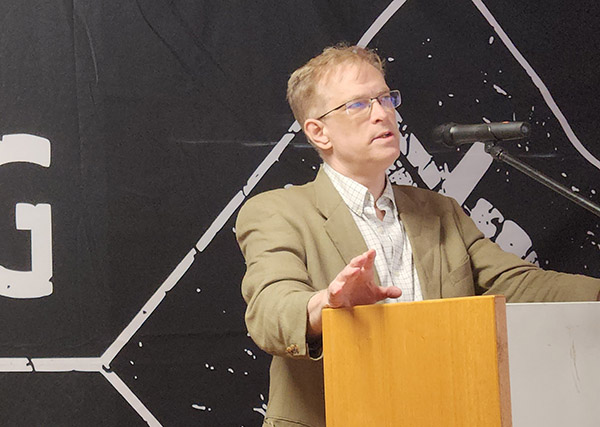
Greg Johnson
What should we look for in future leaders of our race? It’s easy to say what they should not be. Cult podcasters who rake in donations but never get out from behind the mic will never save us. Would-be Bolivars may try — and many in our circle dream of such a person — but they are likely to be driven by vanity and to surround themselves with yes-men. The Roman Republic invented the concept of the dictator who takes charge in a crisis, but steps down after the crisis passes. What we need are aristocrats — rule by the best men, who seek the cooperation and approval of other good men rather than fawning obedience.
Of course, Dr. Johnson noted, no man is a leader unless there are people to lead. Great men may only appear when enough of us are ready to follow. In the meantime, we should try to improve ourselves in every way, whether to be leaders or followers. It is also important to meet each other face to face. Our rulers do this routinely as they plot our dispossession. It is only face to face that we can observe each other and judge a potential leader’s qualities.
What most inhibits dissidents today is the fear of losing their jobs, so we must have groups and businesses that can offer support. Finally, although the leaders to come may rise in the hope of winning honor, there is an even more sublime motive, and that is duty. We must all strive to do the right thing for our people even if we are never known or remembered.
Tapio Rantanen is a Finnish nationalist and Vice Chair of the Black-and-Blue Movement. He spoke about the European soul. Plato, he said, thought of a tripartite soul, driven by appetite and spirit but guided by reason. Plato, like the Romans, believed that the soul survives death.
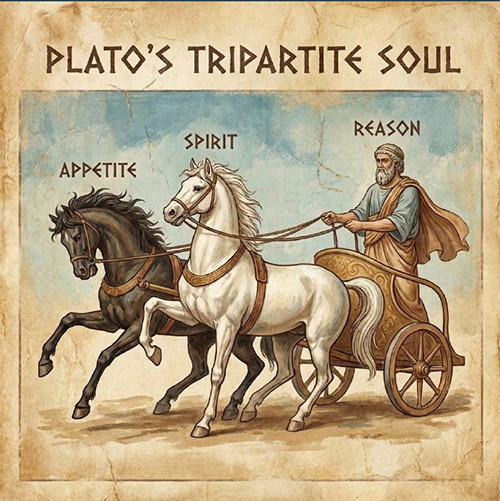
Mr. Rantanen also touched on the Norse concept of hugr, which is like the Platonic multipart soul, and includes hamingja, or inherited luck. According to some interpretations, after death, hamingja may live on and influence the living or even enter another body through reincarnation. Mr. Rantanen also quoted the famous verse from the 13th-century collection of Norse poems, the Hávamál:
Cattle die, kinsmen die,
And so one dies one’s self;
But a noble name will never die,
If good renown one gets.
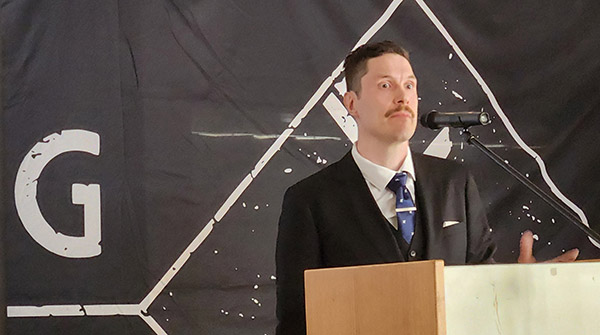
Tapio Rantanen
We are all familiar with the Christian soul, created by God, who passes judgement after death, but Christianity is declining in the West, and many white people are lost souls. Some look to science to explain everything — an error known as scientism. We now live in a world without boundaries, and you can now become anything you like — except what you actually are. It is practically a crime to say that you are a white man or white woman and distinguish yourself from others.
Mr. Rantanen showed an image of Carl Jung’s model of what could be called the soul. Jung believed that the unconscious mind was more vast and complex than the conscious mind, and that we have repressed memories that control us unawares. We deny the disagreeable parts of our personalities, which remain beyond consciousness. Jung thought all humans have the same collective unconscious, but Mr. Rantanen thinks races differ in collective unconscious. How could it not be so, since we inherit the unconscious from our ancestors?
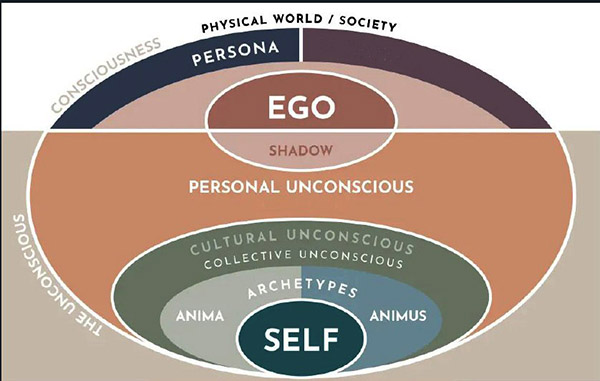
Mr. Rantanen said that good mental health comes from integrating as much of the unconscious with the conscious as possible, and this goes on our entire lives. Likewise, as a people, we must integrate our collective, national consciousness, and this happens only through face-to-face meeting. European people will better succeed in the struggle for survival if they better understand their collective national souls.
Romanian nationalist Codrin Goia gave a fiery talk, dressed in Romanian national garb. He emphasized that Romania is the province of Dacia that was eventually conquered by the Romans after two hard-fought wars. Romanian is a Romance language, but retains several hundred words of original, pre-Latin Dacian.
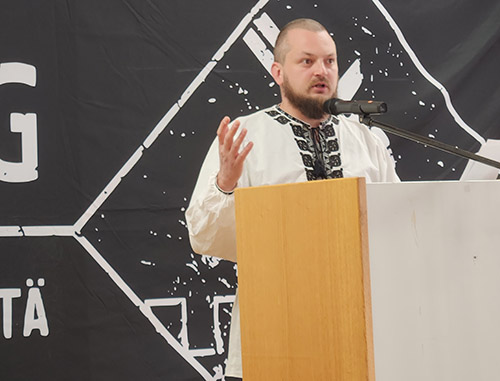
Codrin Goia
Romania adopted Christianity freely and the church was well established by the 5th century. From the 14th to 19th centuries, it was in the forefront of the fight against Islam, and Romania finally threw out the Ottomans in 1877. The Romanian Orthodox Church has recognized as saints 16 martyrs who suffered under Communism, and it holds annual memorial services for the more than 1,000 who died in the 1989 revolution that finally brought down the Ceausescu regime.
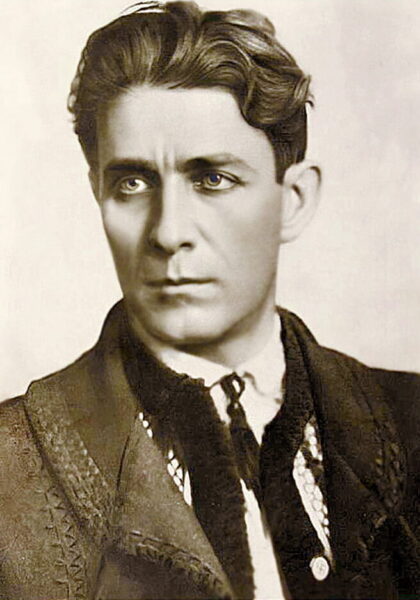
Corneliu Codreanu
Although Romania’s speech laws are not as severe as in some other countries, it is now illegal to quote Corneliu Codreanu publicly, even to cite his praise for honorable behavior. The rest of Europe, said Mr. Goia, is post-Christian, but not Romania, where Christianity is inseparable from nationalism and the church remains the country’s most trusted institution. Mr. Goia’s conclusion: “We did not choose to be born Romanians; we take pride in it.”
Tomislav Sunic is a Croatian former diplomat and academic, whose best-known book is Against Democracy and Equality. He began by lamenting the age-old tendency, ever since the Peloponnesian War, of whites fighting each other, noting that Russians and Ukrainians are almost genetically indistinguishable but are slaughtering each other even today. He noted that each country has national myths and these can build cohesion but also resentment against neighbors. Some European ethnonationalists still strengthen their identities by hating other Europeans.
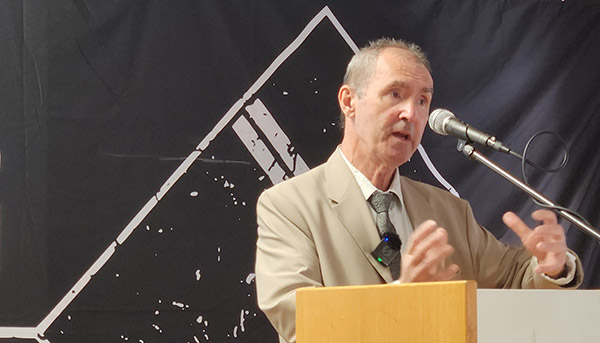
Tomislav Sunic
Our rulers never admit they believe in myths, but they obviously do: uninterrupted progress, democracy, permanent growth, human rights, ethnic equality. Today, we dissidents remind Dr. Sunic of the victims of other myths. According to Ovid, Philomela was the sister-in-law of King Tereus of Thrace. Tereus raped her and then cut out her tongue, so she couldn’t tell anyone. In another myth, Zeus ordered the talkative and eloquent nymph Echo to distract his wife Hera while he went philandering. When Hera found out, she cursed Echo, so that she could speak only the last few words anyone said to her. We are like Philomela and Echo, silenced if we break taboos, especially about race and the power of Jews.
Our real problem is not immigration or Islam; it is lack of will. Europeans have absorbed the Christian concept of original sin, even if they no longer go to church. Until we throw off this crippling guilt, we will never have the homelands we need.
I gave a wide-ranging talk about the role religion may play in white nation-building. I noted that Europeans have always had some form of religion, even though Christianity has now mostly supplanted paganism. I spoke of the many critiques of Christianity and noted the ways in which mainstream churches have become an objective enemy of our race, actively promoting intermarriage and the Great Replacement. I noted, however, that today’s Christians read the same Bible and recite the same Nicene Creed as Urban II, who launched the First Crusade, and that Americans justified slavery and Europeans defended empire on Biblical grounds. Perhaps Christianity need not be a religion of capitulation, but has been denatured along with every other institution in the West.
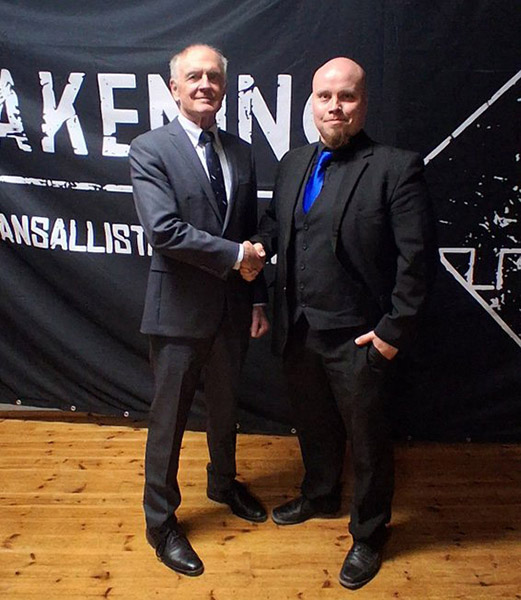
Jared Taylor and Tuukka Kuru
There have been efforts to revive paganism and even build science-based religions for white people, but I predicted that Christianity — of a more muscular, hierarchical kind — would remain the default religion of racially conscious white people. I concluded optimistically, calling attention, as Greg Johnson had, to the impressive men and women who are coming our way. I believe racial consciousness is an increasingly unstoppable force, and though the fight may be long, we will surely ensure the survival of our race.
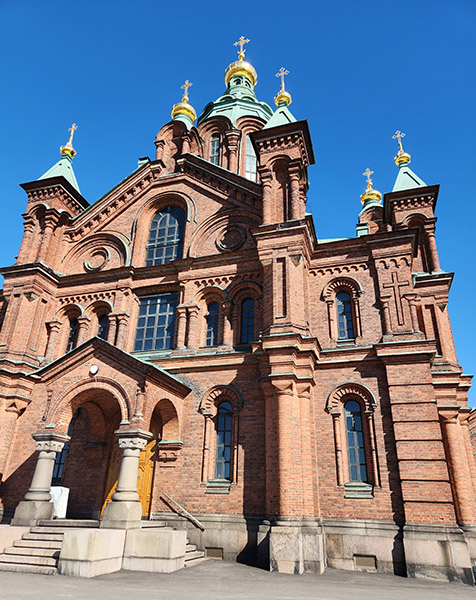
After the conference, I spent a day sightseeing in Helsinki, and found the city very handsome and overwhelmingly white. Finns admire their heroes and I saw statues of authors and warriors. There is a wonderful art museum with a fine collection that highlights many excellent Finnish artists. Mr. Kuru expects to hold another Awakening conference next year, and Finland itself is a reason those who attend will have a very rewarding experience.