Pan-Europa and the Kalergi Plan, Part I
F. Roger Devlin, American Renaissance, March 6, 2026
Subscribe to future audio versions of AmRen articles here.
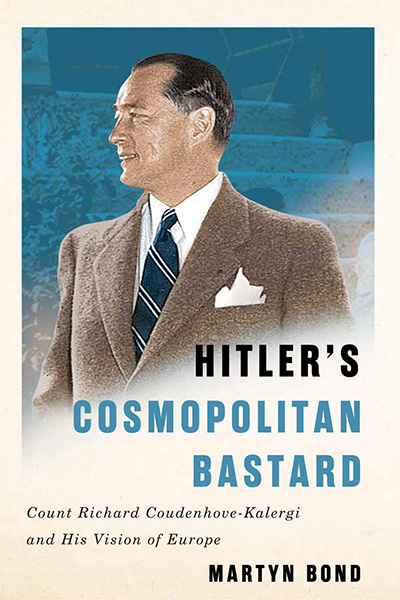
Martyn Bond, Hitler’s Cosmopolitan Bastard: Count Richard Coudenhove-Kalergi and His Vision of Europe, McGill-Queen’s University Press, 2025, 456 pages, $32.95 soft-cover.
Most readers of American Renaissance have probably heard something about the “Kalergi Plan” to destroy the European phenotype through interbreeding with duskier races. The alleged plan is said to be found in a quote from Count Richard Coudenhove-Kalergi’s book Practical Idealism (1925), in a version that has been widely circulated:
The man of the future will be of mixed race. Today’s races and classes will gradually disappear owing to the vanishing of space, time, and prejudice. The Eurasian-Negroid race of the future, similar in appearance to the ancient Egyptians, will replace the diversity of peoples with a diversity of individuals.
Coudenhove predicted further that the mixed population to replace Europeans would be guided to a significant extent by Jews, whom he described as a “noble race of spiritual grace.” Their prominence in the modern world, he wrote, “is due solely to their intellectual superiority,” whereas anti-Semitism is mainly due to envy and narrow-mindedness — the “reaction of the mediocre against the excellent.” Accordingly, “Jewry is the womb from which a new, spiritual nobility of Europe will emerge; the core around which a new spiritual nobility is grouped.”
Many readers will also know that the existence of any such “Kalergi plan” has also been vehemently denied, characterized as an “anti-Semitic conspiracy theory” that exists only in the minds of “white supremacists and neo-Nazis.” No one disputes the authenticity of the above quotations, however.
Until recently, it has been difficult for many in the English-speaking world to know just what to make of these claims and counter-claims, for there was not a lot of information about Coudenhove. Practical Idealism was translated only in 2024 (it can be read here), and most of the count’s voluminous writings remain untranslated to this day.
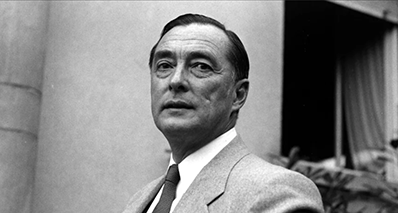
Therefore, people of all political persuasions have cause to welcome the first English-language biography of this notorious and disputed figure: Hitler’s Cosmopolitan Bastard: Count Richard Coudenhove-Kalergi and His Vision of Europe. The work is clearly the product of several years’ research, and its 373 densely printed pages are supported by 33 pages of detailed notes. It must be said that the British academic Martyn Bond is not an ideally unbiased broker of Coudenhove’s ideas; he comes down decisively on the side of those who dismiss the count’s critics as “white supremacists and neo-Nazis.” But he presents plenty of historical data to inform the reflections even of readers who do not share his point of view.
Early life and influences
Richard Coudenhove-Kalergi was born in Tokyo in 1894, the son of a titled Austrian diplomat and his Japanese wife. The family returned to Europe while he was still an infant, and he grew up in a German-speaking region now part of the Czech Republic. At age 13, he was enrolled in the Theresianum, an elite private boarding school in Vienna founded by Empress Maria Theresa, which admitted girls only in 1989. The curriculum was traditional, but the atmosphere international. Mr. Bond writes that “in his class year of fifty students, there were no less than fourteen nationalities,” including Turkish and Japanese. In his memoirs, Coudenhove wrote:
The most important thing I learned was understanding other people and how to handle them, rejecting any national ideology. At that time, Vienna was the international capital of the world. Being cosmopolitan was valued as being superior; being nationalist was seen as petty bourgeois.
This fundamental contrast between good, enlightened cosmopolitanism and bad, narrow-minded nationalism would remain essential to Coudenhove’s thinking throughout his life. His later plans for a united Europe might even be seen in part as an attempt to achieve on a continental scale the easygoing coexistence between boys of different nationalities he fondly remembered from his schooldays.
Yet outside the sheltered atmosphere of the Theresianum, nationalism was on the rise, as Mr. Bond explains:
In response to an earlier threat from Prussia, the German speaking political elite of Austria had co-opted the Hungarians into the political establishment through the historic compromise of 1867, which created the Dual Monarchy. Now Slav nationalism was on the rise. Thomas Masaryk, professor of philosophy at Charles University in Prague, was planning independence for the Czech nation. Josef Pilsudski, the Polish revolutionary then living in Vienna, was planning the creation of a Polish state. Theodor Herzl, a former journalist at the right-of-center, liberal-minded Neue Wiener Presse, had organized the Zionist movement that would later establish the state of Israel. And a powerful Pan-German backlash was also under way.
While still a student, Coudenhove was influenced by the book The United States of Greater Austria (1906) by the Austro-Romanian lawyer Aurel Popovici.
Popovici proposed empowering the ethnic minorities that made up the Austro-Hungarian Empire by striking a bargain with them similar to the deal that the German-speaking Austrians had made with the Hungarians fifty years earlier. Popovici’s idea for a stable future for the heterogeneous empire was to allow home rule for the other minorities and to hold them together in a federal union.
For a time, the program seemed realistic; it enjoyed the sympathy of Franz Ferdinand, heir to the Austrian throne. He, of course, was assassinated in Sarajevo in June 1914, sparking the First World War, at the end of which the Austro-Hungarian Empire fell apart in a series of nationalist uprisings. But Popovici’s unrealized proposals remained with Coudenhove as a partial inspiration for his vision of a future European federation.
During the winter of 1913, the 19-year-old count met the celebrated actress Ida Roland. Like him, she was of mixed background, the product of a marriage between a Jewish father and a Slovak mother. Although thirteen years older than he, divorced, and the mother of a little girl, she quickly charmed him. Their marriage was happy and lasted until her death in 1951.
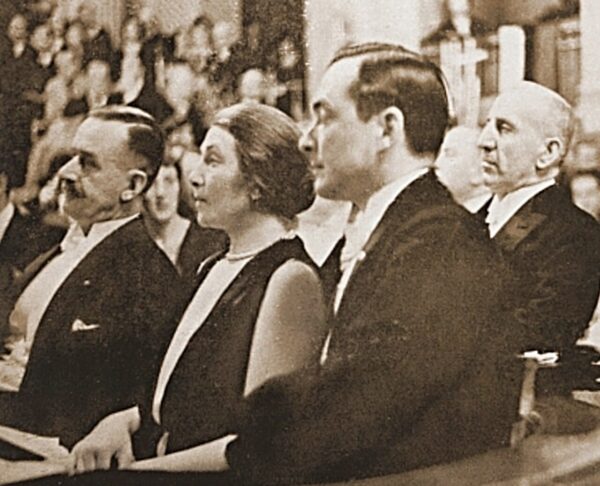
Ida Roland with Thomas Mann and her husband Richard Coudenhove-Kalergi at the second Pan-European Congress in Sing-Akademie zu Berlin on May 17, 1930.
When war broke out in 1914, Coudenhove received a military exemption on account of “weak lungs.” His biographer notes that there is no earlier evidence of any such medical condition, but acknowledges that a convenient diagnosis was “not difficult for a rich young aristocrat to obtain.” In fact, as he frankly admits, Coudenhove “refused . . . to fight for his country.” Instead, the young man spent the war years attending university courses. In his autobiography, he says:
I hated the war from the bottom of my soul and in that I was at one with Idel [his wife] who, as a real woman, was a pacifist throughout her life. It was hard to bear the tension between our personal happiness and the tragedies around us. We lived socially a very retired life, since most of our acquaintances were caught up in enthusiasm for the war and there was no point in trying to bridge the irreconcilable differences between us.
A letter to his wife from August 1914, gives valuable insight into his thinking:
The saddest thing . . . is not so much the frightful killings. […] What is the worst of the horrors, and will perhaps last for several hundred years, is the aggressive tendency of national consciousness that has been aroused. […] Writers glorify war and the cruelty of people is inspired by such hatred as has never existed since the end of the wars of religion. And the basic reason is simply that people speak different languages and on that basis are grouped together as different nations!
Mr. Bond even reports that Coudenhove put some of the blame for war on “the laziness of people who fail to learn other languages.” He saw it as the task of “all objective people in all countries to struggle against this hatred, these lies and these illusions — above all by enlightening the peoples about the lie of nationhood.”
Coudenhove seems to have inferred from seeing wars fought by nations that nationhood was the cause of war. This thinking is like the view that guns cause crime. One wonders how he might have thought of a book such as Lawrence H. Keeley’s War Before Civilization (1996), with its evidence that nation-states are by no means a necessary condition for extremely brutal forms of warfare.
Early writings
In 1919, Coudenhove published his first essay: “Plato’s Republic and Contemporary Forms of Government.” Plato’s concept of rule by an elite class of public-spirited guardians, as set forth in the Republic, appealed to him, and he considered how it might be put into practice under modern conditions. He was clearly no champion of the wisdom or goodness of the common man, and regarded democracy as merely paving the way for plutocracy. To counter the excessive influence of wealth, he championed a spiritual “neo-aristocracy” of artists, authors, and journalists (!), recommending that such verbal intellectuals be granted “a separate, additional electoral franchise” to ensure they could play a disproportionate role in guiding the political life of the nation. He even dreamed of an upper legislative chamber with membership based on educational achievement.
Another early essay recommended adjustments to the League of Nations whereby individual states would be replaced by regional groupings:
If a world organization is to replace global anarchy, so states should form regional groupings first. As the unification of Germany, Italy and Poland were necessary stages in the unification of Europe, so will the unification of Europe be a necessary step towards the unity of mankind.
A short pamphlet published in 1921 lamented the high cost of war preparations in Europe. Coudenhove’s counterproposal was to replace such “armed anarchy” with peaceful organization. This would involve both disarmament and the institution of a system of compulsory arbitration. As a possible model, he cited the Swiss Confederation “which brought together three languages, several cantons of diverse sizes, and both Protestant and Catholic believers in a single political and economic whole, with a light central government and a high level of cantonal autonomy.”
In a 1922 essay, “In Defense of Technology,” Coudenhove went further by proposing that a future European federation would have to provide for the common defense as well, because of possible air attack:
The states of Europe could no longer assure their citizens’ security from aerial attack. They were no longer fit for purpose and therefore had every interest in merging into a single federation that could effectively protect their common borders at the periphery of the continent.
Also in 1922, Coudenhove published an essay entitled “Nobility.” Three years later, it was reprinted as the opening chapter in Practical Idealism, and is the source of the much-publicized quotations about racial blending and Jewish suitability for leadership. Martyn Bond downplays its importance by noting that it is an “early” essay and claiming that its discussion of race-mixing is merely descriptive rather than prescriptive. Here is Mr. Bond’s summary:
Characterized by [Coudenhove] as “more aesthetic than mathematical truth,” [the essay] concerned social ideals. Through a series of stimulating comparisons or opposites such as town and country, intellectual and Junker, gentleman and bohemian, pagan and Christian, he speculated about what he called the “crisis of nobility” in contemporary society. He charted the historical evolution of human society from dominance by force of arms in feudal times to dominance by capital and by brain power in the contemporary world, and he contrasted the decline of the hereditary aristocracy with the rise of a plutocratic class. He pointed approvingly to Jews as examples of a new intellectual aristocracy in business, journalism, literature, and the arts, concluding with the prognosis that a generation led by noble individuals, the new “aristocracy of the spirit,” would rise from the progressive mixing of races and classes. [Note that this does not sound like mere neutral description.] He analyzed the importance of the shift from rural to urban living in the developed countries of the continent, and saw that the less developed would inevitably follow suit, as economic innovation and modernization accelerated this trend.
Coudenhove’s essay clearly contains a great deal of speculation, and cannot realistically be said to outline any “plan” meant to be carried out by the European Union decades later. The mixed-race author tends unsurprisingly to be sympathetic toward racial mixture, but in a passage not discussed by Mr. Bond, he acknowledges that both unmixed and mixed racial types have their typical virtues and faults. The “inbred” man of homogeneous ancestry, he writes, is characterized by “loyalty, piety, a sense of family, a caste mentality, perseverance, stubbornness, energy, and simple-mindedness; the power of prejudice, a lack of objectivity, a narrow mind.” On the other hand, the “hybrid” types more often found in cities “frequently combine lack of character, shamelessness, a weak will, instability, lack of reverence, and disloyalty with objectivity, versatility, mental agility, freedom from prejudice and a broad mind.” The mixtures Coudenhove has in mind here seem to be mainly subracial, rather than crossings between the great continental races of mankind; this reflects how the term “race” was commonly used in his day.
Nor does the essay prove that its author sought to subject Europe to a Jewish dictatorship. A closer look at the discussion of Jews shows the count’s recognition that their virtues are associated with characteristic faults as well. The overall impression one gets, however, is of a pronounced philosemitism. Even as he cautions that Jews are not literally the “new nobility” for which he is calling, he predicts that they will be, as noted above, “the womb from which a new, spiritual nobility of Europe will emerge.” Coudenhove’s father published a tract denouncing antisemitism in 1901; the son reprinted it with an additional preface that includes the following:
For a thousand years, Christian Europe has been trying to eradicate the Jewish people through unspeakable persecutions. […] All Jews who were not skillful, clever and inventive enough to survive the struggle for existence perished under these often-difficult living conditions. So finally a small community emerged, tempered by a heroically endured martyrdom for the idea and purified of all weak-willed and weak-minded elements. Instead of destroying the Jews, Europe reluctantly refined them through this artificial process of selection and educated them into a leading nation of the future.
He was thus an adherent of what later authors have called “the gentile selection hypothesis.”
The Rise of Pan-Europa
Coudenhove did not limit his activism to writing, but actively sought to influence the powerful. He wrote to Tomáš Masaryk, president of the new state of Czechoslovakia created amid the collapse of the Austro-Hungarian Empire, to request an audience, which was granted in the spring of 1920.
[Coudenhove] outlined his idea for a peaceful association of all the countries of the continent as a way of laying the ghosts of nationalism and solving the issue of minorities. After some discussion, Masaryk replied: “I believe your idea is correct, and the United States of Europe will one day come into being. But I fear the time is not yet ripe.”
Masaryk described how he had tried to champion an association of East European states at the Versailles Conference, but the program had run aground on the “ardent nationalism of the leaders of several of those countries, who would not consider putting their new-found independence into an alliance that would constrain their national sovereignty.” Accordingly, Masaryk encouraged the young man privately but declined to endorse his views publicly.
Coudenhove even placed hopes in Mussolini. In February 1923 he published an open letter urging the new Italian Prime Minister
to save the continent by calling a conference in Rome. Mussolini could set an agenda that would not only settle outstanding issues among the great powers, but also map out the future of the continent. “Only by means of full economic union, based on a firm political alliance and a general readiness to submit disputes to arbitration, can the prosperity, the peace, and the independence of the Continent be guaranteed.”
Mussolini did not reply.
In the spring of 1923 the count set down a general statement of his political ideals, publishing it under the title Pan-Europa. As Mr. Bond summarizes:
In barely one hundred fifty pages, Pan-Europa offered historical analysis, geopolitical prognosis, and policy recommendations. The core message was simple: Europe was weak because European states were divided among themselves. United, they would be strong. Their rivalry, which culminated in the Great War, destroyed their global hegemony, opening the door to the rivalry of Bolshevik Russia and capitalist America. The present geopolitical situation forces the states of Europe to “unite or die.”
Pan-Europa distinguished five principal power centers: Europe, the Americas, Russia and its dependencies, the British Empire and the Far East. We see from this that he excluded both Britain and Russia from his definition of Europe. He wrote that “Pan-Europa must be constituted without England, but not against England,” allowing for the possibility that the country might be brought into the union if the British Empire dissolved. It is not clear from Mr. Bond’s summary what he thought about the possible European status of a future non-Bolshevik Russia. As things were in 1923, however, “the single greatest goal of all Europeans, of whatever party or nation, should be to prevent a Russian invasion.”
The Great War had significantly lowered Europe’s status among the world’s power centers, and if it failed to unite, it might become a kind of chessboard on which outside powers competed, as a disunited Italy once was for France and Spain. Coudenhove’s proposal involved 26 states covering five million square kilometers and containing 300 million people.
If their dependent colonies were included, the figure rose to 26 million square kilometers and 431 million people, making Pan-Europa almost as large and as populous as the British Empire at that time, and double the population of Pan-America, his contemporary inspirational model. This alliance, he declared, could be independent in raw materials and in food, if only European states would co-operate instead of competing with each other. Pan-Europa, together with its colonies, would become one of the five great powers of the world.
Within this proposed federation, states would enjoy wide powers of self-determination, but they would speak to the outside world with a single voice. He warned against any further attempt to adjust national borders, arguing that a common market without tariffs would, in any case, reduce national borders to mere administrative boundaries. The benefits states would derive from joining his federation included guaranteed peace with federation neighbors, protection from Russian invasion, disarmament, and prosperity.
Pan-Europa concluded with an invitation to any European leader who shared his vision to call an international conference for the establishment of a system of obligatory arbitration — in effect, an international court of justice — and to prepare mutual security treaties. He also recommended the creation of a central Pan-European secretariat to coordinate future action.
The book was positively reviewed and sold well: 41,000 copies by the end of 1925. Each copy contained a prepaid reply card asking readers if they agreed with the idea of Pan Europa. Returning the card automatically made one a member of the Pan-Europa Union. The author received one thousand such reply cards within the first month. His idea had become a movement.
In January 1924, Coudenhove received a large donation (equivalent to more than $300,000 in today’s money) from the German-Jewish banker Max Warburg to serve as seed money for his organization, and the Austrian Chancellor provided rooms in Vienna’s Hofburg for its headquarters. April saw publication of the first issue of the monthly Pan-Europa Journal.
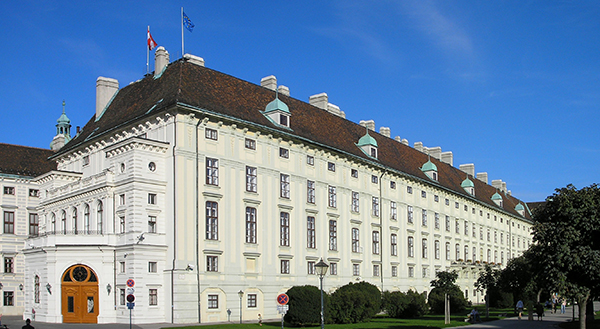
Leopold Wing of the Hofburg Imperial Palace in Vienna. (Credit: Gryffindor Panorama made by Digon, CC BY-SA 3.0, via Wikimedia Commons)
The Count sought to establish branches of his organization in all 26 states of his planned federation, and support groups in England and America. To this end, he began travelling to European capitals to make connections and drum up support in person. His first efforts were directed at Germany and France, since he knew that their traditional enmity was the single greatest obstacle to his program. He spent the last three months of 1924 in Berlin, meeting with many prominent and influential men. At the New Year, he went on to Paris, where he achieved even greater success. By the end of 1925, he had made the rounds of Rome, Warsaw, Budapest and Brussels, and even managed to visit the United States.
Britain was a divisive issue. Coudenhove met with some positive response to his ideas in London, but as he had foreseen, most British of the 1920s put their allegiance to the Empire ahead of any ambition to play a role in the future of Europe. To avoid a rift, the Pan-Europa Union took no official position on British membership.
In October 1926, the First Pan-Europa Congress was held in Vienna. The event was conceived as
a high-profile, international political rally in favor of the political goal of a united Europe. The Congress was not called to discuss whether Pan-Europa was desirable or not, but to determine how and when to make it a reality. But [Coudenhove] also made clear that his Congress was not just for politicians. He expressly wanted membership of his movement to encompass leading figures from business and the arts.
Over 2,000 delegates from 24 countries attended, and everything was done to make the proceedings as lavish and memorable as possible:
The Congress opened to the strains of the Ode to Joy from Beethoven’s Ninth Symphony in the largest and most beautiful hall in Vienna, the Konzerthaus. The mayor of Vienna offered a reception in the Rathaus, and the French, German and Czechoslovak ambassadors vied with each other in offering hospitality. The whole event culminated in a gala evening for all participants in the former imperial palace of Schönbrunn.
While some balked at all the pomp, it achieved Coudenhove’s aim of drawing widespread attention to his movement for European federation. At the head of a private organization less than three years old, he had succeeded in making his Congress a major international political event. The Pan-Europa Union soon had branches in 15 European countries and over 9,000 dues-paying members. His book Pan-Europa was available in nine languages.
By 1929, the movement for European federation looked unstoppable. Aristide Briand, who served six times as Prime Minister of France, announced that summer that he would launch a proposal to establish a European Union at the next meeting of the League of Nations. Addressing France’s Chamber of Deputies, he stated:
For four years the ambitious program suggested by the phrase “United States of Europe” has been in my thoughts without my being able to commit myself to the gigantic task. However, I have come to the conclusion that Europe will never be pacified as long as certain suspicions are not laid to rest, and as long as the nations of Europe do not try to find ways and means of collaboration.
That September, Count Coudenhove watched from the gallery as Briand put the case for European unity to the League of Nations assembled in Geneva. Especially encouraging was the warm response his proposals received from Germany’s Foreign Minister Gustav Stresemann, who dismissed objections that the idea was utopian, and outlined the economic distress of European states more and more driven into political isolation and economic anarchy. The absurdities of customs controls at every border had to be cleared away, and more common functions executed together. “Where,” he asked, “is the European coin and the European stamp?” Germany would happily co-operate with a Europe that was more reasonably and rationally organized.
Continued in Part II.