The Racial Ideology of Empire
Jared Taylor, American Renaissance, February 2005
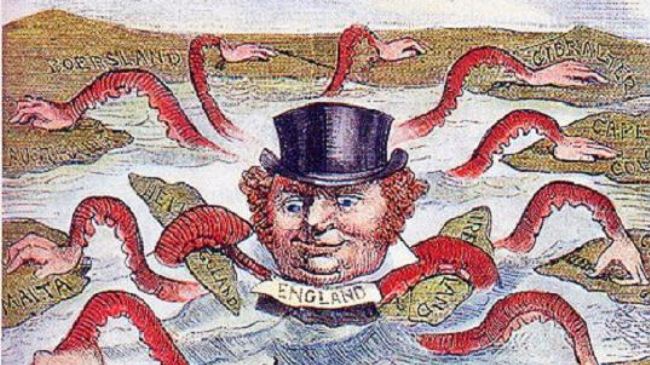
It is not difficult to find expressions of racial consciousness from prominent whites who lived only several generations ago. Colonization and empire-building probably brought out the frankest of these sentiments. British explorer and capitalist Cecil Rhodes, for example, stated at the turn of 20th century: “We are the first race in the world, and the more of the world we inhabit, the better it is for the human race.” At about the same time, British Colonial Secretary Joseph Chamberlain explained that “the spirit of adventure and enterprise distinguishing the Anglo-Saxon race has made us peculiarly fit to carry out the working of colonization.” The French took a similar view, with even a socialist such as Léon Blum noting in 1925: “We recognize the right and even the duty of superior races to draw unto them those which have not arrived at the same level of culture.” The brief American experience of traditional empire brought out the same sentiments. After annexation of the Philippines in 1899, Senator A.J. Beveridge wrote of “the mission of our race, trustees under God, of the civilization of the world.”
It would be easy to conclude from statements like this — and there are many — that race has been a consistent part of Western consciousness, and that only recently have whites lost their way. That would be a mistake. During the ages of discovery and colonization, whites rarely held well-considered or consistent views of race. Their actions and opinions varied widely in time and from place to place. Europeans often felt superior to the primitive peoples with whom they came into contact, but during the entire modern period, there have always been whites who held anti-”racist” views of the kind that prevail today. Since the Second World War, opinion has certainly shifted in an unhealthy direction, but Europeans have never had a sound, generally-accepted understanding of race. An examination of some of our past mistakes may throw light on the mistakes we are making today.
General Principles
Despite a lack of consistency about race, a few principles do emerge from the imperial period. The most obvious is that almost without exception, it has been the whites who were most distant from non-whites who took the most benign view of them. It was always the metropolitan authorities — whether in Britain, Spain, France or Portugal — who pushed for gentler and even equal treatment of colonial subjects. The men on the ground understood that empires could not be run on egalitarian principles. Whites who spent the most time overseas and who knew non-whites best were the ones who were least sentimental about them.
At the same time, whites have long had a tendency to be squeamish and hypocritical about race. Even at the height of empire, colonial authorities were full of false piety, mouthing high-sounding nonsense they did not believe. Except for people on the front lines of empire, there has been a surprising unwillingness of Europeans to assert racial interests, even when they understood and believed in them. Timidity about race is nothing new.
It is important to bear in mind that although we tend to think of empire as whites ruling non-whites, this is only one kind of empire. Anti-“racists” love to talk about overseas empire because it is such a gratifying example of “white supremacy,” but whites have had no compunction about ruling each other. Europeans ended up with large African and Asian empires only because it was easier to subjugate non-white primitives than to conquer fellow Europeans, but the history of the West is of endless efforts by whites to dominate other whites.
Even after the discovery of America, Spain ruled Portugal, and tried to invade Britain. Napoleon made himself emperor of vast European territories without much thought of possessions overseas. Even when overseas empire was most vigorous — when Chamberlain and Rhodes were glorying in bringing British rule to lesser breeds — they fought their most savage colonial war against whites: the Boers. When they boasted about the British race, they meant the British people, not the white race. Even Hitler, presumably the most race-conscious empire-builder of the 20th century, conquered fellow Europeans rather than build an overseas empire, and had an alliance with the non-white Japanese.
This brings us to another rule that governs the history of race and empire. Even among men who had no illusions about race — soldiers, for example, who killed natives to make way for empire — there was nothing remotely like pan-Caucasian solidarity that transcended European nationalism. From the very beginnings of colonialism through the Second World War, Europeans enlisted non-whites in their wars with each other. There was some hesitation about teaching imperial subjects how to kill white men, but only because it might be harder to keep ex-soldiers as subjects, not because having them shoot whites was a betrayal of racial loyalty.
Non-white allies went into action against whites as early as the 1580s, when Francis Drake used Indians in his raids on the Spanish. During the French and Indian War, both sides recruited friendly natives, and both sides let their allies torture and mutilate captives, some of whom were white. Torture shocked British and French commanders, but it was the price of alliance.
During the Revolution, the British offered freedom to American blacks who revolted against their owners, and the first principle of colonization — sentimentality grows with distance — meant the British were much more successful than the revolutionaries in attracting Indian allies. Indians learned very quickly that it was the people farthest away who liked them most, and they wanted British rather than American rule.
As the young republic expanded, both Spain and England regularly armed Indians and set them against Americans. Andrew Jackson wanted Indian lands, but his initial reason for shipping tribes West was to remove potentially dangerous populations that could be stirred up by Europeans. Neither Americans nor their enemies had any scruples about encouraging Indians to kill whites.
Later, the British fielded regiments of Gurkhas and other Asians. The French had their North African Spahis and Harkis, as well as the famous Tirailleurs Sénégalais, made up of blacks from all over West Africa, not just Senegalese. The French used colored troops mainly to control colonies — always deploying them so they never had to fire on their own people — but during the First World War they had them fight Germans. Sixty-four thousand Indian troops died for Britain, many in Europe. France mobilized 555,000 colonial troops, of whom 78,000 died.
During the Second World War, the British raised 1.8 million Indian and 375,000 black soldiers. Although Germany defeated the French early, France still managed to field 160,000 blacks.
Such, then, is the checkered racial history of colonialism. Overseas empire certainly meant whites ruling over non-whites, but it was not based on coherent racial principles. The one great achievement of empire was to turn vast regions white, but the collapse of empire and the non-white immigration that followed, has made it a very bad bargain, certainly for Europeans.
The British
All the great European empires followed the same patterns, and the British furnish as good an example as any of racial incoherence and even naïveté. A surprising example of the latter was the establishment of the first permanent settlement in Jamestown in 1607. By then, the Spanish had been in the New World for over a century, and had a reputation for massacre. The English were determined to do better, bringing civilization and Christianity to what they expected would be grateful natives. As one backer of the Virginia Company wrote of the Indians he had never seen: “Their children when they come to be saved, will blesse the day when first their fathers saw your faces.”
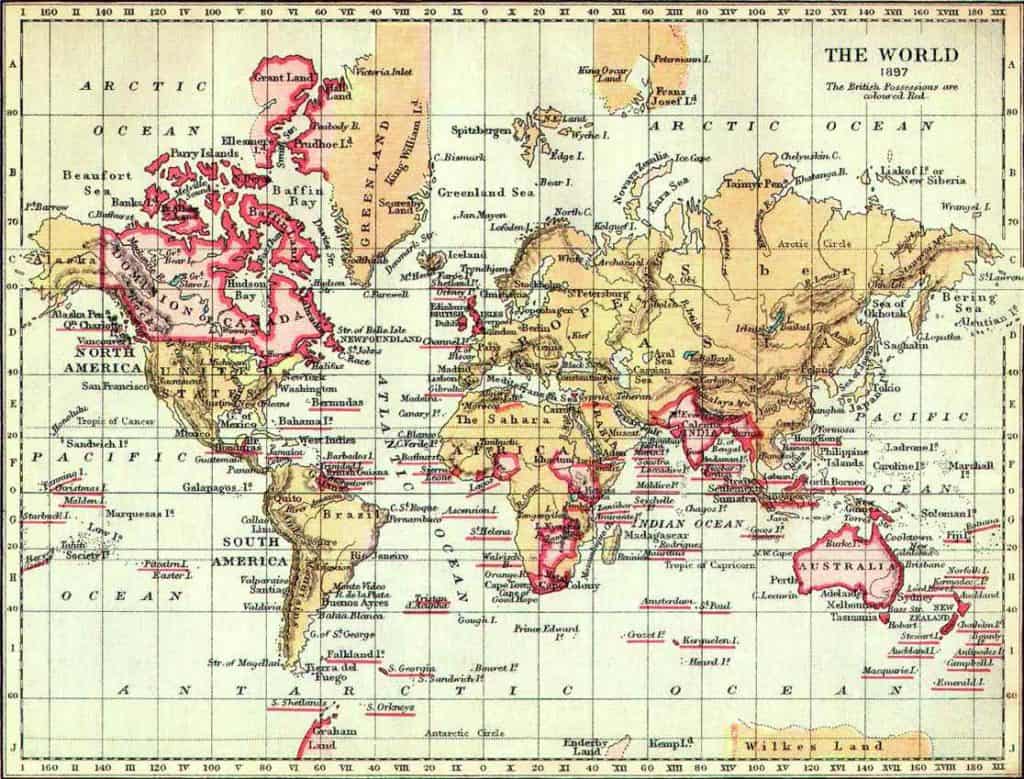
The British Empire in 1897.
The colonists did not consider themselves superior to the “naturals,” no matter how primitive. They reasoned that the ancient Britons had been savages, civilized by the Romans, and that this process would be repeated. Although the colonists considered themselves racially different from Africans and “Moors,” they thought the Indians were born white and turned dark from exposure to the sun and to skin dyes.
The president of the colony, Edward-Maria Wingfield, was so determined to set a loving example that he forbade construction of fortifications and training in the use of weapons. The colony was only ten days old when hundreds of y Indians attacked it. If the English had not panicked the Indians with canon fire, they would probably have massacred every settler. It was only after this edifying encounter that the colonists built their famous three-sided stockade.
The Indian reaction to colonization was the mirror-image of what became the rule in European attitudes towards natives: The tribes that lived closest to Jamestown hated the English and tried to kill them. The more distant ones were friendly and were willing to trade.
Despite frequent attacks, the English did not give up hope that benevolence would win over the Indians. After the first conversions to Christianity, they set aside 10,000 acres for a college where Indians would be instructed in the faith. One English leader, George Thorpe, was especially insistent on kindness to Indians, and even publicly hanged dogs whose barking had frightened them.
As the years went by, Indians and colonists began to mingle, with hired Indians working together with the English in shops and in the field. The appearance of friendliness was false. In 1622, Indians carried out a carefully-hatched extermination plan, turning on the colonists with whom they worked, killing as many as they could. In some areas, they lost the element of surprise and therefore killed only 400 of Jamestown’s 1,200 whites. For Thorpe, the special friend of the Indians, they reserved a particularly cruel death and elaborate mutilation. The remaining colonists launched a war of revenge, but after a year or so relations returned to an appearance of friendliness.
Amazingly, in 1644, Indians carried out an identical sneak attack, and managed to kill 400 to 500 people. This time, the English retaliated mercilessly, and in 1646, the Virginia General Assembly noted that the natives were “so routed and dispersed that they are no longer a nation, and we now suffer only from robbery by a few starved outlaws.”
What is remarkable about Jamestown is the behavior of the English, not that of the Indians. The English approached the Indians with as much good will as it was probably possible for colonizers to approach the colonized. It was the Indians who recognized that colonization meant dispossession, and they resisted in every way they could.
Eventually, of course, the English lost their illusions. By 1690, Governor John Archdale of the Carolinas was praising God for the diseases that killed so many natives: “The Hand of God has been eminently seen in thinning the Indians to make room for the English.” Still, it is sobering to note that even 400 years ago, whites were capable of dangerous illusions in their dealings with non-whites, though they did come to their senses before it was too late.
India
The British colonization of India was a remarkable contrast to that of Virginia, despite the fact that it began at virtually the same time (the East India Company started operations in 1613). The men in India did not think Asians were born white, and had no desire to change or civilize them. They were there to trade, make money, and expand British power. For the first 200 years, they would not even allow missionary work, and yielded reluctantly to the pressures that arose from religious revivals back in England. In 1813, the year missionaries first arrived, Governor Thomas Munro of Madras expressed the prevailing view of experienced India hands:
I have no faith in the modern doctrine of the improvement of the Hindus or of any other people. When I read, as I sometimes do, of a measure by which a large province has been suddenly improved, or a race of semi-barbarians civilized almost to Quakerism, I throw away the book.
The reforms crusading liberals then forced on India were a classic example of people who knew nothing about a country overruling administrators who had lived their all their lives. As the old hands had predicted, Indians reacted badly to evangelism, and were annoyed by the abolition of suttee, or the practice of burning widows. Although slavery was not widely practiced in India, its abolition throughout the empire in 1833 was another instance of reform-minded people from thousands of miles away meddling in affairs of which they had no experience.
Indians appear to have been reasonably content to be ruled by the British, but wanted their culture and religions left alone. Men like Kipling, who spent years in India, understood that “East is East, and West is West, and never the twain shall meet,” but missionaries and crusading liberals thought they could turn Indians into Englishmen. The Indian mutiny (also known as the Sepoy Rebellion) of 1857-1858 was in large part a reaction to these fashionable reforms. The attempt to make East and West meet ended in blood and tears, and British reformers redirected their zeal overnight to putting down the “ungrateful wogs.”
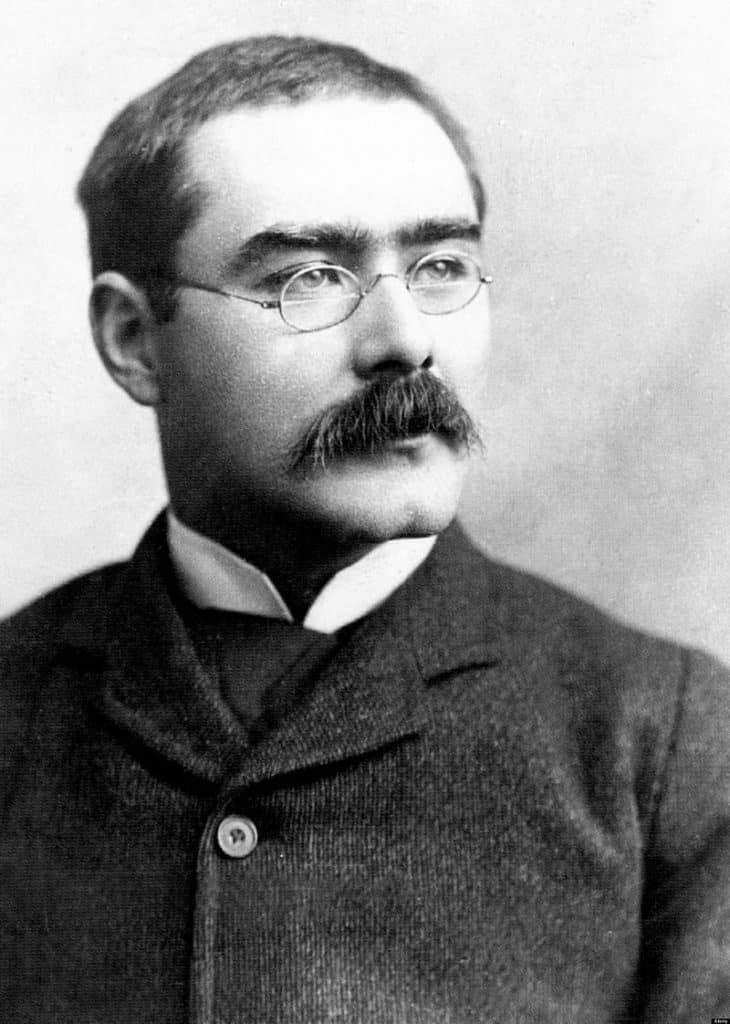
Rudyard Kipling
Yet another example of home-country illusions being forced on administrators who knew better led to what became known as the “white mutiny.” In 1880 the liberal Gladstone government appointed George Robinson (later Marquess of Ripon) as Viceroy of India. He arrived brimming with reform, and proposed a law that would have given Indian judges and juries the power to try Englishmen accused of local crimes. India men were outraged at this blurring of the line between rulers and ruled that they considered essential for doing their jobs. Resistance was so intense the measure was watered down, and any white defendant called before an Indian magistrate got the right to demand a jury that was at least half British or American.
The huge debate that erupted over this issue, both in India and England, damaged relations between whites and Indians. Until the new viceroy made an issue of it, everyone took it for granted that the English were tried by English judges. Forced to defend this tradition, whites had to make racial arguments that stirred up needless resentment.
Empire required a firm sense of the white man’s fitness to rule, but it was not usually necessary to express this in explicitly supremacist terms. It was a delicate balance of confidence, sensitivity to Indian dignity, and industrial power that allowed Britain to rule 250 million Indians with never more than 900 civil servants and 70,000 soldiers. The British were conscious of this balancing act, and understood that a ruling race had to maintain a certain demeanor. As a man in the Indian Civil Service explained in 1900:
To the peasant the visit of a ‘saheeb’ or a casual meeting with one . . . will be talked of for days over the village fire and remembered for years. The white man will be sized up shrewdly and frankly. So take heed unto your manners and your habits.
George Orwell, who served in Burma, noted that “a white man mustn’t be frightened in front of natives; and so, in general, he isn’t frightened.” Sir Francis Younghusband, who was born in India, and who led a British force into Tibet, wrote of the psychological basis of empire:
No European can mix with non-Christian races without feeling his moral superiority over them . . . It is not because we are any cleverer than the natives of India, because we have more brains or bigger heads than they have, that we rule India; but because we are stronger morally than they are.
These sentiments were reflected in the sense of duty to which upper-class Britons were bred. By 1880, Britain was rearing complete generations to standards of “Anglo-Saxon manhood” that would prepare them to rule. Fair play and Christianity were essential ingredients of the master-race mentality, and the men who could pass the stiff examinations required to join the colonial civil service were rightly proud of their incorruptibility.
The empire was a source of great pride and excitement for ordinary people who never left Britain’s shores. Publications such as Boys of the Empire (started in 1900) ran articles like “How to be Strong” and “Empire Heroes.” There was a Boys Empire League, which promoted interest in the colonies, and the Boy Scouts were originally a patriotic organization. Scouting’s founder, George Baden-Powell, had fought the Ndebele in Rhodesia, and expressed strong views of empire to his young charges:
Your forefathers worked hard, fought hard, and died hard to make this empire for you. Don’t let them look down from heaven, and see you loafing around with your hands in your pockets, doing nothing to keep it up.
An ABC for Baby Patriots, published in 1899, caught the spirit with rhymes like:
C is for Colonies
Rightly we boast
That of all the great nations
Great Britain has most.
In the Victorian era, Pears Soap advertisements had copy like this:
The first step towards lightening the white man’s burden is through teaching the virtues of cleanliness. Pears’ Soap is a potent factor in brightening the dark corners of the earth as civilization advances.
Blacks
One group to whom the British believed they were bringing civilization was Africans. Of all the peoples they encountered, however, blacks (and Australian aborigines) appear to have struck them as the most alien. Whites could imagine that American Indians were of the same stock as themselves, and India hands admired Indian high culture, but with only a few exceptions, Africans appear to have struck whites as a lower race. The first blacks arrived in Jamestown in 1619, at the time when the English were still wondering if Indians were not sunburned white people. There were no such illusions about the new arrivals, and the colonists did not hesitate to treat them as a servile race.
In 1681 on Barbados, Governor Richard Dutton argued that black slaves should be treated with Christian kindness, but “as to make negroes Christians, their savage brutishness renders them wholly incapable.” Another 17th century Englishman wrote of Africans that “the men and women go so alike, that one cannot know a man from a woman but by their breasts, which in the most part be very foule and long, hanging downe low like the udder of a goat.” One Caribbean planter wrote that when African women bent over to tend crops, their breasts touched the ground, giving the impression from a distance that they were six-legged creatures. It would be hard to find such harsh descriptions of people of other races.
The impulse to see all races as equal nevertheless survived. British idealists established Sierra Leone in 1787 as a haven for freed slaves, and its backers believed sincerely that with proper instruction Africans could be brought up to the level of Europeans. Illusions of this kind might thrive among members of Christian tract societies back home, but they rarely lasted long under the tropical sun.
The explorer David Livingstone began his career as a missionary with the London Missionary Society, but gave up preaching in the early 1840s, because he was making no progress:
It must be difficult or rather impossible for Christians at home to realize anything like an accurate notion of the grossness which shrouds their minds . . . Their ideas are all earthly and it is with great difficulty that they can be brought to detach [themselves] from sensual objects.
Africa was the graveyard of high expectations. Even the founder of the London Missionary Society, Robert Moffat, could not maintain his optimism, writing of Africans that “Indifference and stupidity form the wreath on every brow: Ignorance — the grossest ignorance — forms the basis of every heart.”
Civil servants met with the same disappointments. Activists had pushed for emancipation, confident that freed slaves would be reborn as ambitious small-holders. Freedom led, instead, to drunkenness and idleness, while productivity plummeted.
The same metropolitan naïveté greeted the suppression of a black insurrection in Jamaica in 1865. Governor Edward Eyre, using methods similar to those adopted during the Indian mutiny just a few years earlier, had about 200 people executed. On Jamaica he was heralded as the savior of civilization, and he was shocked to be summoned before a commission in England to answer for his actions. The hearings badly fractured public opinion, with prominent men lining up on both ides. Eyre was removed as governor but never officially sanctioned, and went to his grave a hero to white Jamaicans and convinced he had been shabbily treated by his country.
It was a classic case of people who knew of blacks only second-hand second-guessing people who had lived among them for years. Eyre’s dismissal made it hard to take firm action elsewhere in the empire for fear of the reaction back home. Sir Garnet Wolseley, a tough soldier who saw service in dozens of colonial engagements had Eyre in mind when he wrote: “I have to think of the howling Societies at home who have sympathy with all black men whilst they care nothing for the miseries inflicted on their own kith and kin who have the misfortune to be located near these interesting niggers.”
As with Indians, colonial administrators in Africa thought it vital to maintain a certain attitude towards natives. Lord Lugard, who spent many years governing Nigeria in the early 1900s, held that whites should immediately rebuff any “insolent familiarity” from blacks, who would naturally be subservient if treated properly.
Lugard worried that some of the British straggling into the colonies did not have the natural air of superiority empire required: “The type of Englishman, in the shape of the trader, whom we meet in these parts, is too awful for words to describe; they are all more or less counter-jumpers of the worst type and biggest bounders into the bargain.” (“Counter-jumpers” are people whose natural position is subservience — serving behind a counter — who jump over the counter to mix with their betters.)
Still, the conviction that non-whites — Africans in particular — did not have the capacity to manage their own affairs lasted well into the 20th century. A 1937 National Geographic article caught the prevailing view: “The Baganda are a pleasant and courteous people and quick to emulate the white man in clothing and ways of living. They train easily, whether as domestic servants, scouts or seamstresses.”
In some circles, this paternalist view continued into the mid-century, especially among men who really knew blacks. The great Alsatian Protestant missionary, Albert Schweitzer (1875–1965) was the Mother Theresa of his time, a Nobel peace prize winner admired for saintly qualities. He took a kindly view of Africans but considered them lazy and improvident, and in 1938 wrote that they were largely incapable of ruling themselves:
When long-resident natives of the district express to me their discontent at being ruled by the whites, I answer that without the white man they would no longer be in existence, because they would either have slaughtered each other or ended in the Pahouin [the neighboring tribe] cooking pots. To this they have no answer.
By this time, of course, people who had no direct experience of non-whites were drowning out the warnings of men who knew better, and decolonization would come shortly.
What eventually brought about the end of empire? What ended the conviction that Anglo-Saxons were “peculiarly fit to carry out the working of colonization”? The two World Wars undoubtedly had a lot to do with it. The agonized soul-searching that followed the first great war, especially, seems to have affected the way Europeans felt about everything they did. For men who prided themselves in their ability to run the affairs of others, it was a terrible blow to have, themselves, blundered into unspeakable carnage.
The Second World War, following just 20 years later, further exhausted the metropolitan powers. The United States, which emerged as the dominant superpower, was aggressively anti-colonial despite the explicitly racial laws that still governed its internal relations with blacks. (This is just another example of the racial incoherence of empire: Jim Crow America opposed European rule in Africa.)
At the same time, at least among Indians and Asians, a class of Western-trained intellectuals was beginning to arise, whom it was difficult to hold in subservience. Empire always depended ultimately on force, and as time went by the British became reluctant to use it.
The 1919 “Amritsar massacre” reopened the wounds left by the controversy over Edward Eyre’s handling of the 1865 Jamaica uprising, and showed how the British were changing. During a period of nationalist disturbances, General Rex Dyer — an India man born in the Punjab — banned “all meeting and gatherings” in the province. When 20,000 people flouted his order and demonstrated in Amritsar, he marched 50 Gurkha and Baluchi troops into the town square and ordered them to fire on the crowd, killing 379 and wounding 1,500. Demonstrations immediately stopped, and Dyer was a hero — at least at first. The Sikhs, who hated the Punjabis, made the general an honorary Sikh at the Golden Temple.
Horror mounted back home, however, and Dyer was hauled before a commission. He explained that he wanted to “strike terror into the whole of the Punjab” in order to forestall rebellion. The British no longer had the stomach for striking terror, and Dyer was forced to resign his commission. (An interesting sidelight of the Dyer investigation was the interrogation of the Baluchis and Gurkhas who did the shooting. They said they enjoyed mowing down plainsmen.) As in the Eyre case, prominent people split over the Amritsar action, with men who knew India backing the general. Churchill condemned the shootings while Rudyard Kipling contributed to a sympathy fund that raised more than £26,000.
Earlier men who fought for Britain — Robert Clive (1725-1774), Lord Kitchener (1850-1916), and John Nicholson (1821-1857), who helped put down the mutiny) — probably would have acted as Dyer did. The difference was that Britain would have backed them.
Until the waning days of empire, most Britons had a high sense of national destiny, and believed their nation was a powerful force for good. However, when increasingly well-educated subjects wanted self-rule it became difficult to deny them. The British certainly had the means to silence colonial elites but no longer had the will. In 1937, Hitler explained to Foreign Secretary Lord Halifax how to control Indian nationalism: “Shoot Gandhi, and if that does not suffice to reduce them to submission, shoot a dozen leading members of [the] Congress [movement]; and if that does not suffice, shoot 200 and so on until order is established.”
Britain was no longer capable of measures like this, which was probably just as well. By the time India became independent in 1947, the exhaustion of two World Wars, pressure from the United States, and the sophisticated tactics and demands of Indian activists left Britain little choice. One incident from the final days of the Raj showed just how far the former rulers had fallen. While the last viceroy, Louis Mountbatten, was negotiating the final withdrawal, his wife Edwina was carrying on an affair with Jawaharlal Nehru, the most prominent nationalist after Gandhi, and India’s future prime minister.
Independence has, of course, led to results that any student of race could have predicted: Moderate success for some Asian and Middle-Eastern peoples; chaos for most Africans. It is now the backwash of empire in the form of non-white immigration that is the most unhappy legacy for the European powers. If, indeed, the loss of confidence that led to decolonization lead inevitably to massive non-white immigration — and it seems to have done so without exception — empire was a catastrophic mistake for the imperial powers.
Hypocrisy and Failure of Will
Given the aftermath of empire, it should perhaps not be surprising to learn that its history is one of constant tension between frank assertions of white supremacy and the insistence that all men are brothers and equals. It is probably a reflection on the nature of whites that the latter view has always assumed a sheen of high morality. For at least two centuries, race has been a subject on which the more one ignores both the scientific evidence and the testimony of experts, the more enlightened one can appear. No doubt this is why even with empires at their most powerful, men who knew better shrank from blunt assertions of racial interests.
Immigration policy — policy that is determining the future for whites everywhere — seems always to have been fertile ground for hypocrisy and evasion. In light of the current debate over efforts to stem the Third-World influx, it is instructive to note that only rarely have whites had the stomach to say openly that they wanted to keep their countries white.
Surprising as it may seem, in the Victorian era the British tried to maintain the fiction that all Imperial subjects, of all races, were on an equal footing. Therefore, when the whites who ran the South African colony of Natal wanted to pass laws preventing immigration from India, the colonial ministry overruled them. The British understood the desire to keep out Indians, but would not permit outright exclusion. In 1897, both sides reached a compromise, according to which immigrants had to arrive with at least £25 sterling and be able to speak a European language. This law successfully excluded the vast majority of Indian immigrants by means of regulations that appeared to be race neutral. Indirect measures of this kind became known as “the Natal formula.”
In the years before it became an independent commonwealth in 1901, Australia had considerable autonomy, but did not have complete control over immigration. Its leaders wanted laws to exclude Asians, but Joseph Chamberlain — the secretary of state for the colonies who was so insistent on the virtues of the “Anglo-Saxon race” — explained this was impossible. In 1897, he asked Australians to:
. . . bear in mind the traditions of the Empire, which makes no distinction in favor of, or against race or color; and to exclude, by reason of their color or by reasons of their race, all Her Majesty’s Indian subjects or even all Asiatics would be an act so offensive to those people, that it would be most painful, I am quite certain, to Her Majesty to have to sanction it.
Chamberlain wanted a “white Australia,” but would not approve overt racial restrictions, writing of the importance of “legislation that will prevent undesirable immigration without making distinctions based entirely on color.” Australia therefore worked out its own version of the Natal formula: Any immigrant would have to write a passage of 50 words dictated in a European language by an immigration officer.
There was no secret about the law’s purpose. An official of the Australian Department of External Affairs explained how the test was supposed to work:
It is not desirable that colored persons should be allowed to pass the test, and before putting it to anyone the Officer should be satisfied that he will fail. If he is considered likely to pass the test in English, it should be applied in some other language of which he is ignorant.
A non-white who seemed likely to pass the test in English, could be made to take it in French or Polish!
Australia passed other evasive legislation. In 1855, it had already kept out Chinese immigrants who came tightly packed in the lower decks of ships. Pretending to take an interest in the comfort of shipboard accommodations, colonial authorities ruled that no vessel could bring in immigrants at a ratio of more than one person to every ten tons of displacement. In 1888, they raised the requirement to every 500 tons of displacement. These were apparently race-neutral laws designed to keep out people of a specific race — a Natal formula before the phrase was even born.
The Canadians also resorted to subterfuge. In 1908, when there was no direct steamer service from India to Canada, legislation required that immigrants come “from the country of their birth” on “a continuous voyage on through tickets.” The provision was aimed at Indians, but lawmakers could not bring themselves to write their real intent into law.
Lessons for Today
What is perhaps most instructive about studying racial policies of the past is to discover how little has changed. When whites leave Southern California, complaining about “crime” or when they claim to be looking for “good schools,” and somehow end up buying houses in white neighborhoods, they are reinventing the Natal formula. They are using ostensibly race-neutral grounds to achieve racial results, whether they realize it or not.
Something else that has not changed is the desire to downplay or even obfuscate the racial consequences of policy — except that the anti-”racists” are now doing it. The backers of the Immigration Reform Act of 1965 claimed it would have no racial impact, and would leave the makeup of the country unchanged. Racial preferences for non-whites get the anodyne name “affirmative action” or even the frankly deceptive “equal employment opportunity.” Transfers of wealth to blacks are “anti-poverty programs.” The dispossession of whites is “diversity” or “enrichment.”
Something else has changed even less: People who know nothing about non-whites still think they are experts on race relations. The less whites actually know, the more confidently they lecture other whites who have spent years among blacks or Asians. From the 1940s to the 1990s, Scandinavians who had never clapped eyes on a black told Americans and South Africans how to behave. Northerners berated Southerners with equal authority. Even today, the politicians and editorialists who bray the loudest about Southern or redneck “racism” live in gilded white ghettos and send their children to private schools. There is probably no other subject for which mouthing clichés passes for learning, and moral fervor trumps a lifetime of experience.
The preponderance of opinion has certainly shifted over time, but whites seem always to have had a predisposition to tread lightly when it comes to race, to hide racial interests behind non-racial generalities, and to be strongly attracted by the appearance of generosity and broad-mindedness that attaches to egalitarianism and the renunciation of racial loyalty. When non-whites were colonial subjects and not in a position to push their way into Europe, these tendencies had only local consequences — one is reminded of the Jamestown massacre of 1622. Now, they are potentially fatal.
Even on racial matters, however, whites are capable of learning. Just as the Jamestown colony eventually lost its illusions, liberals can abandon racial romanticism in the face of hard experience. The current ferment in Belgium and Holland over immigration is a sign that romanticism is dying. When Americans actually have a chance to express themselves — in referenda on racial preferences or benefits for illegal aliens — they almost always show good sense.
Today, with the possible exception of Iceland, no white nation is free of non-white immigration. Scandinavians can no longer wrap their denunciations of Americans or South Africans in the conviction that if they were in our place they would work miracles of reconciliation and uplift. They are in our place now, and the first-hand experience of race is sobering.
If this were empire, it is as if the people back home now have an inkling of what Edward Eyre faced in Jamaica or of why Rex Dyer opened fire in Amritsar. Far fewer people can shelter their illusions behind walls of ignorance.
Will whites wake up in time to save their civilization? If they do, they will look back in gratitude to the men who knew the world best, who thought about it hardest. They will wonder why, during the 20th century, Europeans ignored the warnings of men like Albert Schweitzer, and did not listen to Rudyard Kipling when he wrote: “A man should, whatever happens, keep to his own caste, race and breed. Let the white go to the white and the black to the black.”
Editor’s Note: This essay is featured in Jared Taylor’s book, If We Do Nothing, available for purchase here.