Butt Naked, Psychopath
Jef Costello, American Renaissance, September 26, 2025
Subscribe to future audio versions of AmRen articles here.
Joshua Blahyi aka General Butt Naked, Redemption of an African Warlord: The Joshua Blahyi Story, Destiny Image Publishers, 2013, 160 pp., $17.99 (softcover)
Joshua Milton Blahyi (born September 30, 1971), better known to the world as General Butt Naked, wants you to know that he’s a changed man. In his memoir, The Redemption of an African Warlord: The Joshua Blahyi Story, he claims to have found Jesus and given up his evil ways.

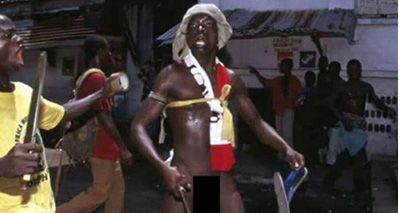
Mr. Blahyi was a warlord during the First Liberian Civil War (1989–1997). His nom de guerre stems from the fact that he and his men would go into battle naked. This was to convince his opponents that Mr. Blahyi was stark, raving mad, and it worked. Mr. Blahyi became both hated and feared for his appalling record of atrocities.
Child sacrifice, often involving cannibalism, is a recurring theme in Mr. Blahyi’s book. Here he describes a ritual, the circumstances of which he leaves vague:
Some women ran to my door with their usual cry for help. I asked them to bring me a young baby. They complied by bringing the baby, who was less than a year old. I held the two legs of the baby and burst his head against the wall. The brain and everything in the baby was used to speedily prepare me to cast the spirit of fear upon my enemies.
He also describes “negotiating” with the mother of a three-year-old girl to give her to him as a sacrifice. The mother accepts. He notes that this is an odd thing for a mother to do, but such was “the effect of the spiritual influence I gained over people.”
The sacrifice followed:
My soldiers and I moved to the frontline on the new bridge and started the ritual by opening the little girl’s back and plucking out her heart. I shared the little girl’s heart with my soldiers. After we ate, I asked my boys to go to the river and bring some water for me to wash my hands.
Those eager to read more lurid tales will be disappointed; Mr. Blahyi limits discussion of his atrocities. Elsewhere, however, he may well have exaggerated them. He has claimed that he and his men killed some 20,000 people, but others dispute this figure. No one, however, denies that Mr. Blahyi was a prolific killer, who committed many atrocities against fellow Liberians.
It would be impossible to summarize the account Mr. Blahyi gives of the Liberian Civil War and the country’s constantly shifting political landscape. It is bewilderingly convoluted, and he never succeeds in explaining what was at stake. One comes away with the impression of a savage country constantly at war — a war that seems to be purely a ruthless, unprincipled struggle for power.
Mr. Blahyi became world famous when, in 2008, he became the first Liberian warlord to testify before the country’s Truth and Reconciliation Commission. He talked about his actions in detail, including his record of atrocities. A year later, the Commission recommended Mr. Blahyi and 37 others for prosecution, but post-war stability and political considerations took priority over prosecutions.
In 2009, Mr. Blahyi was interviewed for a Vice News documentary called “The Cannibal Warlords of Liberia.” As of this writing, it has been viewed more than 28 million times on YouTube. It was principally this film (and another Vice segment a year later) that make Mr. Blahyi such a household name that he appeared in parody as General Butt Fucking Naked in the 2011 Broadway musical The Book of Mormon, written by the creators of South Park.
In The Redemption of an African Warlord, Mr. Blahyi attributes his history of violence to the influence of a “black witch” called Nya-geh-a-weh, whom he describes as closer to a demon or a god than a human witch. Mr. Blahyi’s tribe, the Sarpo, had made a pact with Nya-ghe-a-weh: In exchange for making them great warriors, Nya-geh-a-weh would demand human sacrifice.
The demon lived under a rock, which he referred to as his throne. “You will cleanse my throne with the blood of four of your female babies,” Nya-geh-a-weh commands. He then commands that nine young men to be sacrificed. This satisfied him — for the moment.
The tribe agreed to have no other gods before Nya-geh-a-weh. And in true Old Testament fashion, he imposed dietary restrictions on the Sarpo that make it hard for them to eat with outsiders and thus make peace with them.
As a boy, Mr. Blahyi was initiated into the cult of Nya-geh-a-weh as a necessary condition of warriorhood. He was taken to the big rock, the demon’s throne, and left alone. Mr. Blahyi spent three days and three nights before the rock, with only chalk to eat.
At midnight on the third day, the rock tilted upwards and Mr. Blahyi entered the dark, underground lair of the demon:
He was a gigantic figure, about twelve feet high and wearing old rags that looked as if they were just taken from the mud. He had bruises all over his left side, and his left wing was folded under his arm, making his hand stuck to his chest. He moved his right leg twice, then dragged his left leg to catch up. He had a very big rod in his hand. Despite his disabilities he moved fast.
The demon called Mr. Blahyi “my son,” and then showed him scenes from his own life, projected onto a kind of screen. Then, Nya-geh-a-weh said he would make the boy his High Priest. From then on, Mr. Blahyi was in complete thrall to Nya-geh-a-weh, and the demon gave him magical powers, such as the ability to steal the soul of a sleeping person and bind it to Nya-geh-a-weh.
Soon Mr. Blahyi acquired vast political power. He claims to have recruited Liberian president Samuel K. Doe as a priest of Nya-geh-a-weh, in a position subordinate to himself. He writes that “Almost all of Doe’s cabinet and other strategic officials from his time in power were initiated and dedicated to Nya-geh-a-weh.”
Soon Nya-geh-a-weh got “complete control over the government.” Mr. Blahyi also explains how he got the country to support Samuel Doe:
I manipulated almost the whole nation to vote for him. I planted blind agents in all major restaurants and bakeries to sell his fame. I extracted white blood cells from persons I felt qualified for the ritual, invoked the fame of the president into them, and distributed them in small capsules. I gave them to the blind agents and instructed them to put them in all the food and bread they prepared. We automatically controlled anyone who ate any of those specially prepared meals, which is how they were led to vote for him.
Then, one day, Mr. Blahyi had another vision — not of the demon Nya-geh-a-weh but, apparently, of Jesus Christ. He saw a very bright light, “brighter than the sun,” and within it the figure of a man about 10 feet tall.
The figure said, “My son, why are you enslaving yourself? . . . You rightly said you are supposed to be a king, but you are living as a slave. . . . A king’s servant is at his footstool, but your servant is on your shoulder.”
Mr. Blahyi was more or less instantly converted to Christianity, about whose theology he knew virtually nothing, and was received into a Protestant church. There, he was re-christened “Joshua,” and he repudiated his past. Jesus continued to appear to him — almost as often as Nya-geh-a-weh did — and he was commanded to expose the demon to the world.
When feeling particularly haunted by his past, Mr. Blahyi recites the words “The Blood of Jesus! The Blood! Holy Ghost fire.” Nya-geh-a-weh continues to bedevil him, but Mr. Blahyi is then immediately surrounded by “uncountable angels” who protect him. He now lives in Liberia as a preacher.
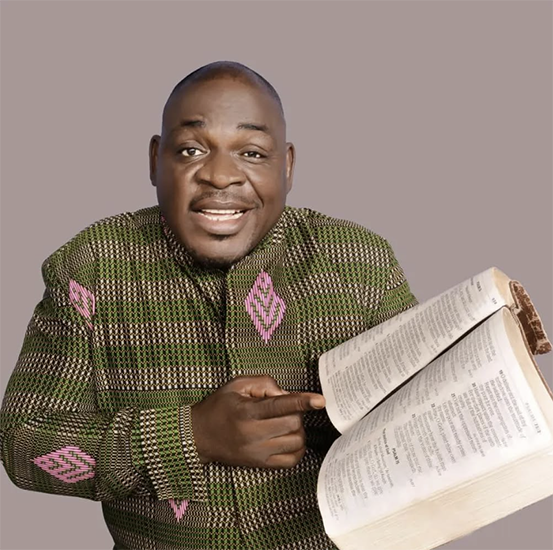
A March 2023 post from Mr. Blahyi’s Instagram.
Any Westerner reading The Redemption of an African Warlord is likely to be struck by the depth of Liberian superstitiousness. In fact, the most interesting and vivid parts of the book are Mr. Blahyi’s recollections of Nya-geh-a-weh and of the magic he claims to have performed in the demon’s name.
These passages seem completely sincere, not deliberate inventions. If so, we are dealing here with a mentality so different from our own I doubt we will ever truly be able to fathom it.
Also unfathomable is Mr. Blahyi’s extreme self-aggrandizement. As noted, he has been accused of exaggerating his crimes, but he made these exaggerated claims after he converted to Christianity. We would expect the reformed Mr. Blahyi to minimize his crimes, not magnify them.
By Mr. Blahyi’s account, he effectively controlled the Liberian President, his entire cabinet, and everyone who voted for him. To convert Mr. Blahyi to Christianity, no less a figure then Jesus himself had to appear. And Jesus immediately confirms Mr. Blahyi’s notion of himself as “a king.”
And Jesus gives him the full VIP treatment: “uncountable angels” to act as bodyguards. And Mr. Blahyi reports that the families of his victims were quickly converted from hating him to seeing him as “the love of their lives.”
Mr. Blahyi’s profile picture on social media.
However, what is perhaps most interesting about Mr. Blahyi is the way he tries to account for his actions. Though he professes contrition for his past deeds, it is also quite clear that he believes he committed them under the supernatural control of Nya-geh-a-weh. When Jesus points out that this makes him a slave to the demon, Mr. Blahyi quickly switches sides and chooses Jesus as his new master, and it is clear that he does this because he believes Jesus’s magic is stronger.
In short, Mr. Blahyi never genuinely takes responsibility. He is always the pawn of forces greater than himself. Conservatives like to deride liberals for implicitly denying autonomy to blacks; claiming that they can’t be held responsible for their actions because they are always somehow made to behave badly by almighty whitey.
Liberals may be on to something. When we see blacks blaming whites or circumstances for their actions, we think they are evasive and insincere. But Joshua Blahyi seems unable to account for his actions any other way. He seems not to have any real conception of agency or personal responsibility. And those around him, both perpetrators and victims, seem cut from the same cloth.
There is a powerful lesson here: It is not possible for us to live with such people. There is no hope of ever truly understanding them, and certainly no hope of turning them into simulacra of ourselves.