Letter From Brazil
George Lefebvre, American Renaissance, May 20, 2026
Subscribe to future audio versions of AmRen articles here.
I am a French Brazilian, born in São Paulo, and grew up in a largely European enclave shaped by Portuguese, German, and Italian communities. I attended a local private school, whose student demographics closely reflected those of the place where I lived.
My current community is gated and tightly guarded, and racial and socioeconomic roles are highly stratified; most people of African or Mestizo background are present only in positions such as domestic work or security, and they live in the surrounding community outside the gates. It is common (as I do) to have a black maid who does housework, cooking, make the bed and clean, so I have never had to learn these skills. She lives on the outskirts of our community with her husband and their three children. We ensure that she is generously provided for, to the extent that she is arguably overfed.
Living in Brazil, I have always instinctively understood that race is a biological phenomenon, and that people of different races differ in abilities—hence the economic stratification. Brazil has always been a multiracial society, formed through the historical presence and mixing of Indigenous peoples, Europeans, and Africans brought as slaves. North America and Europe, by contrast, have up until recently had European supermajorities; in Brazil, this was never the case. Although I love living in Brazil, it often feels less like a unified nation and more like a collection of different societies. Also, race categories are more fluid than in the USA; many people are mixed, and classification can be subjective.
We do not have many working-class whites. There are a few such communities in Southern Brazil (Rio Grande do Sul, Santa Catarina, Paraná), composed mainly of factory workers. The white working class is certainly not a major political or cultural identity category as it is in the US.
In Brazil, there are a lot of luxury activities that well-to-do Europeans and some Asians enjoy. São Paulo has a small but very exclusive golf scene, closely tied to Brazil’s elite social clubs and gated communities. Many of the top clubs are private, invitation-based, or embedded in luxury developments. Golfing is one of my favorite pastimes and I have a wide range of clubs to choose from in São Paulo.
As for beaches, I usually go to places like Angra dos Reis islands with private beaches and estates. These islands are difficult for the poorer people to get to, as they usually require helicopters or boats and are heavily guarded.
In my city of São Paulo, a lot of the white businessmen use helicopters. I read in the New York Times that São Paulo has one of the largest helicopter fleets in the world. There are many luxury buildings with helipads on rooftops. When I need to go out of my compound into the city center of São Paulo, I have an armored sedan (i.e. reinforced steel, bulletproof glass and run-flat tires). I usually plan the route beforehand to avoid the riskiest areas.
It was only until I traveled abroad that I realized Western Civilization is heading downhill rapidly. I worry that the USA and the land of my ancestors, France, will turn into a high-crime society with no identity and nothing left of Western Civilization.
However, there is an important difference between Brazil and the United States; there is much more racial hostility and animus towards whites in America. Although there are many killings in Brazil, I cannot remember a single homicide against a white person for explicitly racial reasons. I understand they are frequent in the USA and at epidemic levels in South Africa. This is so, even though slavery ended later in Brazil than the USA, the black and Latino population is substantially poorer, and the police are 30 times more likely to shoot a black person in Brazil than in the USA. This suggests that the resentment a lot of black Americans have for white people — nearly totally absent in African Brazilians — will not improve no matter how well they are treated.
It is difficult to understand where this divergence has come from. The only historical difference is that after slavery ended in Brazil in 1888, there were no Jim Crow laws, but I do not think that is a determining factor, because Jim Crow ended in the 1950s. One important factor in Brazil is that open discussion of race has often been discouraged. It’s subtle censorship; it comes from cultural norms, national identity, and ideology rather than formal censorship. Also, even though Brazil imported far more slaves than the USA did (nearly 5 million as opposed to about 400,000), slavery is not mentioned in schools and public discussion nearly as much as in the USA and is far less a key part of our national history. Many blacks don’t even know they are descendants of slaves because they don’t learn that in school and the news doesn’t talk about it.
There is far less emphasis on the negative things the Portuguese did here in the past, and the Catholic church teaches that God wants racial harmony. I have thought that the lack of enforced mixing in Brazil could be another factor behind better race relations; we have a kind of voluntary residential segregation. Although racial discrimination is illegal, only a few blacks and Mestizos can afford to live amongst whites.
My prediction for the USA is that as it turns demographically into Brazil, the white working class will gradually melt into the majority, non-white population. Americans with enough money will live apart, in guarded enclaves, away from crime and destitution.
A further thing that will change in the USA as it turns into Brazil is that the police will become more corrupt and brutal. There have been many documented cases of police killing street children in Brazil, including the notorious Candelária massacre (1993), in which police officers shot children sleeping in the street. Police act increasingly like a Mafia racket.
The future America will probably have substantial areas with no electricity or running water, like the favelas in our country, which are shanty towns made of debris. Residents live very sad lives, with gun and drug crimes at astronomically high rates.
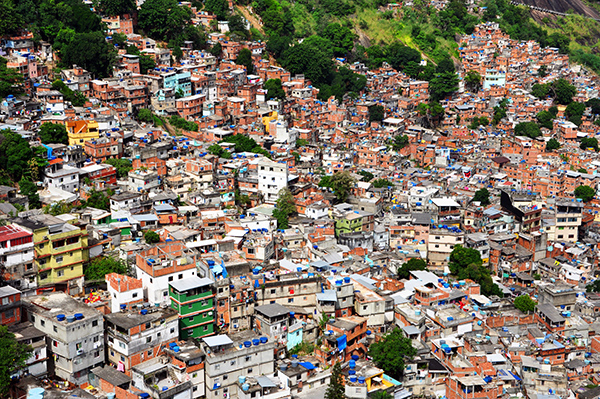
Rocinha favela, Rio de Janeiro, Brazil (Credit: chensiyuan, CC BY-SA 4.0, via Wikimedia Commons)
My prediction is that the future America for whites will be somewhere between Brazil (at best) and South Africa/Zimbabwe (at worst), hopefully more like Brazil, but given American racial liberalism, I am pessimistic. Only time will tell if Americans of all races decide that separation is best for everybody, and especially for white Americans, who will increasingly see their future as a people taken out of their hands and the country they once knew changed forever.