South Africa Under Black Rule
Gedaliah Braun, American Renaissance, July 1998
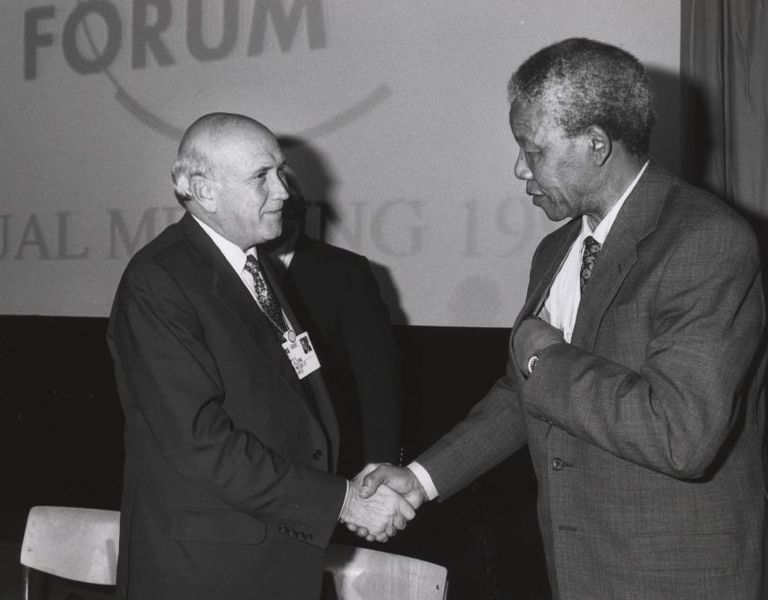
Frederik de Klerk and Nelson Mandela shake hands at the 1992 Davos meeting. (Photo Credit: Copyright World Economic Forum)
South Africa is now ruled by blacks; the only prosperous country on the continent has been handed to them on a platter. While the country has not sunk overnight into the morass of the rest of Africa, and while most of the dire predictions of the white right did not come to pass, a dispassionate view of the last four years gives one no confidence that South Africa’s future will be fundamentally different from that of other black-ruled nations. Virtually every trait that makes one skeptical of black rule — dishonesty, deviousness, incompetence, corruption, unreliability, and callous indifference to human suffering — manifests itself daily.
When I first visited South Africa in 1986, after a decade in black Africa, it was at the end of the apartheid era. The contrast with the rest of Africa was stunning: all of the amenities one associates with the modern world — from telephones to potable water to public toilets — were plentiful in South Africa.
Most of the apartheid legislation was still in place, though much of it was becoming a dead letter. Apartheid’s ostensible goal was an exclusively white South Africa, with most blacks living in nominally independent tribal “homelands.” Those living in South African townships near whites were “temporary sojourners” and thus were not, for example, allowed to own businesses, as this would give them a degree of permanence.
Influx Control, limiting the migration of blacks into urban areas — white or black — had already been scrapped. The pass laws, however, were still enforced. These laws, which were probably the most determined attempt at white control over blacks, required blacks to carry a kind of internal passport: any black male in a white area after dark without the proper endorsement in his book could be arrested and taken to special courts. It was the extension of pass laws to women that supposedly led to demonstrations and the “Sharpeville Massacre” of 1960.
Contrary to accepted wisdom, I believe that many blacks knew and understood the reasons for these laws. While many blacks no doubt saw the pass laws as onerous, it is not uncommon for someone to suffer on account of a law but still understand the reasons for it. If I am a heavy smoker, I will suffer on a long flight without a cigarette, but may nevertheless admit that there are good reasons for the prohibition.
Black men, as a group, are trouble — they are violent and prone to criminality — and the pass laws were designed to control their movements. (A phrase never far from white consciousness was swart gevaar — “black danger.”)
If today there were a way to get young men off the streets of Soweto after dark, I am sure the vast majority of its peace-loving residents would approve enthusiastically. Indeed, the head of one of the most influential think-tanks in South Africa recently told me that a group of his black employees had said that the only way to deal with the problems of the “new South Africa” was to “bring back the pass laws!”
The major watershed event in recent South African history came in February 1990, when the last white president, F. W. de Klerk, announced that the black liberation organization, the African National Congress (ANC), was to be unbanned, Nelson Mandela released from prison, and all remaining apartheid legislation abolished. This led to four years of “negotiations” during which the whites could do little but give in to the demands of the ANC. The results were the one-man-one-vote elections of April 1994, in which the ANC won just under two thirds of the vote and a corresponding proportion of the members of Parliament (MPs).
White Neighborhoods
Probably the most significant direct effect of black rule has been the dramatic rise in crime, primarily black-on-white. With the abolition of the Group Areas Act, which had designated specific neighborhoods for specific racial groups, blacks began moving into white neighborhoods. This was slow at first because, I would guess, many blacks could not believe whites would allow it. My neighborhood near central Johannesburg, which was still substantially white as late as 1995, is now overwhelmingly black.
What are the consequences? A few years ago, it was difficult to find a parking space on the street at night. Now, theft and vandalism are so bad that you simply cannot leave a car out at night. Rubbish is everywhere. Few people — white or black — feel safe walking after dark. In short, we have what follows any transition from white to black.
Why haven’t I moved? For one thing, my income is limited and moving is expensive. Second, I’ve lived in close proximity to blacks in Africa for twelve years; as individuals, I do not dislike them. Third, I don’t have children.
Another change since black rule has been the growth of the black taxi industry. In 1986, public transport was still segregated; blacks had separate buses that ran between Johannesburg and the townships. Some time in the 1980s minivans began appearing, taking blacks anywhere they wanted to go. Originally hailed as precursors to the development of large-scale black businesses, the industry soon degenerated into competitive tribal cabals that dealt with rivals in the way they knew best: by killing them. One consequence, however, was that blacks had easy access to white areas hitherto out of bounds, which paved the way for the invasion that eventually occurred.
Psychological Impact
Even though the Western media grudgingly acknowledge that post-apartheid South Africa has seen an enormous eruption in crime, virtually no one attempts to explain it. I believe the reasons for it are psychological, and that probably the most important consequence of doing away with apartheid was its effect on black psychology.
To begin with, there is ample evidence that African blacks feel inferior to whites. The reasons for this are not hard to understand: In most of the ways that count in today’s world, blacks as a group are generally less able than whites and are not so foolish as to fail to recognize this. Most Africans are indifferent to the emotionally charged refusals by whites — typically those with the least contact with blacks — to recognize racial differences. My own basis for saying that blacks accept these differences is my experience of talking to hundreds of Africans. However, one fairly typical piece of “objective” evidence can be found in this statement by two militant black American psychiatrists, William H. Grier and Price M. Cobbs, in their book Black Rage:
The fact of the matter is that black people are inclined to regard the white man as superior. There are examples without number in the patois and the everyday behavior of millions of blacks which speak for the fact that they do indeed feel that the white man is intrinsically better. (p. 191.)
One discovery I made living in black Africa is that virtually all blacks unaffected by liberal egalitarian ideology not only recognize this inequality but are not in the least bothered by it! I say this after countless conversations with blacks all over the indigenous black world. Ask any African why blacks can’t, for example, make airplanes or computers and he’ll look at you as if you were foolish for asking, since the answer is obvious: “The white man has the brain for it and we don’t!”
Perhaps because of this, among themselves, blacks often seem consumed by a need to feel superior and to achieve ‘status’. From a black point of view, the best way to do this is to make someone else (feel) inferior to you, since if he is inferior you must be superior. This helps explain much of the callous and often brutal behavior of black nurses, policemen, school teachers and the like: When they find themselves in even the most petty positions of authority, many blacks lord it over their underlings in the most extravagant manner.
When blacks saw the white man dismantling the mechanisms of apartheid, and in general deferring to black wishes, they asked themselves: “Why is he doing this? It’s certainly not because we deserve it.” The obvious answer was that the white man was foolish, weak, and frightened, and this diminished the fear, respect, and even awe that facilitated white control.
Black criminal predators have a bully mentality, naturally preying on the weak. Fear in others incites them as blood to a shark. And fear is precisely what they detect in whites. The result is that potential black criminals, long kept at bay by their own fear, were let off the leash — with wholly predictable results.
Even aside from violent crime, one indication of the level of lawlessness here is that one will see more people flagrantly running red lights in one day than one is likely to see in a lifetime in America. Also, since the end of white rule, the likelihood of a black man being arrested for such ‘minor’ offenses as openly urinating in the street is zero.
In general, blacks tend either to follow rules slavishly, not grasping the possibility of exceptions under any circumstances, or to simply flout the law. One might regard this as a typical manifestation of the apparent lack among Africans of the concept of gradation: something is either on or off, all or nothing; therefore, once they start breaking laws they tend to break them all.
I believe a similar change in black psychology has occurred in the United States. From 1969 to 1973 I lived in New Orleans, in a white neighborhood, though half a block away it was black. I could walk anywhere, night or day. By the mid-1980s, however, things had changed dramatically: Everyone had stories about black-on-white crime, and areas that had for years been white were being abandoned. What caused this turnaround? In the early 1980s, New Orleans got its first black mayor. My conjecture is that the increase in crime was disproportionately black-on-white, and was associated with decreasing fear and respect for whites brought on by access to political power: “What do we have to fear? We’re as good as the white man! The mayor himself is black!”
Dinesh D’Souza makes a related point in his book, The End of Racism:
These pathologies have existed in the black community since slavery, but they have been restricted and contained both by white-imposed discipline and black-imposed norms enforced by churches and local community institutions. But those institutions have been greatly weakened since the 1960s, and in the new environment of social permissiveness and government subsidy, black pathologies have proliferated. (p. 37.)
Black criminal propensities were previously held in check by slavery, segregation, apartheid, and strict tribal custom. Remove these constraints and pathologies assert themselves.
Another factor contributing to the rise in crime is the extent to which the newly africanized South African Police Service itself engages in crime. The police will stop an innocent black driver and tell him his car is stolen and must be confiscated on the spot. When the hapless owner goes to the township police station he discovers that his car has vanished! Given the level of police incompetence and corruption, there is no practical recourse. To my knowledge, this sort of thing occurs almost exclusively in black areas, presumably because in white areas there are still white policemen whose presence is sufficient to deter it.
Not unlike black nurses and black school teachers, black policemen are on the whole pretty useless. Since 1990 or so, the previously white higher echelons, which kept the rank and file in at least a state of semi-discipline, have also become black. In general, Africans simply cannot manage. They are incapable of running any large establishment and lack the discipline, organization and cooperation necessary to control crime. Although this may sound harsh I believe they also lack the necessary morality. Police will obviously be more effective if they are morally outraged by crime and feel, viscerally, that it is bad. I would doubt there are many African police, at any level, who feel this way.
In passing, I would note that one of the more remarkable spectacles in the aftermath of the black crime epidemic is that “liberal” politicians are so vociferous in complaining about it! No one ever points out that these same people were themselves instrumental in bringing about the very conditions that gave rise to the entirely foreseeable results they now condemn. They are also the ones whose wealth protects them from the effects of black rule, and are the first to flee the country.
The New Constitution
To understand the recent changes in South Africa, one must realize how firmly Western liberal egalitarian ideology has taken root at the top levels of society. In many cases I do not think the leaders really believe in what they espouse, but are so in thrall to Western political correctness that they flout many of their most deeply held customs and traditions.
For example, one of the first things the newly created Constitutional Court did was unanimously to declare capital punishment unconstitutional. Nelson Mandela defended this by saying that the white government had unjustly executed many blacks, implying that if capital punishment were left on the books, the new black government would feel compelled to follow the white example! Persistent calls for a referendum on this question have been ignored.
The black elite is radically out of step with the man in the street. There is widespread approval of the township vigilantes who administer on-the-spot capital punishment to thieves caught in the markets — just as is done in Nigeria or Kenya. No one doubts what the results of a referendum would be.
Also, today’s South Africa is officially a haven for homosexuals, but one thing I learned from living in black Africa is that homosexuality is anathema there. Many Nigerians, for example, refuse to believe that it exists, and when it is explained to them, regard it with undisguised loathing and contempt. President Robert Mugabe of Zimbabwe is typical of Africans in his view that homosexuals are despicable. In spite of this, the South African Constitution goes beyond any other in ensuring the “rights” of homosexuals. There are gay parades, gay marriage will almost certainly be institutionalized, and in general it is politically unacceptable publicly to say anything bad about homosexuality.
Feminism is another alien Western import. Africa is a male-dominated continent. Women are there to serve men’s needs, to bear and raise children, and to take care of the home. This subservience is nicely illustrated by the fact that Daniel Arap Moi, the president of Kenya for the last 20 years, has never appeared in public with his wife and nothing whatever is known about her; it’s as if she didn’t exist. Nothing could better illustrate the place of women in Africa.
Yet in South Africa, the constant refrain is that the country is now a “nonracist, nonsexist democracy.” The ANC insists that a third of its MPs be women! An MP of my acquaintance tells me that many of these women are illiterate and hopelessly ignorant. Further idiocies are found in attempts to integrate the armed forces sexually, as in the U.S. In addition, South Africa now has probably the most liberal available-on-demand abortion laws in the world, even though this goes very much against the African grain.
Given that the black elite has ridden roughshod over ordinary blacks’ sensibilities, one might ask for evidence of black resistance to these moves. Such a query assumes that Africans are in the habit of protesting things they don’t like, and yet nothing could be further from the truth. Blacks have a sheep-like mentality, are overawed by authority, and are therefore easily cowed. Whatever they may think, they will keep their mouths shut. In any case, “protest” would have to be organized by black leaders. But no black leader is likely to object publicly to the officially sanctioned legitimization of homosexuality, for example.
Indeed, while blacks may find homosexuality revolting, it must be noted that their feelings tend to be both shallow and mercurial. However harsh it may sound to say so, blacks are, in many ways, child-like, and this is illustrated by the often superficial quality of their emotions. They are easily provoked into violence and mayhem but, like chameleons, they can turn completely docile the next moment.
A recent incident is perhaps revealing. I was driving in heavy traffic, and cut in front of a black taxi. As luck would have it, we met at the light and the driver shook his fist at me, cursing me in anger. I raised my hand, acknowledging fault. Instantly, the anger became a broad (and, I believe, genuine) smile of friendship. This kind of instant transformation is common.
Public Services
When I was in Johannesburg in January 1986, the mammoth Johannesburg General Hospital was for whites only. “Jo’burg Gen” was very impressive. The nursing staff was white, as were the medical and administrative staffs. It was clean and well-run. The previous white hospital, near the city center, served blacks.
What has happened under the “new dispensation?” Conditions have deteriorated dramatically. Patient infection rates have skyrocketed and theft of supplies is rampant. Discipline among the nearly all-black nursing and maintenance staff is virtually nonexistent — they simply will not work. Patients sometimes go without clean sheets. A rabbi friend, a chaplain at Jo’burg Gen, says it is not uncommon now for patients to die because of nurses’ incompetence and indifference. I have seen for myself that cockroaches have untrammeled right of access.
There was recently a call by the Minister of Health, a black woman, for entering classes of medical students to reflect demographics — for 76 percent to be black regardless of merit. From a black standpoint, this makes perfect sense. Western medicine is, to Africans, the white man’s witchcraft rather than a disciplined body of knowledge and practices. Blacks think of a medical “degree” as amagic talisman with which they can heal the sick and become wealthy and powerful. Since this piece of paper in and of itself has the power to heal, it doesn’t matter how you get it; it certainly doesn’t matter what abilities or aptitudes you may have or what, if anything, you have learned in order to get it.
Was the old system of segregated hospitals morally justified? Needless to say, the vast majority of Americans would find the idea morally indefensible, but after twelve years in black countries it struck me as the merest common sense. Considering the demographics of South Africa — five million whites and over 30 million blacks — was it possible for the minority to provide medical care for blacks equal in quality to what they provided for themselves? Given that all the resources, aside from manual labor, would have to come from this small white minority, it seems obvious that it was not.
Moreover, it is not clear that whites were under any obligation — even ideally — to do so. If they had somehow prevented blacks from developing their own health care systems, that would be a different matter. But it is obvious this was not the case, since where blacks have all the resources they need (as in Nigeria, for example), medical care is a nightmare, as it is wherever blacks are responsible for providing it.
It might be argued, however, that whites had an obligation to provide at least some care for blacks, perhaps the best whites could afford. But this is basically what they did, either in separate hospitals or in separate sections of white hospitals. I have seen some of these, prior to 1990, and they were vastly superior to anything you would find in black Africa.
The relevant analogy is of a wealthy man with a good-for-nothing brother with indigent children. Does he have an obligation to help them? Perhaps. Does he have an obligation to see that they are as well off as his own children? I don’t think so. The guiding principle here is beggars can’t be choosers. Given their useless father, his children simply have to accept whatever their uncle chooses to give them and be grateful for it.
Similarly, if blacks were capable of providing decent health care they would have long ago been doing so, as have the Indians in South Africa, despite being subject to levels of discrimination almost equal to those of blacks. But their utter failure to do so anywhere in the world suggests that blacks are incapable of it. Therefore, since whites are providing the health care, it is surely up to them if they wish to keep the facilities separate.
The same reasoning applies to Western donor and African beggar nations: The West may give out of self-interest or out of charity, but it is not obliged to give any more than it sees fit, and any attempt to browbeat it into doing more — or even, in some truly ludicrous situations, trying to dictate the conditions of aid — is only an attempt by African leaders to manipulate (unjustified) white guilt. This era, one hopes, is drawing to a close.
In an extraordinary example of a remnant of that mentality, Nelson Mandela recently told international investors that industrialized countries “owe us that support, not as a question of charity, but because we are entitled to it. Our region was subjected to the most brutal form of exploitation in the colonial era which robbed us of our resources.” Even a few blacks can see the breath-taking chutzpah of such a remark. One had this to say in a letter to the editor of the Johannesburg Star:
President Mandela’s statement that the southern African region has been subjected to ‘the most brutal form of exploitation’ by the industrialized nations must not go unchallenged. Every piece of technology that exists here was brought in by the developed nations . . .
Westerners established and developed infrastructure, industry and administrative controls, all of which are, ultimately, for the benefit of all Africa’s people . . .
The industrialized nations owe us nothing. To say that they are morally obliged to invest in our shaky region is preposterous. Without them the riches of Southern Africa would never have been discovered, and could never have been turned into wealth.
Separate schooling had the same rationale as separate hospitals. If blacks were capable of establishing an educational system they would have done so — as have the Indians. Most blacks are capable of some learning and some as much as any white, and the task of educating them was undertaken by the Afrikaner government and missionaries. Just how many blacks received such a basic education I do not know, but I do know that the black schools under apartheid were infinitely better than the general chaos and mayhem that passes for “black education” now.
Nevertheless, the official bogeyman has long been “segregation.” No one ever seems to point out that demographically “integration” is a nonstarter, since there are not enough whites to go around. The underlying assumption is that whites are so superior that a mere handful of them in each class will transform the travesty that is black education! (Americans thought something roughly similar back in the 1950s.) Many blacks think the reason whites are educated and they are not is that whites have a secret formula they use to educate themselves, which they selfishly refuse to divulge to blacks!
I recently asked a young white teenager in Cape Town how many blacks were in his school. About 40 percent. So how is it? Not so bad, he said. But it turned out that he was just being “polite.” His parents were looking for another school. Why, I asked, if his school was okay. “It’s not,” he said. “It’s chaos.” Theft and violence were the norm.
It is often asserted here that blacks do less well because less money is spent on them. Evidence from the United States has consistently shown that this is not the case. More money has had very little effect on the performance of black students in Washington, DC, Kansas City, and any number of other cities. The Afrikaners’ assumption (including that of the architect of apartheid, Hendrik Verwoerd) that money spent on education must match the ability of its recipients to absorb it may have been substantially correct.
Within a few years most government schools will be overwhelmingly black, replicating the conditions in the townships. As in the United States, affluent whites will go to private schools and only the poorest will attend government schools. South Africa is thus becoming an unattractive place for middle and lower class whites, who are the very people with virtually no chance of leaving.
Universities face similar problems. Witswatersrand University (“Wits”), in Johannesburg, has traditionally been the leading university in South Africa, and deservedly so. But the push, for at least the last ten years, has been to turn it into an African university, that is to say, one with no standards, very little teaching, no significant research, and that issues meaningless paper degrees. The paradox is striking. Blacks go to Wits because it is white. Yet these same students (or at least a very vocal minority among them) and the black government are doing their best to turn white universities black, which they cannot fail to know means their ruin. Indeed, one suspects that it is the very contrast between white success and black failure that they wish to eliminate.
It is apparent that the ANC is intent on acquiring power at every level and exercising it without restraint. One strategy is to create mega-municipalities incorporating all surrounding cities and towns. Greater Johannesburg, for example, has large areas that are still predominantly white. If they stayed independent they would retain power and influence. Therefore, the ANC has transformed the area into four huge municipalities, each having a large ANC majority.
One such prosperous white area is Randburg. Until recently it had excellent emergency services, but since amalgamation with the large black township of Alexandra, it has been unable to provide its usual level of ambulance service both to itself and to the much more populous township. Combined with the newly-introduced presence of black bureaucrats, the predictable result is that neither Alexandra nor Randburg now have proper emergency services.
One of the few relatively bright spots in South Africa is the white-run press. It has retained most of the independence and freedom it enjoyed under apartheid. When I first arrived here I was surprised to find the press full of indignation directed against the white government. “This is oppression?” I thought to myself.
The most prominent critic of the old regime was probably The Weekly Mail. Left wing and very ideological, it left no stone unturned in attacking apartheid and white rule. Now that it has achieved its aim, it doesn’t much like what it got but, to its credit, has been uncovering corruption on a stupendous scale. Such publications must be having some kind of restraining effect on the government, though only time will tell how long they will be tolerated. Interestingly — and as an indication of the status whites have retained — black journalists who report on corruption are severely rebuked by the authorities, who accuse them of being whites’ lackeys, etc.
A second bright spot, also a holdover from the previous regime, is the mostly still-white judiciary, which retains an independence that is virtually unheard of in black Africa. Gradual replacement by more compliant black judges — who won’t understand that a court can go against the government — will eventually end this check on government power.
Perhaps the single most important constraint on the ANC government so far has been the influence of international corporations. Nelson Mandela has been told, in no uncertain terms, that if he wants foreign investment he had better forget about nationalization, keep government spending down, control labor unions’ wage demands etc., all of which are contrary to the ANC’s natural tendencies, which are to see government as an infinite trough from which all can feed. The government is the natural ideological ally of the socialist- and communist-led Confederation of South African Trade Unions (Cosatu). Cosatu has already pressured it into accepting a labor bill highly favorable to workers and unfavorable to employers, as well as affirmative action laws that virtually force businesses to increase black employment at all levels.
In this ideological tug-of-war between labor interests and overseas investors, there seems little doubt that the wrong side will eventually win, though this probably spells doom for the South African economy. Should that not influence President Mandela and his chosen successor, Thabo Mbeki? Unfortunately, it will not. The country and its black majority may become dirt poor, but high-ranking government officials are unlikely to suffer. Africa is full of countries where the people starve and the leaders drive Mercedes.
White Attitudes
There is unquestionably great uneasiness among whites. Many are leaving and many more are thinking of leaving. Accurate figures are difficult to come by because many migrs simply go on a “visit” and never return, but the number who would leave if they could must be considerable, especially among those with school-age children. Black rule plus draconian affirmative action makes many whites feel there is no future for them.
At the same time, there is no doubt that whites will continue to dominate the economy for the foreseeable future. The case of Zimbabwe is instructive: In spite of a much smaller white population and a militant black government constantly threatening white interests, there is a never-ending chorus of complaints to do something about “white control” of the economy, 18 years after “independence”!
One also hears more and more about black disaffection. I know a young “street-wise” black woman who always seems to know the “township scuttlebutt.” Around the time of the 1994 elections, she was spouting the usual rhetoric: Whites had stolen their country and now they were going to get it back. Four short years later, with none of the grandiose promises fulfilled, her tune has changed: “Oh, it’s these foreigners who are causing all the problems!” Who are these foreigners? Black immigrants from neighboring countries. They are the cause of all the crime, are taking all the jobs away from South African blacks. And so on. The solution? “When the [white] National Party comes back into power they will throw all these foreigners out!”
My own view is that South Africa will gradually sink towards the level of the rest of the continent, though it is unlikely to reach the same depths, given a continuing white presence. Black disaffection with black rule is to be expected as is the case throughout black Africa.
But South Africa, due to liberal ideological influence, is a bit like America, where blacks systematically vote for blacks no matter what. South Africa stuck to this mold when it elected an ANC government in 1994 by a nearly two-thirds majority. I once thought that disappointment with black rule might lead to a black backlash by the 1999 national elections, but I have been largely disabused of that idea. If blacks had the sense to vote against the current government they would not have elected it in the first place.
Nevertheless, as I say, I hear repeated stories about blacks lamenting present conditions. A Romanian woman who supervises 60 black workers says that all she hears is how bad the government is, how much better the white government was, etc. So one cannot completely rule out increasing numbers of blacks voting for whites, in spite of the numerous factors militating against this. After all, the colored (mixed race) majority in Western Cape Province has twice elected a white provincial government, which is an example of nonwhites voting for whites.
One thing that counts against this exercise in common sense is black superstitiousness — they readily believe that others can “see” who they are voting for inside the booth — which makes them easy to intimidate. My “scuttlebutt” informant recently confirmed, unprompted and with eyewitness testimony, what I had heard during the 1994 elections: that blacks were constantly threatened that if they didn’t vote ANC their houses would be burned down, etc., implying that “someone” would know — by magic — how they voted. Add to this the typical black awe of authority and you get manipulability.
The almost limitless credulity of blacks means that many will be suckered into believing that a black government will make them rich — that they will own the houses, factories and farms of their employers. This is associated with the common black failure to understand the nature of wealth creation: To them it is just sitting there waiting to be taken, not something that requires sacrifice, hard work, discipline and foresight. All of this explains why blacks vote for blacks.
Yet in the past four years they have seen that dreams of sudden wealth were chimeras. More important, the vast majority don’t understand how an election works. It would therefore not be surprising if, with the awareness that miracles did not occur the last time, masses of blacks simply lose all interest in the electoral process and do not vote at all, thus proportionately increasing the power of the white electorate.
The 1994 election was widely hailed as a “miracle” simply because it took place, though views differed as to just what was miraculous about it. Outside the country, self-righteous commentators seemed to think natural laws must have been suspended in order for the wicked white regime to hand over power to blacks — but this process had been set in motion years before, and would have been nearly impossible to turn back. Within South Africa, the “miracle” was that there had not been riots or even full-scale civil war between Zulus and the largely-Xhosa ANC. But blacks had no reason to riot; they were getting everything they wanted. In any case, the election was covered by nearly every media organization in the world, and even unsophisticated blacks had some notion that something important was going on. For the 1999 elections, there will be nothing like the media hype there was for the last one, and this too should reduce the black turnout, giving whites more influence.
On the other hand, white political parties cannot campaign in the townships. All attempts so far to hold public rallies have been disrupted. I suspect the reason for this is that the ANC elite at some level shares my view that if ordinary South African blacks are left to their own devices — and to the extent that they are free from Western ideological influence (as I believe many are) — a large number would indeed vote for whites. One way to prevent this is not to let white politicians anywhere near them. A similar fear most likely explains why President Daniel Arap Moi of Kenya prevented the registration of the Sarafina party, headed by the formidable figure of Richard Leakey (of the famous family of anthropologists), who otherwise might have won an embarrassingly large number of votes.
South Africa has sophisticated opinion polling techniques. If the ANC were going to lose an election it would be known in advance. What would a black government do? Not a single person I’ve asked, black or white, has ever differed in his answer: The ANC would cancel the election and declare some kind of one-party/military government. In that case, South Africa’s decline could be sudden rather than gradual.
I have independent confirmation of my view that when blacks are not encumbered by Western liberal-egalitarian dogma they are happy to vote for whites. Blacks are a large majority of the Brazilian state of Bahia, but they consistently elect white governments. Therefore, I would not totally rule out blacks here doing the same if they had the chance. Whether the ideological brainwashing — which is by no means as widespread in South Africa as in the U.S. — can be overcome is an open question, but it seems to me that the “loyalty” on which ANC rule is based is a house of cards. Given the extremely volatile and unstable African temperament, the possible outcomes are not nearly as predictable as many are likely to assume.
South Africa should, of course, be a lesson for America. Both countries are making the same mistake, which is to assume that there is no such thing as racial differences. It is this mistaken assumption that prevents recognition of the fundamental paradox of black-white relations. Blacks want to live in white neighborhoods, go to white schools and hospitals because they are white. Yet these objects of their desire will remain desirable and superior only as long as they remain white. A few blacks can live in a white neighborhood or go to a black school without seriously affecting it, but as soon as their numbers approach predominance, the very things that made the blacks want to go there cease to exist and blacks find themselves in the very situation they sought to flee: black slums, broken-down black schools, hell-hole hospitals, etc.
Blacks can enter into these white structures only if their numbers are controlled; but that is impossible so long as everyone assumes that the very idea of fundamental racial differences is somehow shameful and morally abhorrent. To bring about any real racial progress this assumption must be irrefutably — and, most of all, publicly — shown to be the profound and pernicious fallacy that it is.
[Editor’s Note: This is just one of thirteen essays in our collection of first-hand reports about the reality of race, Face to Face with Race.]