What God(s) for the White Man?
Jared Taylor, American Renaissance, April 3, 2026

Credit Image: © Roald/NTB Scanpix via ZUMA Press
Liberals and “progressives” disdain and even despise religion. They want to tell us what to think and how to behave, and see religion as an irrational obstacle to their plans for a global ideology. The West has seen a steady decline in religious affiliation, especially since the mid-20th century.
But religion persists. There is no known people or society in history or anthropology that had no religion, defined broadly as belief in spirits, supernatural forces, animism, or practice of rituals. There were atheists and materialists in ancient Greece and Rome, and Hinduism tolerated the atheist school of Charvaka, but these were within deeply religious societies. It may be that some conception beyond the material is inevitable for the only species that has consciousness and can foresee its own death.
The white man has had religion of some kind from his earliest appearance in history up to the present, with Christianity reaching near-total dominance in the High and Late Middle Ages. Serious attacks on it began in the Enlightenment, and the French Revolution was viciously anti-clerical. In 1796, Antoine Destutt de Tracy coined the word idéologie, hoping to found all knowledge on reason, and with the intention of undermining religion. Marx and the Communists were sworn enemies of religion, but as this map shows, with the curious exceptions of Estonia and Hungary, faith in God has been remarkably durable in the nations it ruled.
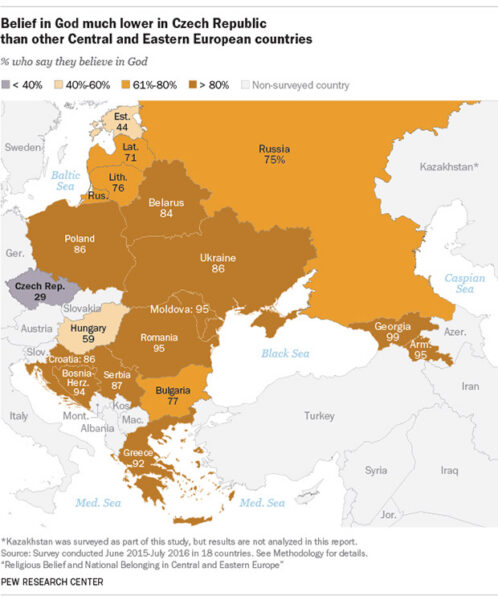
If we hope to build a mass movement of racial consciousness, how should we view religion? We need answers to this question for several reasons. First, in every survey in every country studied, people with strong religious affiliations have more children. In the United States in 2020, women who attended church every week were having 2.1 children over their lifetimes while nonreligious women had only 1.4. There are similar differences in Europe.
Secular sociologists liken churches to clubs for people who want families and children. Married members support each other, and single members meet others who have the same goal. Whites who are determined to sustain our numbers should not neglect religion’s role in increasing birthrates.
Second, religion sets common rules. It can be the glue that creates high trust, which is the key to getting large numbers of people who are not immediate kin to cooperate. Biologist David Wilson writes that “religions exist primarily for people to achieve together what they cannot achieve on their own.” To the extent that’s true, we should have religion on our side. Also, many people need moral guidance, and religion can help.
What choices do we have? Christianity had become the primary faith of Europe by 800 when Pope Leo III crowned Charlemagne Holy Roman Emperor. Numerically, Christianity is still the overwhelmingly dominant religion of believing white people, and for that reason, there will be more Christians in our circles than people of any other religion. However, many racially conscious whites see universalist Christianity and its turn-the-other-cheek morality as one of the main causes of our loss of nerve.
If we are to have religion that is not Christianity, pre-Christian paganism stretches all the way back to what Hans F. K. Gunther described in his 1966 book, Religious Attitudes of the Indo-Europeans. A modern expression of this would be Dominique Venner’s “handbook written by a European for Europeans,” Samurai of the West. There have also been attempts to found scientific religions for whites, such as Raymond Cattell’s Beyondism and William Pierce’s Cosmotheism, but Christianity is still the default religion of white people.
Christianity
Not much more than a century ago, to be white was to be Christian. About halfway through Treasure Island, the hero Jim Hawkins stumbles onto a castaway left on the island. The first words out of the man’s mouth are, “I’m poor Ben Gunn, I am; and I haven’t spoke with a Christian these three years.” Jim, who at first thinks the darkly-tanned Gunn might be a native, realizes his error: “I could now see that he was a white man like myself . . .”
The British Catholic author Hilaire Belloc (1870–1953) famously claimed in 1920 that “Europe is the Faith and the Faith is Europe.” Europe was Christendom. No longer. In 2025, an estimated 69 percent of Christians lived in the “global south,” and only 31 percent in the “global north.” Because of low birthrates and defections from the faith, the number of white Christians declines by a fraction of a percent every year, while it grows by 2.5 percent a year in Africa and by 1.6 percent in Asia. A non-white pope is inevitable. Many racially conscious whites see this transformation of Christianity into a non-white religion as a fatal defect aside from any objections to Christian doctrine.
Whatever we may think of Christianity today, during the 1,000 or so years that “Christian” meant “white,” the faith had a colossal influence on our art, music, architecture, and literature that was only strengthened by absorbing so many popular pagan elements.
Johann Sebastian Bach wrote, “The aim and final end of all music should be none other than the glory of God and the refreshment of the soul.” At the beginning of manuscripts, he routinely sought inspiration by writing “J.J.” (Jesu Juva), meaning “Jesus, help me,” and when the composition was complete, he wrote a dedication at the end: ‘S.D.G.” (Soli Deo Gloria), meaning “To God alone [the] Glory.” Handel, Haydn, Mendelssohn, and Bruckner were similarly devout, and even as recent a composer as Dvořák started some manuscripts “With God,” and ended with “God be thanked.”
Christianity gave rise to many forms of immediately recognizable sacred architectures — Romanesque, Byzantine, Gothic, Baroque, Rococo — as well as local variants such as Norwegian stave churches that adapted pre-existing building techniques, and Colonial American meeting houses. Even 21st-century churches are almost always immediately recognizable as houses of worship.
As for art, from Christian conversion up until the 14th century, almost all painting and sculpture was sacred. Only in the Early Renaissance did artists take up secular subjects, and many continued to paint Biblical scenes. A good part of any European national collection makes no sense to anyone who is ignorant of Christianity.
Outright hostility to Christianity therefore means repudiating what was, for centuries, the beating heart of European Civilization. The famous Italian journalist Oriana Fallaci was an outspoken atheist and, in her words, “profoundly anti-clerical,” but she also called herself “a Christian atheist.” She admired Christianity’s role in building Western Civilization, and she saw it as a defense against Islam, which she hated.
Nevertheless, there are many arguments against Christianity as a religion for white people. First, the Reformation split Europe. From Luther’s Ninety-Five Theses in 1517 until the Peace of Westphalia in 1648, Protestants and Catholics killed an estimated 3 to 10 million of each other in religious wars that are incomprehensible to us today.
Second, Christianity is a universal religion that encourages conversion without regard to race, which has made the faith increasingly Third World. As non-whites dominate Christianity, they will not just interpret it to their own advantage. They could infuse it with a spirit and an aesthetic that we find jarringly alien.
Third, the Enlightenment philosophers found Christianity fanatical, superstitious, and irrational. Voltaire wrote passionately against clerical abuse of power, intolerance of dissent, and the murderous practices of a “religion of love” that burned dissenters. He famously wrote that “Christianity is the most ridiculous, the most absurd, and the most bloody religion that has ever infected the world.” Also: “The Bible. That is what fools have written, what imbeciles commend, what rogues teach and young children are made to learn by heart.”
The French Revolution killed and exiled priests who refused to swear allegiance to the Republican Constitution or celebrate the new “Cult of Reason” rather than traditional rites. Some 30,000 priests fled the country, and as many as 2,000 or 3,000 were killed in the terror or murdered by mobs.
Dominique Venner had a different critique of the Biblical message: “Christianity has introduced an unprecedented gap between what men do and what they say. . . . the Christian Word asks men to love what they naturally hate — their enemies — and to hate what they naturally love — themselves.” Venner also complained that there is no way to test Christianity’s results — unlike governments, laws, or rulers: “This religion promised nothing on earth and everything in another world, of which it was the sole judge.”
An even broader attack, popularized by Nietzsche, is that Christianity violates the nature of European man. It is an alien, Semitic cult that inverts the natural, life-affirming values of the strong and noble, and glorifies weakness and submission. A truly European morality values strength, power, beauty, joy, and seeks success in this life. What Nietzsche called a “slave morality” resents the strong and superior, and makes a virtue of humility, poverty, and suffering. Christianity devalues this life — including the body, instincts, and pleasure — in favor of an imaginary afterlife, in which this world’s losers have eternal bliss while the rich and powerful suffer eternal torment.
Hans Gunther wrote that Indo-European religion recognizes no all-powerful creator. The gods, like men, inhabit a world that exists independently of them, and all are subject to Destiny. The Indo-European does not think in terms of righteousness and sin, as the Christian does, but of what is honorable and dishonorable. He does not fear death, much less damnation. The beyond has no real meaning in this life, and death has no influence on belief or morality — except as a reminder that we have only a limited time on earth to fulfill duties to our families and nations.
There is no concept of a redeemer because there is nothing from which to be redeemed. Morality is not a commandment of God but comes effortlessly to the high-minded, honorable man. He does not try to wheedle himself into favor with the gods by sacrifice or prayer. (Post-Homeric Greeks, who entreated the gods with sacrifices, had been corrupted by the non-Nordics whom the Achaean invaders had conquered.) Morality does not depend on the prospect of a reward in heaven, but comes naturally to the superior man.
Gunther quotes Goethe on the Germanic spirit: “It is belief in life in spite of all: in spite of the knowledge of the fundamentally tragic character of life.” Likewise, Schopenhauer: “A happy life is impossible; the highest to which man can attain is an heroic course of life.” Inborn nobility means inflexible courage before destiny. Indo-European man addresses himself to the gods standing, face up, with his arms outstretched. He does not kneel or prostrate himself as Orientals do, because he is not a creature of or slave to the gods.
Today, a more practical objection to Christianity is that both mainstream Protestantism and the Church of Rome are objective if not subjective enemies of our race. Even “conservative” denominations seem to compete to see which can apologize most cravenly for slavery, or stand most ostentatiously with “our immigrant brothers and sisters.” Both Catholics and Protestants dilute their teachings, offer scripture à la carte, and foolishly think other religions are allies. It seems that only Mormons don’t festoon their sanctuaries with BLM and homosexual banners.
As for Rome, John Paul II (1978–2005) and Benedict XVI (2006–2013) were the last popes to put up the slightest opposition to Islam. Our current pope, Leo XIV, emphasizes “commitment to dialogue and fraternity” with Muslims, and calls for all religions to be “the yeast of unity in a fragmented world.” The Vatican holds joint Catholic-Islam Iftar dinners and has a dedicated prayer room for Muslims who visit the Papal Library.
Pope Leo also says migrants are “missionaries of hope” and a “divine blessing” to those who receive them. Since 2019, right in St. Peter’s Square, there has been a bronze sculpture called Angels Unawares, of 140 people from everywhere, crammed into a boat. A pair of wings sprouts from among them, symbolizing the presence of the sacred.
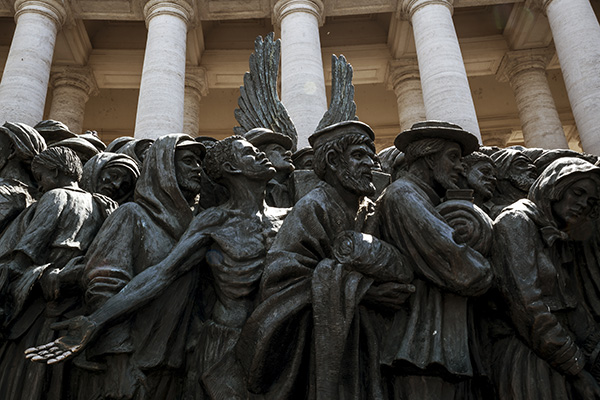
Credit Image: © Valeria Ferraro/SOPA Images via ZUMA Press Wire
Dominique Venner wrote that Europeans submit to replacement “because they have been destroyed from within by a very ancient culture of guilt and compassion.”
After all this, how can we defend the faith? First, it may have lost its nerve not because it is Christian but because it was part of a general collapse of every Western institution: universities, media, corporations, government. Today, Pope Leo reads the same 73-book Bible and recites the same Nicene Creed as Pope Urban II. Leo lets Muslims pray in his library. Urban (1088–1099) launched the First Crusade.
Discovery and imperialism were Christian duties. The year after Columbus reached America, Pope Alexander VI decreed that in the New World, “the Christian religion be exalted and be everywhere increased and spread, that the health of souls be cared for and that barbarous nations be overthrown and brought to the faith itself.” Resistance was rebellion against God’s plan. Official documents and papal bulls repeatedly encouraged both Spain and Portugal “to spread the faith,” “exalt the Catholic religion,” “bring souls to Christ,” and “overthrow barbarous nations” for their own spiritual good.
British imperialism was a “civilizing mission” that carried with it “the Bible and the flag.” Queen Victoria was a pious Anglican who saw the empire in providential terms. Lord Curzon, viceroy of India, believed that empire was a “divine instrument” and “the greatest instrument for good that the world has ever seen.” John Nicholson, who put down the Indian Mutiny, read the Bible every day. Cecil Rhodes was an exception. His “Confession of Faith” was a belief in the destiny of “the English-speaking race:” “I contend that we are the finest race in the world and that the more of the world we inhabit the better it is for the human race.”
Many American slaveowners justified slavery on Biblical grounds. In 1861, the Confederate states deliberately distinguished their constitution from that of the United States, “ . . . invoking the favor and guidance of Almighty God [we] do ordain and establish this Constitution.” The motto of the Confederacy was not E Pluribus Unum but Deo Vindice (God our Vindicator). Into the mid-1960s, Southerners argued that racial purity was “a gift of God” and that segregation was part of “the Divine plan.”
They turned Galatians 3:28 on its head. “There is neither Jew nor Gentile, neither slave nor free, nor is there male and female, for you are all one in Christ Jesus.” What could be more absurd than to claim there is neither male nor female in this world? Distinctions like these disappear only before God.
This is not necessarily to say that the teachings of Christianity are true or that Nietzsche or Gunther or Venner were wrong: only that Christianity need not be a doctrine of capitulation. In fact, there are still Christian Identity groups that quote the Bible to justify racial separation. Here is such a site, which offers a series of no fewer than 60 commentaries on the Book of Genesis alone.
Without going as far as that, there are Protestant denominations that are skeptical of critical race theory and oppose same-sex marriage, such as the Independent Fundamentalist Baptists, the Presbyterian Church in America, the Orthodox Presbyterian Church, the Lutheran Church-Missouri Synod, the Wisconsin Evangelical Lutheran Synod, and a number of Pentecostal denominations.
Catholics can find shelter from Pope Leo-type post-Christianity in Latin-Mass congregations such as those affiliated with the Society of Saint Pius X, the Priestly Fraternity of St. Peter, the Institute of Christ the King Sovereign Priest, and Ecclesia Dei communities. They emphasize ancient liturgy, modesty, traditional sex roles, large families, and resistance to secular culture.
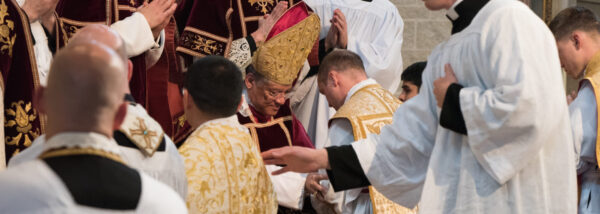
For those willing to renounce communion with the pope, Eastern Orthodox Churches offer the ancient Divine liturgy and reject Rome’s innovations. In America, there has been a flood of defections to the Antiochian Orthodox Christian Archdiocese, the Orthodox Church in America, the Greek Orthodox Archdiocese of America, and the Russian Orthodox Church Outside Russia.
In Europe, disillusioned Catholics have moved to the Greek, Russian, and Romanian dioceses, though not in such large numbers. Orthodox writers quietly encourage Catholics to “come home.”
Nevertheless, after years of decline, some European countries have seen a rise in the number of adults seeking Catholic instruction. This Easter, the Church in France expects to baptize 10,384 catechumens. This is a 45 percent increase from last year, and the highest number since the French Bishops Conference started counting 20 years ago. In 2015, there were only 3,900 baptisms. Also, for the first time, 18- to 25-year-olds are the largest age group joining the church, surpassing those 26 to 40, who have been the largest. Priests also reported unusually large attendance at this year’s Ash Wednesday masses, with standing-room-only congregations.
In Britain in 2018, only 8 percent of the population said they were Christians who went to church at least once a month. In 2024, 12 percent were. For ages 18 to 24, the number rose from just 4 percent to an astonishing 16 percent. Perhaps even more surprising, men in that age group are almost twice as likely as women to be regular churchgoers: 21 percent vs 12 percent. Britain’s biggest Christian publisher SPCK reported that Britons bought 310,458 bibles in 2024, up from 258,391 in 2023, and 194,013 in 2018. Some new churchgoers reported that they gave up trying to live without God, that they craved belonging and community.
In some age groups, Catholic attendance is going up while Anglican attendance goes down. Among those 18 to 34, 41 percent identify as Catholic, up from 22 percent in 2018, while Anglican affiliation dropped from 30 percent to 20 percent. I doubt that last week’s installation of the Church of England’s first female Archbishop of Canterbury, Sarah Mullally, will do much to pep up the Anglicans.
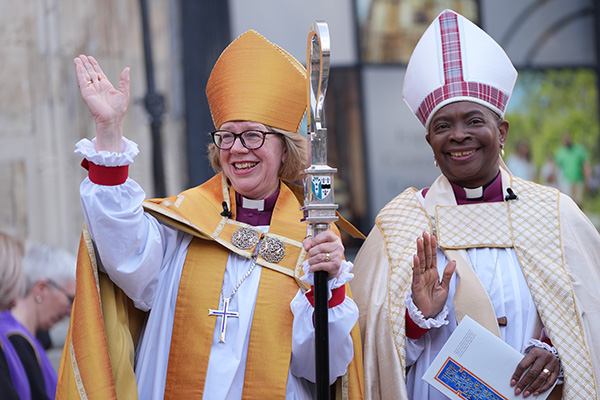
The Installation of Dame Sarah Mullally, the new Archbishop of Canterbury, at Canterbury Cathedral. (Credit Image: © i-Images via ZUMA Press)
In the United States as well, there may be signs of a Gen Z revival. Compared to those born between 1995 and 2002, Americans born between 2003 and 2007 are slightly more likely to identify with a religion (61% v. 55%), pray daily (35% v. 30%), and say religion is very important (37% v. 32%). They are a lot more likely to say they attend religious services at least monthly (41% v. 26%).
Young Americans are having less sex. They are skeptical of “hookups,” have fewer partners, and remain virgins longer. It’s not clear whether this is because of high rates of depression and social-media isolation or because young people are returning to tradition, but what had seemed like a relentless decline of Christianity may be flattening out.
Alternatives to Christianity
Ancient Greece and Rome are still very present in the West, especially in architecture, literature, and philosophy. Elements of the proposed White House ballroom would look at home on the Acropolis or in the Roman Forum.

Whites take immense pleasure in Homer, the Greek philosophers, tragedians and historians, as well as in Virgil, Tacitus, Cicero, Caesar, and Marcus Aurelius. European museums hang scenes from Greek myths alongside depictions of Bible stories. And yet, even though we know a lot about the practices of Roman and Greek religion, there have not been many attempts to revive it. Modern Hellenism gained momentum in Greece only in the 1990s, and in 2017, despite opposition from the Orthodox church, the Greek government recognized it as a religion. There are a few Hellenic societies in the United States.
Roman religious revival likewise began in the 20th century, with active communities in Italy, Eastern Europe, and the United States. Nova Roma promotes paganism, but neither Greek nor Roman revival appears to be a vehicle for racial consciousness — although there must be a certain amount of self-selection that keeps these movements overwhelmingly white.
Neo-Paganism, based on pre-Christian Nordic practices, can be explicitly white, and became more prominent after the Second World War. Estimates put the number of European adherents in the low hundreds of thousands, with the figure in the United States reaching perhaps one million. Paganism includes Wicca, Druidry, Goddess Spirituality, Odinism, Asatru, and many local European variants.
There are two strands. The majority promotes “Universal Heathenry,” open to all, and some have stated policies of non-discrimination. This is most common in the United States and Western Europe, while in Eastern Europe, there is a greater tendency towards “Folkish Heathenry” tied to ethnic/nationalist identity.
The largest racially oriented heathen group in the United States is the Asatru Folk Assembly. It has five temples — or hofs — that host marriages, funerals, baby-namings, and other rituals. It was founded by Steven McNallen, who spoke at the American Renaissance conference in 2023.

Hof
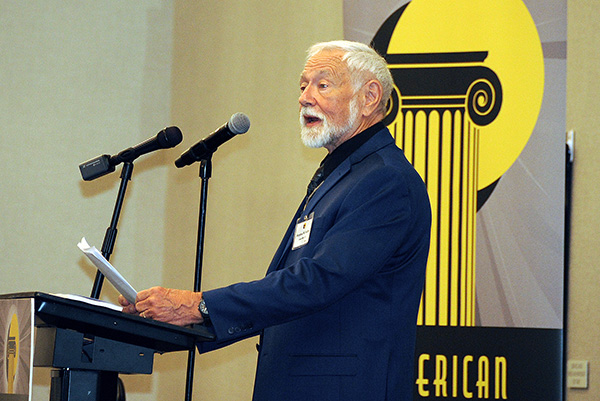
Steven McNallen
The SPLC claims to have detected more than 40 pagan “hate groups,” but it always exaggerates.
White Americans have proposed at least two religions for our people. National Alliance founder William Pierce developed Cosmotheism as a rational religion based on science, nature, and evolution. Man, the world, and the Creator are not separate, and the purpose of everything is the Creator’s self-completion through ever-higher consciousness and self-discipline. Individuals participate in this unconsciously, while conscious participation nourishes the “divine spark” of Europeans and directs their “race-soul” towards godhead. It has few practitioners.
The distinguished psychologist Raymond Cattell also derived “a new morality from science,” which he called Beyondism. He recognized that humans need religion, but thought Christian preoccupation with prodigal sons and lost sheep was perverse. The purpose of a nation should be eugenic, and building better humans should be a mystic goal that takes the place of religion. Cattell saw different races as evolutionary experiments that should be left to run their courses, and if some groups “go to the wall,” that is Nature’s plan. Our planet should be livable for another five billion years; let us seek to become gods ourselves.
I do not think scientifically invented “religions” are any different from de Tracy’s idéologie. There is no divinity in them. They can’t compete with myth, pageantry, ritual, or the promise of something unimaginably grander than anything we can see or touch.
Finally, there is the austere path of Dominique Venner. For him, it was enough to be part of this fabulous adventure we call Western Civilization, which he saw as “a unique way of being women and men in the face of life, death, love, history, destiny.” Venner did not believe in an afterlife, nor did he think life had intrinsic value: “It is worth only its intensity, its beauty, the breath of greatness that each man — and first in his own eyes — can give it.” For European man, “the vital feeling of belonging to a people . . . that precedes and survives him” was immortality more certain than anything promised by Christianity. Venner rejected religion, but he urged Europeans to spend as much time as possible in nature, absorbing and participating in the majesty of forests, mountains, storms, and raging rivers.
Pierce and Cattell proposed reason; Venner chose heroism. Probably neither satisfies the spiritual hunger of large numbers of whites. My — admittedly tentative — prediction is that the religion of the racially conscious white man will be a classical form of Christianity. It need not go all the way back to Urban II and the First Crusade, but it will be a manly Christianity that is comfortable with hierarchy, evolution, and clear racial boundaries.
It is no coincidence that by far the most successful intentional white community is Orania, which is explicitly Christian and requires adherence to Afrikaner Christian culture. In the United States, Return to the Land is open to members of “European heritage communities,” and it is largely Christian.
Victor Orban of Hungary, who leads what is probably the most explicitly ethno-nationalist white country, calls his nation a “Christian democracy,” and emphasizes Christianity as essential to Hungarian nationhood. He says, “Europe can be saved only if it returns to its Christian roots.”
Even Dominique Venner might not disagree. In his suicide note, he wrote, “I love life and expect nothing beyond it, except the perpetuation of my race and my spirit.” And yet he chose to end his life in Notre-Dame Cathedral because he admired that great monument “built by the genius of my ancestors on more ancient places of worship, recalling our immemorial origins.”