Jason Arday and the Soul of the University
Kevin DeAnna, American Renaissance, August 4, 2026
One of the bizarre things graduate students may notice is how much black academics praise themselves in their own works — as if they were studying themselves. In various required multicultural classes that forced me to read black authors, I was amazed at the amount of self-praise and navel-gazing. Such is the character of Professor Jason Arday who, at age 37, became the youngest black professor ever appointed at Cambridge. Writing a forthcoming memoir at age 40 reveals a level of narcissism not seen since Barack Obama.
However, just before the publication of what admirers are calling his “extraordinary life story,” critics have argued that Professor Arday is guilty of plagiarism — and implausible claims about himself. Plagiarism is hardly unknown among black academics. Harvard’s first black woman president, Claudine Gay, was forced out for plagiarism. University of Minnesota Professor Rachel Hardeman resigned last year after a colleague accused her of especially blatant plagiarism. Other black academics accused of plagiarism have charged that their critics are racially motivated. Yet this may be the way many blacks operate. It is also striking that some of the most prominent blacks accused of plagiarism write exclusively on racism, diversity, and other questionable concepts — but then, that’s what most black “scholars” write about.
Jason Arday is a sociologist of race. Typical titles: “Cool Britannia and Multi-Ethnic Britain: Uncorking the Champagne Supernova,” “Fighting the Tide: Understanding the difficulties facing Black, Asian and Minority Ethnic (BAME) doctoral students pursuing a career in academia,” and Black Curriculum: Black British History in the National Curriculum Report. The usual stuff, except that it appears he did not even come up with it himself.
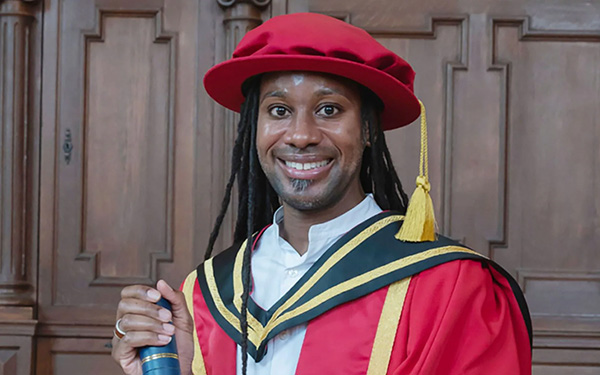
Jason Arday
Nathan Cofnas, who has been brutally persecuted because of his commitment to pursuing unwelcome truths, recently published an article alleging that Prof. Arday is not just a plagiarist but a fabulist. Dr. Cofnas was tipped off by a faculty member at Cambridge. Mr. Arday’s 2015 PhD dissertation, An exploration of peer-mentoring among student teachers’ to inform reflective practice within the context of action research, is strikingly similar to an earlier work, An analysis of the concept reflective practice and an investigation into the development of student teachers’ reflective practice within the context of action research, by Paula Zwozdiak-Myers of Brunel University in London. Even the last eight words of the titles are identical.
“From literally the first page of the Introduction to his dissertation . . . Arday relies heavily on Zwozdiak-Myers for key ideas and arguments,” Mr. Cofnas wrote. “Many passages are lifted with minimal editing, sometimes retaining copy-editing mistakes from the original source.” He lists many copied passages that are especially amusing because much of it is jargon anyway; now it is plagiarized jargon. The Sunday Times also found “multiple examples of identical or near identical passages.”
Mr. Cofnas located two other sources Mr. Arday allegedly plagiarized. There are two cases of “verbatim copying and pasting” from an article by Muhammad Athar Hussain in the Turkish Online Journal of Distance Education in 2011, and another copy/paste from a 2008 article in the International Journal for Academic Development. Mr. Arday cited neither source.
This seems to be a pattern. In 2023, a retired professor who hosts educational materials on his website wrote Mr. Arday asking about passages that appeared to have been lifted. (He also pointed out Mr. Arday’s grammatical and spelling errors, which, we can assume, are his own.) Mr. Arday responded by accusing him of “bullying and harassment.” Nonetheless, two journals issued corrections to Mr. Arday’s papers.
Mr. Cofnas analyzes 10 articles Mr. Arday calls his best work. He found much that appears to be plagiarism, but also something worse. In one paper Mr. Arday quotes a middle-aged Latin American academic who apparently had trouble speaking English. Remarkably, she uses almost exactly the same words as a young Asian undergraduate Mr. Arday quotes in another paper — a striking coincidence.
Mr. Arday’s work, such as it is, is mostly personal stories and anecdotes about “racism.” “When you take away the work that is plagiarized or not otherwise written by Arday, there is essentially nothing resembling real scholarship,” Mr. Cofnas writes. “There is no indication that Arday is familiar with even elementary statistics. His research involves reporting his own experiences of alleged racism or having conversations with people and providing subjective commentary.”
Beyond this, Mr. Arday’s personal story, which is part of his fame, sounds ludicrous. “No Hollywood scriptwriter would have dared pen such an outrageously unlikely plot,” writes the Daily Mail. Mr. Arday has a diagnosis of autism and claims he did not speak until age 11 or read until age 18. One would think a severe learning disability would make academics skeptical, but it seems to have made them more credulous.
In 2023 the @BBCNews ran a video story on Jason Arday joining @Cambridge_Uni. This is how his new boss described hiring him. Did they even look at any of his work? https://t.co/mbcJSIDzLE pic.twitter.com/gRkotAFqN4
— Dionysus (@DionLeFou) July 26, 2026
Mr. Arday has also made sweeping boasts about his athletic ability. “[Professor Arday] says he once ran 600 miles in six days for charity, 300 miles in three days, and 30 marathons in 35 days, partly with a broken leg,” according to The Telegraph. While not strictly impossible (though perhaps not possible with an injury), this would make him one of the greatest athletes in the world in the relatively small community of ultra-distance runners. Instead, he is unknown and there is no proof of his claims. The world record is 650 miles in 6 days, and this was on a flat circuit with a whole team of medical support. Southampton Soylent University, which gave Mr. Arday an honorary degree, quietly removed its mention of his athletic feats from its website.
Mr. Arday also claims to have been a semi-professional football player, but there is no proof of that, either. His boasts of having raised millions of pounds for charity are doubtful. For good measure, Steve Sailer found he also claims to have been featured in one of the most famous British documentaries of all time, though this too is highly doubtful.
Nonetheless, Mr. Arday continues to enjoy remarkable backing. Simon & Schuster says Mr. Arday’s ghost-written memoir Great and Unfortunate Things will be released on schedule in August. Cambridge is also supporting Mr. Arday. According to Human Events, a spokesman said:
Professor Arday has been the victim of a vile campaign to undermine his credibility, which must stop. Allegations of plagiarism regarding his thesis and journal publications have been thoroughly investigated by the relevant institution and the journals in question. Professor Arday has been cleared by those investigations of any wrongdoing.
Various anti-racists are also mobilizing to dismiss the growing scandal as a right-wing racist smear.
Jason Arday is the youngest Black professor in Cambridge’s history – and now rightwing newspapers are trying to smear him with untrue accusations of plagiarism.
Not on our watch. Add your name in solidarity with Jason here: https://t.co/oP4eSVPdCa pic.twitter.com/nWsGpcmC5c
— Good Law Project (@GoodLawProject) July 28, 2026
The smear campaign against Prof Jason Arday is as predictable as it is baseless. Ignore the haters and use it as publicity for the his wonderful autobiography that drops at the end of August. It’s a truly a remarkable story, pre-order your copy now https://t.co/i0PjZJ4BE7
— Kehinde Andrews (@kehinde_andrews) July 27, 2026
According to Retraction Watch, Times Higher Education had planned a story on Mr. Arday’s plagiarism in 2025. It first sent the article to Mr. Arday for comment, but spiked it when the paper got a fierce letter from a defamation lawyer instead. Given the furious reaction to the charges so far, that may have been wise. No one wants to be called a racist or to spoil the heart-warming success story. Many institutions and journalists have invested heavily in Mr. Arday, with the BBC giving him repeated, fawning coverage. They can hardly back down without sacrificing their own credibility. Still, Mr. Arday has already been forced to issue corrections to articles, and we can expect more.
Even The Guardian is revealing claims from Mr. Arday that defy belief. A new article is framed as a way of pushing back against conservative “activists” (scare-quotes in The Guardian) seemingly dedicated to punishing black academics. Yet The Guardian reveals that Mr. Arday not only claims to have been sent racist, threatening emails, but that he was physically threatened by a man with a knife and that mutilated animals were sent to his office. There is no evidence any of this occurred other than Mr. Arday’s word. “When Arday was asked about his claims by the Guardian, he stood by them,” said the article. “To be honest with you, I thought you’d just believe me,” he asks. “Why would I lie?”
Why indeed. Mr. Arday tells elite liberals fairy tales they want to hear. Isn’t that why he was hired? The worst of it is not plagiarism or his claims of athletic prowess. It is that his work is mostly anecdotes (which may or may not be fantasies) and quotes from interviews (that may or may not have even occurred). There is little data or research; just accusations of racism and demands that non-whites get more of everything. His career is proof of how the system works.
Jason Arday is not a disgrace to modern academia. You could call him its crowning achievement. He publishes unfalsifiable jargon vaguely linked to complaints about white racism and demands respect and status based on phony credentials. His fantasies are what most professors tell us about race anyway. Jason Arday is not an exception to the honorable profession of higher education. He is increasingly the rule, and the scandal tells us more about academia than about him.