How to Take Your Country Back
Jared Taylor, American Renaissance, May 29, 2026

Credit Image: © Imago via ZUMA Press
Subscribe to future audio versions of AmRen articles here.
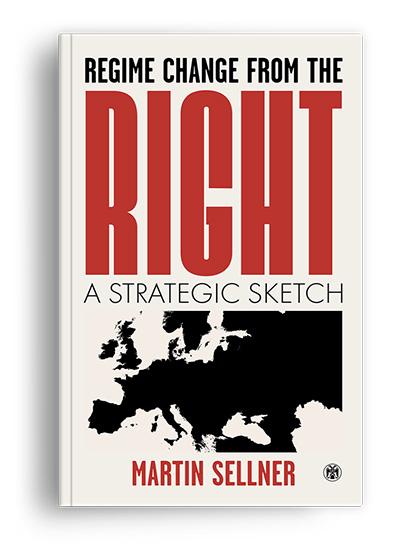
Martin Sellner, Regime Change from the Right: A Strategic Sketch, Imperium Press, 2025, 245 pp., $22.00 (softcover)
Martin Sellner is a 37-year-old Austrian who has done more than anyone to popularize remigration as the only solution to the dispossession of Europeans. He has been an active identitarian since he was a teenager and is one of those rare people who can both do effective street action and write first-rate political theory.
Regime Change from the Right is his first book to be translated into English. It is a sophisticated, carefully thought-out guide to the cultural and political changes necessary for European countries to preserve what he calls “ethno-cultural identity.” It is written for Europeans, but it shows so much insight into how taboos fall, when thought patterns shift, and how politics work, that it is an invaluable handbook for anyone, Right or Left, who wants radical change.
The problem
The problem is replacement of Europeans by non-whites; this could lead to “total existential annihilation.” The solution is for non-whites to stop coming to Europe, and those who have come must go. European citizens overwhelmingly oppose replacement, but their will is thwarted by three groups: political parties that want to import new voters, employers who want cheap labor, and ideological groups that want to extinguish their own racial/cultural identity. As Mr. Sellner notes, this last group is the smallest but the loudest, and in Germany, it even uses such slogans as “Germany, die!” and “Bomber Harris [of RAF Bomber Command who pioneered saturation bombing], do it again.” This group once made demands in the name of equality and acceptance; now it vents pure hatred for a “disgusting white-majority society.”
There is an affiliated group, however, that is more important:
a sociocultural class whose strong education and international mobility make it one of the winners in the global job market. This class doesn’t necessarily profit directly from population replacement but suffers no harm from it. In their urban or rural enclaves, they remain largely untouched by the influx of foreigners. They perceive it only as a growing culinary diversity or an oversupply of cheap cleaners, laborers, caregivers, and prostitutes. This elite class shapes the public discourse and supplies members to the three [other] groups.
Germans have an additional burden: “The people of the Nazis have become the negatively chosen people. The magnitude of their forefathers’ guilt has forever removed them from the normal course of history.” And yet, the very same arguments used against them now discredit all whites, even those who fought the Nazis: “Everything conservative and nationalist is outdated and leads us back to Auschwitz, the Big Bang of German universal guilt. In contrast, moving leftward points towards the future. There, progress, openness, and reason await.”
All white patriots face the same challenge of destroying the “cult of guilt and reparation.” Until this can be achieved, the only permissible discussions are how to make population replacement work; not why it should be stopped.
Mr. Sellner argues strongly that it is the job of metapolitics — activism, education, social media, theory, counter-culture-building — to shift the acceptable boundaries of discourse to include the real problem and its only solution. Until that happens, we have what Mr. Sellner calls “democracy simulation.” Politics operates within rigid limits: “Parliament is not the center of power. It is more like a stage where what has been decided in the metapolitical power center is performed.” Voting is almost an afterthought because “an artificial consensus has already been created beforehand through censorship and propaganda.”
Dissidents must fight uphill. They are demonized and can face tremendous pressure: ostracism, job loss, and even criminal charges by the state. This stifles free speech and emasculates democracy. Oppression in Germany (and other European countries) is certainly greater than in the United States, but when any nation takes fundamental questions off the table — and punishes anyone who notices — it thwarts the people’s will. As Mr. Sellner notes, “Germany can be called a democratic constitutional state only with a great deal of imagination. Yet it is also not totalitarianism in the classic sense.”
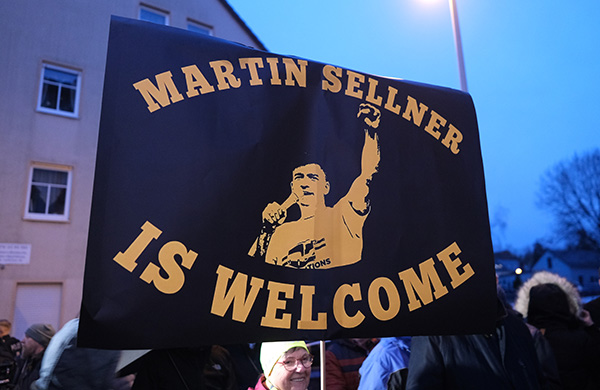
Credit Image: © Sebastian Willnow/dpa via ZUMA Press
Mr. Sellner has devoted his life to saving Europe, but the continent does not have much time. Unlike Gulf Arab states that import useful foreigners but give them no voice, in the West, “demography devours democracy.” Once enough non-whites arrive and begin to vote, they reach a tipping point and a “political shift through parliamentary means becomes virtually impossible.”
In the meantime, our rulers keep us distracted. The more our lives are swallowed up in consumption and entertainment — bread and circuses — the more of us live in what Mr. Sellner calls the “zone of indifference” and don’t even try to find a way out.
The solution
The only way for whites to regain their homelands is to send non-whites away. However, Mr. Sellner mentions a few false “solutions” that tempt nationalists. One small-scale, temporary solution is to carve out enclaves — even as small as a single family — in which to keep Europe alive. These can grow into communes, home-school co-ops, study groups, and cultural initiatives. If the enclave is big enough, it may become a racial/cultural haven, but such efforts are not likely to last more than one or two generations. Their greatest flaw is that they are rearguard efforts that cannot win state power for national preservation. Survival in the catacombs is better than extinction, but it is not enough.
Some people believe the current system is so corrupt and overburdened that we need only wait for it to collapse. Mr. Sellner replies that “just because a system is ideologically wrong or evil does not mean it must inevitably collapse.” Furthermore, by the time it does, the Great Replacement could have reached the tipping point, and collapse will be into Third-World savagery. We need to stop and reverse the foreign influx now. Apocalyptic thinking leads to paralysis; any solution that depends on events beyond our control is an excuse to do nothing.
Mr. Sellner also warns against Constitution fetishism — which I thought was a uniquely American failing. Apparently, there are also Europeans who believe constitutions have quasi-magical powers, and all will be well if only constitutions could get the deference they deserve. What a constitution says is not nearly as important as how it is interpreted, and with enough authority or apparent legitimacy, rulers can interpret laws however they like. A good example is the way American courts reinterpreted “civil rights” laws that banned racial discrimination so as to permit the very thing they prohibited — racial discrimination — so long as the victims were white. The problem with Western governments is not misinterpreting constitutions; it is their treachery to their people.
Mr. Sellner argues repeatedly that violence always fails. It is a priceless gift to our rulers because it retroactively justifies the claim that every critic of population replacement is a Nazi who was just concealing his true, berserker ambitions. It justifies repression that ordinary people would never otherwise accept. Violence also kills any goodwill the police may have towards us, and scares away potential allies who sincerely want change. Violence is a particular temptation for conspiracy theorists who attribute only vile motives to their opponents. Anyone who believes we are ruled by shapeshifting, blood-sucking pedophiles probably thinks all will be well if we just kill them. What is more, amateur militias will never defeat an army — unless a regime is so discredited that soldiers refuse to obey orders, and if that day comes, dissidents will not need weapons.
For us to accomplish ethno-national preservation, there must be as little distraction as possible on futile goals, and as much unity as possible on the only grand strategy that will succeed: remigration. Europeans — like white Americans — have many hobby horses: libertarian, socialist, atheist, pagan, sound money, Christian, futurist, traditionalist. A society with millions on antidepressants and with more deaths than births obviously needs change. But the immediate, potentially fatal crisis is replacement. Whites need not abandon their faiths or aspirations, but preserving our homelands comes first.
“Civil society as a whole must develop an identitarian consciousness,” Mr. Sellner writes, with the understanding that remigration can take place without violence, with dignity, within the constitution, and even bring benefits to non-white countries of origin. “Millions of patriots are ready to do something for their country,” he adds. “What’s missing are organizers.” And once an alternative, revolutionary idea eclipses the ruling ideology, society can shift quickly.
Metapolitics
Once there is agreement on the need for remigration, every part of the identitarian Right should direct its actions toward that goal. Flyers, demonstrations, tweets, campaign booths, banner-drops, and articles should all advance the goal. Whoever controls the opinions and moods of the people — whoever wins the battle of metapolitics — controls who wins office and therefore who has power. But metapolitics must not operate in a vacuum. It must be part of a movement of many components, but ideas and opinions come first: “A group striving for political power can triumph only if it first succeeds in mastering the cultural superstructure of a society.”
A society’s beliefs are not set in stone. They change according to the number of people who promote new ideas, as well as their status and persuasiveness. Constant repetition makes new ideas normal, and cultural conquest requires constant taboo-breaking. Some people are better at it than others, and we should keep clumsy, even repellent taboo-breakers out of the limelight.
Patriots are building what Mr. Sellner calls the counter-narrative space, and this is now the most successful part of our movement. It has many branches, from YouTubers and X giants to publishing houses and think-tanks. But it should be even broader. We need a whole library of theory about white survival. Theory — many words for the few — attracts intellectuals, while social media — few words for the many — rouses ordinary people.
However, social media is most likely to go off the rails. There are no barriers to entry, and it seeks mass appeal, often at the expense of theoretical depth or even logic. The shrillest, loudest, most provocative outbursts get millions of views. People can make money on X or Rumble or YouTube, and that can become a fatal distraction.
The counter-narrative space must always connect to the real world. As Mr. Sellner explains, “When the sole call to action after an emotionally stirring report is a prompt to click ‘like’ and subscribe, the information war, at its worst, devolves into a lucrative resistance simulation.” At the same time, intellectuals should never become arrogant and keep activists at arm’s length. We need both, and they must keep an eye on each other, constantly refining the message to make it more effective.

Martin Sellner during a rally against population replacement on October 3, 2020 in Vienna, Austria. (Credit Image: © Isabelle Ouvrard/APA Picturedesk via ZUMA Press)
We are now reaching the point where we can tailor our message to every taste and genre. With enough reach, our ideas will impregnate music, fashion, fiction, cinema, even the universities. Mr. Sellner longs for the day when the arts begin to reflect our message. He warns, however, that when activists try their hand at literature or fine art, the result is almost always kitsch — unlike meme-making, in which we have no equal. Mr. Sellner reminds us that mockery is one of our most effective weapons; puncturing the foolish ideas of our rulers is great sport.
As someone who has, himself, taken to the streets, Mr. Sellner always wants to find room in the movement for daring action. “The proper domain of the avant-garde is spectacular, nonviolent activism,” he writes. “It brings attention, popularity, and thereby idealistic authority. No organ of theory development can match this.” He continues:
Every political movement relies on some type of hot-blooded youth. However, the task of political strategists is to channel the invaluable resource of passionate youthful idealism into targeted political work, rather than letting it dissipate in subcultural posturing and violent antics.
Political parties
Metapolitics must eventually become politics, and in this respect, Europe is far ahead of the United States. Americans are in the odd position of having a president who has tweeted about “remigration” and the “tipping point,” but who leads a party that is terrified of the faintest sign of white consciousness. In Europe, there are “far-right” parties that, to varying degrees, campaign against mass immigration and even — sometimes — call for remigration. Mr. Sellner has watched these parties closely, and is full of insights on what they can accomplish and how they can neuter themselves.
The worst kind of “right-wing” party practices what Mr. Sellner calls “parliamentary patriotism.” It may take a right-of-center position that opposes Islamic mass migration only to “protect sexual and religious minorities.” This reinforces the ruling ideology that is driving us to extinction. Such a party “participates in the democracy simulation instead of ruthlessly exposing it.” Any party or movement that does nothing but screech about the Left’s latest outrage is a distraction.
A truly identitarian party — Mr. Sellner sometimes writes of “right-wing” parties — openly fights for ethno-cultural preservation, but it may lose sight of the goal: “This pursuit of vote maximization always creates tension between appealing to the societal mainstream and staying true to the right-wing movement’s core objective.” The many-layered movement that is outside the party can always be more radical and provocative, because its job is to change the way people think, not win votes. Thus, there is tension between the party and the movement, but it should be healthy tension:
The looming pitfalls for the right-wing party are opportunism and misguided pragmatism. For the movement, they are an addiction to provocation and elitist vanity. Metapolitics is not an end in itself. The movement aims to build a critical mass and a right-wing civil society through pre-political work, ultimately serving a party with real political power.
The movement’s metapolitical work is often provocative: banner drops, demonstrations, even strikes and civil disobedience. The movement is always pushing the limits of politically correct boundaries and will always face resistance and repression. However, whenever the movement breaks a taboo, the party should immediately occupy this new ground until its platform becomes one of full reconquista. At every stage, party and movement leaders should work in concert, though not always openly.
If the party sells out, it will begin to see the movement as an irritant. If the movement veers off into juvenile self-indulgence, it will be an irritant. It will not always be easy to strike the right balance.
If the party goes soft, movement leaders should speak privately, and only when that fails, should they criticize publicly. However, those in the movement must recognize that the party must present itself in a way that is compatible with the views of the public. In all cases, the party must retain enough independence so that it is not held responsible for every movement provocation. With the right balance, “activism and counter-narrative-space initiatives can be indirectly but effectively supported by legal battles, public communications, media work, and logistics — without the party being held responsible for every statement or action.” At the same time, the party should craft every election campaign not only to increase votes but with an eye to supporting the metapolitical campaign that goes on around it. Mr. Sellner explains: “Every opposition party needs flanking protection from an idealistic, activist environment. If it acknowledges and helps shape that environment, it will benefit. If it ignores it, attacks it, or watches it run wild, it will suffer.”
The party should also keep close but informal ties with movement thinkers and theoreticians, borrowing their arguments and quietly supporting their research. When it comes time to take power, a new elite will have to replace the old. The party will need a cadre of thoughtful, committed, seasoned people to help it take charge.

Martin Sellner and Lena Kotré (AfD), member of the Brandenburg state parliament, speak at a press conference before their lecture on remigration, January 22, 2026. (Credit Image: © Frank Hammerschmidt/dpa via ZUMA Press)
Mr. Sellner explains that sometimes a party can be more effective out of power. The Greens never win impressive vote totals, regularly performing worse than the AfD in Germany or the Freedom Party in Austria. However, Greens do not dilute their message for electoral success. This protects their credibility and helps maintain intellectual dominance in schools, universities, media, and key positions in the ideological state machinery. Greens never underestimate the need to dominate political discourse, even if it means sacrificing seats in parliament. As Mr. Sellner notes, the cordon sanitaire, whereby “democratic” political parties band together to keep “far-right” parties out of power no matter how many votes they win, is a product of meta-political power — and shows its power over merely political success.
Regime change
The term “regime change” is in the title of this book, but it is only a last resort. A national effort to achieve remigration should be able to succeed without it, that is, without changing the basic political machinery. As Mr. Sellner uses the term, attempted regime change — rather than an attack on the democracy simulation — begins when soft totalitarianism slips into outright tyranny.
It is true that both in Europe and America, dissidents face persecution, and in Europe, the state sometimes crushes them. This is not a sign of regime strength but of weakness. If our rulers played by their own democratic rules, they would listen to the people. If, instead, they move brutally against patriots who speak for millions, their legitimacy suffers. Eventually, they lose all authority. As Mr. Sellner explains, “Repression and authority are mutually exclusive. The less authority the ruling ideology possesses, the more overt repression becomes necessary.”
Not even Germany or Britain has crossed the line into dictatorship, but if that time comes — and free speech, assembly, and petition are brazenly suppressed — the goal will become restoration of free speech. At that point, identitarians will have a host of new allies, and no one will believe hypocritical claims of “democracy” and “freedom.” Millions will help pull down a regime that survives only through brutish methods.
There is much wisdom in this book. Martin Sellner has an instinct for strategy and tactics; he has thought through all the elements that must come together for our movement to succeed. This is an important book that all of us should read and reflect on. Of course, as he notes, this is not the last word, and every struggle will be different. However, the principles of primary objective, grand strategy, movement, and party — which he outlines in far greater detail than I have here — are essential guidelines for us all.
I am happy to report that Mr. Sellner has just unveiled an organization that should take the movement into important new territory: he has just announced establishment of the Institute for Remigration. This sounds like the organization we need at the very moment we need it most, to be run by a man who has devoted himself to what I believe is the greatest struggle in human history. And he is far from alone. His generation, which has often taken the name of Generation Identity, is pushing forward in ways that I believe will be unstoppable.