Rearmament: Another Way to Control EU Nations
Augustin Goland, American Renaissance, May 1, 2026
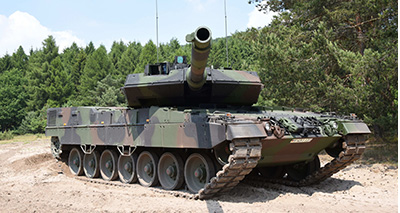
Credit Image: © Ralph Zwilling/DPA via ZUMA Press
Subscribe to future audio versions of AmRen articles here.
In light of what it sees as Donald Trump’s weakened commitments to NATO, the European Union has launched a new program to fund arms purchases by its member states. It’s called SAFE — Security Action for Europe — and at first glance it looks attractive: cheap loans for military equipment financed through the common debt of the entire EU. Because the AAA-rated EU rather than individual nations is the initial borrower, interest rates are low.
Under this program, Poland, a country that is key to NATO’s Eastern flank, would receive more money than any other borrower — as much as €43.7 billion, or nearly 29 percent of the entire €150 billion pool. This debt would be repaid by Polish taxpayers for up to 45 years, with a variable interest rate and an unknown Euro exchange rate (Poland still has its own currency). Thus, no one can precisely calculate the full cost of participating in the program. Even more important, no one can predict how the EU will use arms debt to force other policies on member states; only that the chances of its doing so are very high.
A constitutional crisis in Warsaw
Donald Tusk’s left-liberal, pro-EU government badly wants this loan. Meanwhile, on March 12, 2026, President Karol Nawrocki, who was elected last year on a conservative, sovereigntist platform, vetoed a bill that was to provide the legal basis for it. A day after the veto, the Tusk government adopted a resolution authorizing the defense and finance ministers to sign the SAFE loan agreements with the European Commission without passing authorizing legislation, thus bypassing the head of state’s veto.
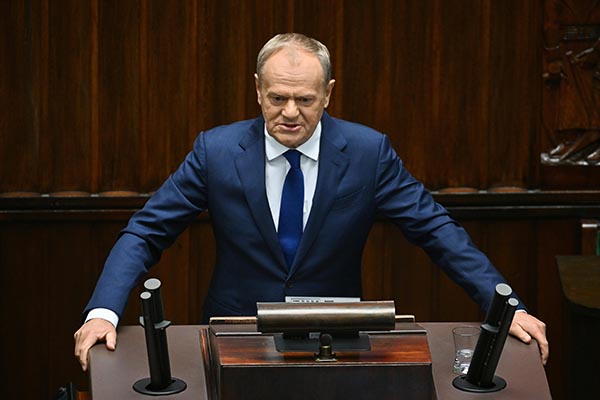
Donald Tusk (Credit Image: © Damian Burzykowski/Newspix via ZUMA Press)
This is not just a political tug-of-war between Poland’s Euro-enthusiastic government and its Euro-sceptic president. It raises a fundamental question about the limits of executive power. The Polish Constitution leaves no room for doubt here: such heavy financial obligations entered into over such a long repayment period require a statutory basis, approved by parliament and signed by the president. Instead, Mr. Tusk’s government wants to act on the basis of an ordinary resolution of the Council of Ministers, bypassing the constitutional safeguards of democratic oversight. The European Commission has signaled its readiness to sign the agreement despite the lack of a valid legal basis on the Polish side.
This is ironic in light of Brussels’ constant hectoring of Poland and Hungary for their alleged violations of both European and domestic legal norms. Corner-cutting appears to be just fine, so long as EU bureaucrats like the result.
SAFE as a control mechanism
Why is Brussels so intent on signing this agreement right now and with this very government, even if it means violating Polish law? The answer is simple: SAFE is not a neutral financial instrument. It’s a control mechanism. The program, modeled on the post-COVID-19 “recovery” fund, known as “NextGenerationEU,” builds conditionality into its mechanism. The European Commission may suspend the disbursement of subsequent tranches of the loan if it deems a given country’s subsequent loan applications “unsatisfactory” — without specifying any objective criteria for this assessment — and EU member states have to send applications for subsequent tranches twice a year.
To understand what this means, just look at the example of Hungary: While Viktor Orbán was still in power, Budapest submitted an application for the first tranche of its €16.2-billion SAFE loan. The European Commission found it unsatisfactory and withheld the disbursement just when Hungary was entering the election campaign ahead of parliamentary elections on April 12, 2026. Just as the Commission has for years been withholding NextGeneration EU funds from Hungary (as it did from Poland until the government changed to a liberal-left one), the signal to Hungarian voters was clear: Your country will not get money unless you vote Viktor Orbán and his Fidesz party out of power.
There is another important issue for Poland. For over 30 years, Poland has built its defense capabilities on a partnership with the United States, buying equipment such as Abrams tanks, HIMARS launchers, F-16 and F-35 fighter jets, and Patriot systems. The SAFE requirement that at least 65 percent of the purchases be from Europe will force Poland to switch sources, primarily to French and German manufacturers. This is therefore not about strengthening Poland’s defense, which is crucial for NATO’s eastern flank, but about subordinating Poland’s armaments policy to the interests of the largest European defense companies. This would also mean a deeper integration of Poland into security structures in which Brussels — not Warsaw — will have the final say.
A debt trap for sovereigntists
It is no coincidence that the largest loans, relative to the size of their respective defense budgets and GDP, go to Poland and Hungary — two countries that for years have most consistently blocked plans for deeper centralization of the European Union and have opposed EU-coordinated mass immigration and Brussels’ woke agenda.
The SAFE mechanism works like a debt trap: A country takes on debt, but the European Commission decides whether to disburse further loan tranches; if it refuses, current obligations will have to be paid anyway. The commission can suspend the whole loan if it decides that a country is in breach of the rule of law and does not respect “European values” (the Commissioners left-liberal woke “values”).
The incoming prime minister of Hungary, Péter Magyar, has declared, like his predecessor, his opposition to the EU Migration Pact, which, starting this year, is set to allow the European Commission to relocate illegal immigrants arriving, for example, in Spain, to Central European countries that have so far resisted mass immigration. Mr. Magyar also claims that he will not agree to further centralization of the EU, but a country that, in the face of a real threat of Russian aggression, finances its armed forces with a huge loan from Brussels will not be able to afford real opposition when threatened with vague and arbitrary loan conditions.
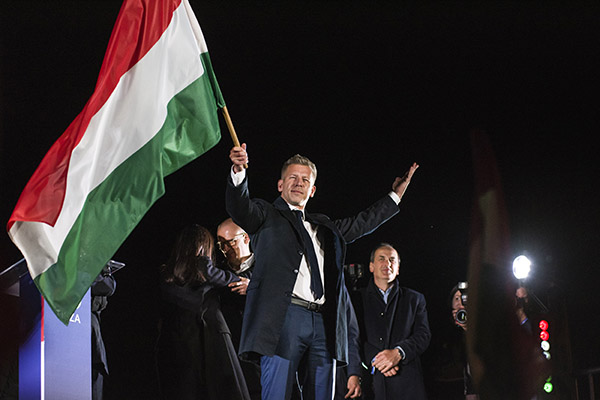
Péter Magyar (Credit Image: © Attila Husejnow/SOPA Images via ZUMA Press Wire)
It is true that it would be the EU Council – composed of ministers from the 27 EU countries – that has the final say on withholding funds. However, the Western European nations most interested in offloading their excess migrants hold a sufficient majority to back such decisions and force their Central European partners into compliance. Once Donald Tusk’s government has signed up for the €44-billion euro SAFE loan — albeit unlawfully in light of the Polish constitution — the same sort of blackmail awaits every future government. The debt incurred will burden the budgets of the member states, regardless of the will of future voters and governments. Remember: The repayment can be as long as 45 years.
What’s worse, the SAFE program is not an isolated financial mechanism. It enters into effect at a time when the EU Migration Pact is taking concrete shape, and the two processes are closely connected. The pact, composed of 10 legal acts adopted at the EU level, does not resolve the problem of illegal migration through border protection. Instead, it “facilitates” migration, based on the belief that it is inevitable and good for European society, economy, and culture. It can force low-immigration nations to take illegals from such places as Spain, France, and Germany, and obligates the unwilling recipients to process their asylum requests.
SAFE and the Migration Pact
For Brussels, mass migration is not a crisis to be halted, but a phenomenon to be managed and its costs shared. The “compulsory solidarity” mechanism — the expression itself is a horror — grants enormous power over migrant relocation policy to the European Commission and the EU Council, which decides by qualified majority vote on the final obligations of member states. Poland, which has so far pursued a cautious migration policy (though less so in the last 10 years), is thus set to become a relocation hub for Western European countries burdened by people from Africa, South Asia, and the Middle East.
Spain showed us how this will play out. In April, the socialist government of Pedro Sánchez issued a decree enabling the mass legalization of between half a million and even one million illegals who were present in Spain before the end of 2025. The government justified this on humanitarian grounds and the need for labor, but its consequences reach far beyond Spain. The right of residence in any EU member automatically opens the door to free movement throughout the entire 29-nation Schengen Area, which means that the effects of Madrid’s migration policy will be felt throughout the continent. Furthermore, the prospect of future amnesties is a powerful incentive for yet more waves of illegal migrants.
It is nearly impossible to run criminal background checks on hundreds of thousands of people, especially on those from countries with inadequate and/or corrupt public administration. Madrid’s amnesty openly violates EU Treaties, breaching the principle of sincere cooperation and the rules of the common migration policy.
The Migration Pact mechanism is simple and brutal. One country legalizes hundreds of thousands of illegal immigrants, and all the other countries must participate in the “solidarity-based” free admission across the EU, including further arrivals attracted by the prospect of more amnesties.
It should also be noted that more than 75 percent of migrants whose European asylum claims are denied are not deported from the EU — most often because they have thrown away their passports or because their home countries refuse to take them back. Poland, which for years guarded Europe’s eastern flank against the hybrid migratory aggression of Belarus and Russia (which opened a route through their territories to use migration as a weapon against Poland, the Baltic states, and the whole EU), is now — through both the Migration Pact and the SAFE noose — set to become a country that, for decades, will be in debt to Brussels, make its defense industry dependent on European suppliers, and open itself to redistribution of migrants legalized by any EU country.
The rush to create a European centralized superstate
Brussels is fully aware that all this is happening at a particular political moment. Following the parliamentary elections in Hungary on April 12, 2026, in which Viktor Orbán lost power to Péter Magyar, the last major brake on deeper European integration disappears. The very radical EU treaty reform proposal, adopted by the European Parliament in the fall of 2023 but shelved until now, may now regain momentum. The changes this reform carries could lead to a significant limitation of the member states’ sovereignty in key areas — foreign policy, defense, border protection, education, and health — and could let the European Union take command of member states’ armed forces and replace their diplomatic missions with offices of the European External Action Service. Brussels could also unilaterally open migration routes into Europe — all this completely beyond the control of citizens of individual states.
However, the window for enacting this reform is narrow. Brussels has about a year before parliamentary elections in France, which, according to polls, could be won by Marine Le Pen’s sovereigntist, anti-mass immigration party National Rally. That would be a serious obstacle to the project of deep centralization of Europe. Hence the rush. Hence the pressure on Poland to sign the SAFE loan right now, even if it is contrary to Polish constitutional law, before the political winds shift. This is also why the European Commission interfered so heavily in Hungary’s election. It wasn’t just about changing the government in Budapest. After the change of government in Warsaw in December 2023, the last remaining opponent to deeper European integration had to be removed. In Hungary, even if the voting process itself was free of irregularities, free elections are not only about counting votes fairly — they are about preventing outside influence.
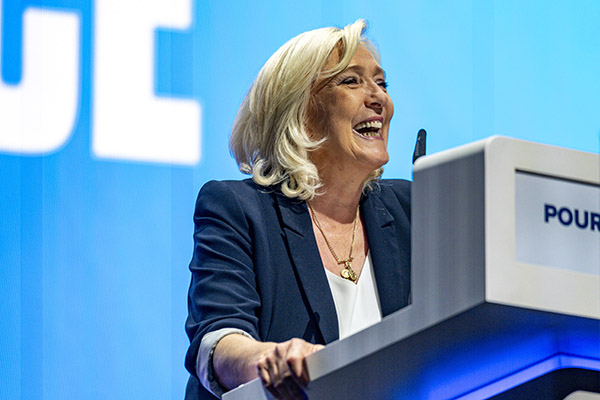
Marine Le Pen (Credit Image: © Sandrine Thesillat/PsnewZ via ZUMA Press)
Election interference in Hungary
For years, Brussels exerted financial pressure on Hungary by withholding cohesion funds and NextGenerationEU funds, and Hungarian voters understood perfectly that access to billions of euros depended on the outcome of the elections. The opposition candidate, Péter Magyar, made it a central campaign promise that, if elected, EU money would start flowing. The same pressure was applied to Poland, where funds were unfrozen when Donald Tusk came to power.
But in Hungary’s case, the interference went much further than financial blackmail. The European Commission, for the first time in its history, activated the so-called Rapid Response System under the Digital Services Act (DSA), declaring a disinformation threat in Hungary and appointing 44 “trusted fact-checkers” — mostly openly left-wing — to label content as disinformation. Meta, owner of Facebook, which is exceptionally popular in Hungary, fully complied with this information control, just as it had done in the United States under the Biden administration.
Posts by politicians associated with Fidesz were algorithmically downranked; Viktor Orbán’s and Foreign Minister Szijjártó’s pages, as well as that of the Mi Hazánk party (the staunchly nationalist Our Homeland Movement) were brazenly notified by Facebook that their content was downgraded or blocked, while Péter Magyar’s activity achieved statistically inexplicable reach. Hungary was a testing ground for the use of this new, powerful tool of control and manipulation. Next year, it could be Poland, along with France, where President Macron is calling on the European Commission to strengthen and expand the DSA.
The ECJ’s Ideological Agenda
In signing the SAFE agreement with the Polish government, Brussels is not limiting its ambitions solely to defense and migration. A government bound by long-term debt and facing algorithmic censorship in election campaigns will also be unable to resist the ideological pressure from the EU and from unelected judges of the European Court of Justice (ECJ).
The ECJ is not idle. To mention just its most recent decisions, in November 2025, it ruled that Poland is obligated to recognize the “marriage” that two Polish men entered into in Germany — citing EU provisions on freedom of movement — even though the Polish constitution defines marriage as the union between a man and a woman. This is another example of the ECJ overstepping the powers conferred by the EU treaties, which do not include regulating family law. While the ECJ ruling does not mandate the introduction of same-sex “marriage” into Polish law, it makes a mockery of that law and of the Poles’ right to their centuries-old definition of marriage.
A few months earlier, in March 2025, the ECJ delivered a judgment supposedly in the field of personal data protection that, in essence, creates an entirely new legal order. A female asylum seeker from Iran in Hungary applied to have her sex changed on her official documents. The Hungarian authorities refused; Hungarian law does not ordinarily permit such a change unless someone has had sex-change surgery. However, the EU court held that on “personal data protection” grounds, Hungary must correct the sex designation in the woman’s civil status records. The effect of this ruling means that throughout the entire European Union, sex data in official documentation may be deemed “incorrect” if someone simply declares that he or she identifies as a different sex. This means public authorities in all member states are now supposed to treat biological men as women and vice versa, with full legal consequences.
Politicians betraying their countries
What if a member country decides not to comply? Well, this is where SAFE defense-procurement loans come in. For countries such as Poland and Hungary (and the Baltic states) that face the threat of Russian expansionism, making defense dependent on Brussels means no effective way to fight ECJ rulings, regulations, and ideological packages imposed by institutions that no one in Poland elected and that no one can disregard. Sovereignty once surrendered — in exchange for cheap loans — will be difficult to regain. That’s precisely why Donald Tusk’s decision to sign SAFE over the presidential veto is not just unlawful and a political mistake. It is a betrayal.